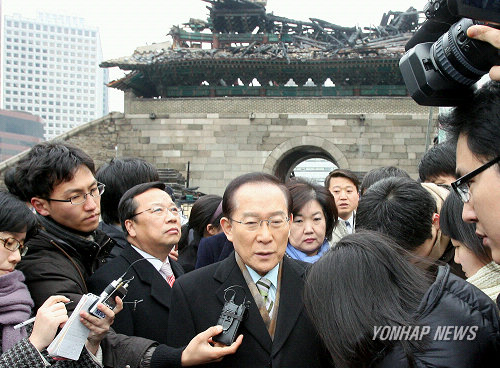

An anonymous editorial in the Digital Chosunilbo asks:
The pain of the Korean public will not be easy to heal. Watching the face of the nation disappear into flame, Koreans acutely felt the fear that the country they believed had grown into an economic powerhouse may be just a mirage floating above the desert sand. What would foreigners living in Seoul call Korea now? How can they trust in this country after seeing what has happened?
The following is my first attempt (in what I imagine may become a series of attempts) to answer that question.
The longer I’m in Asia, the more I see what I’ve come to call Nonfunctional Systems. Actually, in conversations, I call them Systems That Don’t Function — you can hear the capitals on those words, once you’ve heard me say it a few times.
An example of a system that does not function — there are so many! — is traffic law in many parts of Asia (and I don’t even mean East Asia, I mean Asia in general). Now, countries like Korea and China and Thailand and Vietnam actually have imported Western traffic law, or constructed native forms that are very closely based upon Western models. This is only natural, since the technology of the automobile itself arrived in Asia via the West. However, a system like traffic law can only function when everyone knows, and agrees upon, the rules. If people don’t know the rules, they can’t follow them. If people choose to ignore the rules, nobody can trust them. (Or be sure that driving through a green light will actually be safe, because someone on an intersecting road might run a red light.)
What happens when sophisticated traffic law gets interpolated by, for example, the fuzzy logic of Confucian hierarchy and negotiability of rules and permissiveness for whole classes of individuals?
Other, quite random, examples of this include the following systems, off the top of my head, with some more trivial than others:
- In Korea, again, the notion of the “bicycle path” which, as one acquaintance put it, “is a red sidewalk in Asia.” If you’ve never walked down a sidewalk in Asia, his meaning was that it’s about as likely a place to ride your bicycle as up the side of a building: old ladies squat in the middle of the bike path beside displays of vegetables for sale, local businesses stretch banners at shoulder height across the ends of the sidewalks and leav displays in the middle of them, people park their cars all over the sidewalk and bike path, and any number of random barriers are often thrown in as well. Plus you’re competing with motor-scooters who occasionally use the sidewalk, and hordes of pedestrians don’t see a bike path: they see a red sidewalk in Asia.Yet when I told an engineer I knew, “Well, you don’t really have bike paths in this city,” (which was in Jeonbuk, not in Seoul) he took great offense and said, “Well, what is that?” He did not get that something being labeled “bike path” — that the material for the “official bike path” being a different color, with a cyclist logo on it occasionally — didn’t mean it could ever be practially or safely used by cyclists.
- In Laos, when I traveled there recently, broadband cable internet was not unavailable — but it was hampered by the fact that the clip designed to keep the network plugged into the computer is broken on every cable I encountered. The same clip was missing from the majority of phones I attempted to use. Nothing stayed connected to anything. Thus tons of time and potential income from failed attempts by foreigners to access these networks were wasted… on what would cost likely 10 cents and five minutes to fix.
- In China, there are tons of official offices for ensuring the quality of food and other products, both those for domestic consumption as well those leaving the country. Anyone not living under a rock knows exactly how effective they’ve been… and it’s no surprise to long-term China watchers, who know about the Party’s longstanding love-affair with quotas.
- A tragic example is the Daegu subway fire, where several systems should have prevented the tragedy, but every system was nonfunctional: from materials to emergency training and mental health care for the ill, everything conspired to kill a horrifying number of people.
Now, the focus of my discussion of Nonfunctioning Systems is going to be in Korea, because I live there. And it’s under these systems that I, and many people I care about, live. When a driver who doesn’t feel it’s his duty to exactly follow traffic law hits me while I’m crossing on a green light, the car won’t care what color my skin is, or which language I speak. It will crush my bones as easily as any Koreans’. By this simple fact, I claim my right to talk about such things.
So for those of you not living in Korea, Namdaemun is an old city gate and is classified as National Treasure #1. (1) Since it burned down a few nights ago, everyone’s suddenly calling it Seungnyemun, but really, until it was burned down (video here, amazing Flickr set here, some historical photos at Gusts of Popular Feeling), everyone — everyone — was calling it Namdaemun. Hell, that’s what the station named after it was called!(Or this is my impression, anyway. So I’m going to keep calling it Namdaemun,
the “Great South Gate.”)People walked past it daily without giving it a moment’s thought or a glance, but really, that’s not a criticism. There’s good evidence that shows this is pretty much the normal human way of processing cities — that we block out a great deal of what’s around us because, unlike denizens of some village in the middle of nowhere, city-dwellers are pretty much bombarded with stimuli.So anyway, yeah, Namdaemun was burned down. Parts of the Korean media, and certain elements of Korean society, have reacted as if this was a horrible tragedy on the scale of, say, 9/11, the death of a president, or collapse of a shopping mall or bridge that has caused multiple deaths. Not everyone, mind you: nobody I know has gone into mourning, or made a pilgrimage to the ruins of the gate. But some people have reacted to the destruction of what could be argued to be a symbol of Korean history with the vigorous grief of a people beseiged.And if this is the case, then by whom is the Korean people beseiged, pray tell?Let me count the offenders.Chae, aka The Firebug Ajeoshi.The Marmot writes:
Police say their prime suspect — a 70-year-old man by the name of Chae — has admitted to lighting the fire that destroyed Sungnyemun Gate.
Chae is the same man who attempted to light Changgyeonggung Palace’s Munjeongjeon Hall alight in 2006. For that attempt, he was let go with a suspended sentence.
Chae stated in 2006 that he lit the fire to draw attention to a land compensation dispute involving some property of his. Police believe he lit the Sungnyemun fire for the same reason, and have confiscated a letter of his admitting as much.
…he told police that he lit the Sungnyemun fire out of disgruntlement with not only his land issue, but also with the fines he received in the 2006 sentence.
… Chae admitted that he also considered launching a terrorist attack on a train or some other form of public transportation, but abandoned it out of fear of human casualties.

Michael at Scribblings of the Metropolitician certainly found grist for his (believe me, understandable) ajeoshi mill, and I suppose that if mental illness is ruled out on Chae’s part, maybe some argument for the role of the over-tolerance of “bad behaviour” on the part of some older men in Korean society could be made with regard to Namdaemun’s torching.
But me, I’m not satisfied by considering Mr. Chae. While it’s wrong to remove him from the picture entirely, as is done in this editorial which claims that Namdaemun “was felled by peacetime neglect and indifference,” (I mean, a crazed arsonist was also crucial to its fall) it’s also foolish to ignore the neglect an indifference. There’s too much else that doesn’t sit right for me, and my interest these days in Nonfunctional Systems.
The Legal System
Note my mention of “mental illness” above. I have strong doubts that mental illness was even considered in the prosecution of Mr. Chae’s first offense. Mental illness is a major taboo in Korea, as it was in the West a few generations ago.
Now, social taboos are one thing: societies change at the pace they change. They can be helped along, of course — positive depictions of mental health care in films and on TV help, for example — but you can’t abolish taboos and prejudices overnight. To expect people to do so would be unrealistic.
Legal systems, however, needn’t be bound by the benighted prejudices and taboos of the society in which they function. Laws, in other words, and legal systems, should not be operated as if they were in a social void, but rather should be operated in the light of the best of scientific knowledge available. And we’ve all known since Phineas Gage that consciousness is a function of brain, and brain is a part of the body. By very simple deduction, if bodies and body-parts can get “sick,” so can brains. Thus mental illness is possible. And when people engage in unusually destructive, socially-tabooed acts, mental illness in fact is the most logical place to look for an explanation. (It’s not the only place, but a good place to start.)
A legal system that doesn’t vet first offenders for signs of mental illness — especially when the first offense involves something like attempting to torch a palace that is considered a national treasure — cannot actually be considered functional. Yes, it may be embarrassing to the man’s family if he is found to be mentally ill. But that embarrassment is a less dire concern than the chance he’ll offend again, let alone the chance he may escalate to worse acts — like the terrorism he admits to contemplating.
My point is this: if the legal system operated as if it were part of a world where some people are mentally ill, maybe Chae would have been treated, or at least restrained, in such a way that this event would never have occurred. Oh, and I’m not the only person who thinks that the taboo on discussing mental illness was an importan factor in this and other major arson cases in Korea, including the Daegu subway fire — this commenter at Marmot’s had the same thought! And yes, it’s time to recognize: allowing mental health to be a taboo issue kills people, and harms society. It just does.
(I hasten to add that most legal systems have these problems. But in modern Korea, where fully modern psychiatry is relatively available, I am fairly certain mental illnesses are more severely under-reported than in, say, Canada or Britain. I’d even wager that some percentage of the “bad ajeoshis” that foreigners are occasionally attacked by are just mentally ill, and living without treatment.)
Of course, that doesn’t prevent nutters whose could decide to shoot for the stars — or some other major monument — on the first try.
The Government
Yeah, um. I don’t think it’s the government’s fault for letting pe ople have access to the monument. Really, people should have access to the great monuments of their past. It’s a good thing to be able to experience what little is left standing of your history. I cannot criticise the government for that decision.
But…. fire detectors? (I mean detectors networked to the nearest fire station!) A full sprinkler system that could be operated remotely? A single guard, even? Hell, a lock on a gate, keeping people out at night? All of this would be lot cheaper than the millions of won that it’ll take to restore this structure… let alone get people over the social hysteria that will surely come of this as the media continues to inflate it into The End of the World for Koreans.
And, worse, whoever was calling the shots — I’ve read that it was bigwigs at the CHA (Cultural Heritage Administration) — and who told the firefighters not to do their job. That’s right. The reason that some people think they looked so amateur in some of the shots (not in these shots, of course) seems almost clearly because someone (presumably with the CHA and — hell, isn’t it a sure thing? — definitely an older guy in a suit who works behind a desk and knows nothing about firefighting) told them they had to do it without damaging the structure. The classic symptom of a Nonfunctional System is when someone who has no idea how to do X is telling people how to do X when it is their job and they know better than he does. Of course, one sees this in Korea so often it’s hard not to imagine it as the most reasonable explanation for any absolutely silly, waste-of-time mess one sees. But really, does anyone believe Seoul’s firefighters so incompetent as to have just poured water onto the roof for hours on their own accord? I have trouble swallowing that they weren’t forced into that corner by someone who thought he knew better.
K.T. Telecop
I don’t know much about KT Telecop, though it might be my English-awareness skews me to feel a little leery of any security company with such a silly name. (I wouldn’t hire such a silly-sounding outfit to guard a national treasure, anymore than I’d go to “The True Love Hospital [Clinic]” for heart surgery.)
I have read that they claim to have dispatched security officers within nine minutes of the alarm in the building going off. I don’t know how long it took them to arrive, or what they did when they arrived. Some netizens claim that they didn’t call the firemen right away, but netizens aren’t really all that trustworthy and someone could have made that up.
But here’s what I do know:
Security is an odd concept in Korea. Or, rather, the Korean concept of security is odd. In my experience, a lot of it is a make-work project for little old men. Outside of many, many apartment buildings, you will find retirees who sit in glass boxes, napping and/or watching TV and glancing up as residents and visitors come and go.
They are not armed. (Thank goodness, given the personalities and vanishingly low level of education I’ve encountered in a few of them.) They are not physically fit, or ready to “protect” the building. They are not even really able to credibly summon help when needed — at least not consistently. But then again, I’m not sure to what degree that’s expected of them: they seem rather more just like retirees who let people in when they’re locked out, who watch the comings and goings, who (sometimes) make sure trash is disposed of in the correct way, who give directions to visitors.
These functions are fine, but they’re not security. Which is neither here nor there: you’d think that there would be far more security in place at National Treasure #1, right?

Well, nominally — oh, nominally, this is a very important word when looking at Nonfunctional Systems — there was a lot more security. There were a bunch of infrared alarms, and CCTV units. But you know, they didn’t stick even one retired ajeoshi on the scene. No heated booth, no old guy snoozing in the box. No, the site was unmanned at night. Now, I don’t think the retired ajeoshis in the booths in front of all the apartment blocks I’ve lived in here actually made me any safer, but I do think that someone might have thought twice about starting a fire if there’d been a single human soul posted in a booth watching people come and go, or shooing people off after closing time. And as Brendon Carr notes, there are hundreds of young men at the government’s disposal at any given time who could do such guard duties.
But, you see, the government instead had a security company that was guarding nearby buildings “cover” the monument for free. That’s right, quite a savings they won themselves when they took that offer a month ago. Well, you get what you pay for, I guess. Especially when you pay nothing.
A follow-up report made since the incident has found that security at other major national monuments are also lax, to the point where by night, homeless people have been using Namdaemun as, among other things, a storm shelter, place to eat ramen, and a public urinal! (And the alarm system at Dongdaemun was shut off because it got set off so often nobody could be bothered to answer the call!)
So Who Do We Blame?
Part of the problem is that problems get conceived this way: it has to be someone’s fault. Don’t get me wrong — there are lots of examples of stupid decisions made along the way — but when you’re looking for a person, or people, to blame, what you get is tearful apologies, demotions, and unhappy losers jumping off bridges leaving suicide notes begging for forgiveness. It happens when inter-Korean espionage is implied, when fecal matter is found in dumplings, when political corruption comes up — and it fixes nothing.
The reason is that problems of this nature are systemic. If we just search for an individual to blame, then individuals get blamed, and as much as possible, the whole mess continues as it did.
After the Daegu subway fire, for example, the materials used in the interiors of trains were replaced, but I haven’t seen all that much security in the Seoul subway, and trains are still routinely so crammed full of people on several lines that, in the case of an emergency, evacuation is almost sure to end up being a stampede, with deaths an inevitability.
And don’t forget that this is precisely the kind of emergency situation that Firebug Chae contemplated creating.
The conclusion that remains inescapable, however, is that the Arson of Namdaemun was an Avoidable Cataclysm, and that it was allowed to happen by Nonfunctional Systems. So I’d much rather that the process of laying blame on individuals be set aside in favor of making those Nonfunctional Systems start to be a little more functional.
Postscript:
The shenanigans at the site didn’t stop even by the torching. A video in this news report shows an ajumma (older woman) who set up a table of foodstuffs (in the style traditional of a funeral for a human being, where food is set out for the dead) and started charging W10,000 (let’s call it $10) a head from any and all mourners at the site. When questioned about it, she claimed she wasn’t charging anyone anything, that they were paying her out of their own free will, which bystanders (thank goodness) loudly contested.
The fact that such cynical exploitation is possible — that large numbers of people seem passively prone to the predations of such individuals in Korean society — opens whole new doors for the discussion of Nonfunctional Systems, namely in the area of Education, but I’ll leave that for another time. And criticisms of the Media handling of this event, too, like Michael’s and most graphically Matt’s, are worth thinking about — but Media in Korea is such a long Nonfuctional Systems post I’ll save it for another month altogether.
Notes:1. And elderly pedestrian fatalities.(Pedestrian fatalities among Koreans under age 14 are only 4th in the world, though! To be fair, however, I’m not entirely sure all juvenile pedestrian fatalities can rightly be blamed on the drivers involved. Westerners first arriving here often note that Korean kids are allowed to run wild, and, literally, play in the street unsupervised, much more than in Western countries. Sure, one reason is there are no yards, but even so, once gets the impression that the mindset of the old-fashioned days, when kids were let to roam free around the village, hasn’t quite ebbed away yet from the minds of people who grew up that way.)To be fair, there’s also something else worth noting, which I realized when I started cycling in Korea: Korean pedestrians are the least attentive you’ll ever meet. You can honk, you can shout, but they keep on trudging down the bike path, spread as far apart as possible so as to take up the whole pathway, until after you’ve almost hit them.It’s not just the constant distraction of cellphones, either; there’s something very inward-focused and remote about people who walk around with a frown on their faces all day, not interacting with anyone they don’t already do, as so many urban people — but especially urban Koreans — do.
Interestingly, this has led some researchers to consider how cars can be modified to avoid such fatalities (through “the establishment of South Korean vehicle safety regulations that would lead to the development of advanced vehicular technologies to reduce the severity of pedestrian injuries”).
2. Yeah, National Treasures are numbered. They’re numbered very precisely, as are their counterparts, Intangible Cultural Properties.
For example, the circle-dance known as Gang Gang Sulae (page in Korea, sorry) is Intangible Cultural Property #8. Of course, given the familiarity of the average young person with a lot of the Intangible Cultural Properties, one wonders how many will be completely lost in a few generations, with nary a tear. But all cultures change, and it’s often the tangible national treasures that continue to bear the greatest symbolic significance despite those changes.
Hi, no rush, I know you’re sorting out technical things. Just thought you’d like to know, I’ve obviously registerd for the site because I’m able to write this comment, but this post says I must be a “Subscriber” to view it. How do I become one?
Actually, by registering, you became one. Just login. (I’ve actually given your account a higher clearance, though. Just so you know!)
Same problem, I registered and I can comment but can’t read the rest of the post.
Everything seems to be working now. Re: traffice in Asia – in some Northern European country a town planner in a small community removed all the signage, speed limit signs, traffic signals, etc and the number of accidents in the town actually declined.
Mark,
I also promoted you to the Inner Circle. Muhaha. Actually, both your ids — you had registered before, with another email address.
Hmmm. Yes, but I think you would agree, if we removed the lights and traffic signals and speed limits and speed cameras from a town in Korea and the highway nearby, the death rate in that town would go up. I actually have been on the most dangerous highway in the developed world (in terms of traffic accidents, not in terms of zombies or bad music shows). I saw very clearly why it is such a dangerous road, too… people drive like maniacs when they think nobody’s looking.
(Or seeing — and with all the tinted car windows here, that’s all the time except in the vicinity of a speed camera.)
Why did this work in Northern Europe, and why would it not in, say, Korea or Vietnam? (Or Cyprus?) I think that’s the deeper question that I’m focusing the original question onto.
If you have more information about that town, or a link or something, I’d like to see it!
I think I read about it in Emergence by Steve Johnson. Not to get all pretentious, but I do read a lot and sometimes the interesting factoids blur a bit.
I like the concept, but I think it works in part because everybody is so used to obeying the rules they were perversely more cautious or more aware of those rules when there were no reminders of them.
In the same vein, the USA has fewer people trying to cheat on their income taxes than say in the EU. There is the perception that the IRS is a draconion agency that will come down hard on cheaters, but by and large that isn’t necessary as most people in the USA comply with the rules.
“…nobody I know has gone into mourning, or made a pilgrimage to the ruins of the gate.”
I’m not sure that’s entirely true… I visited the ruins on Tuesday, and even wrote about it. Does that count as a pilgrimage?
I’m logged in but I still can’t see the post.
Mark,
That makes sense. But I think it still only makes sense because there’s less belief that rules are negotiable in those situations. People
Charles!
There you go ruining everything.
Mind, when I say “pilgrimage” I use the quasi-religious sense where you went there so as to engage in some sort of mourning ritual, weeping and so on.
Koreabeat, it should be visible now.
Thanks.
Somewhat off-topic, these are my two favorite articles on the subject of systems failures.
http://www.theatlantic.com/doc/199803/valujet-crash
http://www.theatlantic.com/doc/200111/langewiesche