

No, really. This is not a litany of typos and mistakes and the like… instead, this post is made of meat… that is, of truly interesting facts I learned grading essays this week:
- Everyone knows that the world leader in sex-change operations is Thailand. But did you know that the runner-up is Iran? Wikipedia says so, therefore it must be, er… plausible? Now, why is Iran so big on sex change operations? For some reason, John McCain singing, “Bomb bomb bomb, bomb bomb Iran,” comes to mind. That’d probably be the biggest mass death of transsexuals on earth. And then, sadly, one must wonder whether the Christian Right in America knows this. Shhh, don’t tell them.
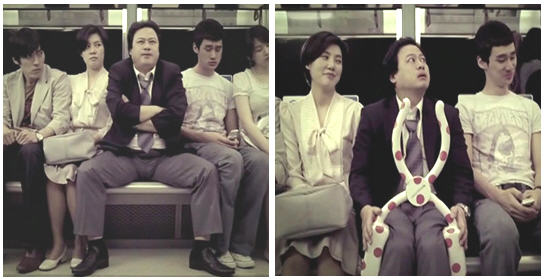
- There’s a specific word in Korean for men who sit on the subway with their legs spread as far apart as possible, to the discomfort of their nearest fellow passengers. I can’t remember the word, but there is one. (EDIT: See below for more.) It also can be used to describe guys who hold newspapers so broadly as to disturb their neighbours. (The student seemed to think it was purely misogyny; unfortunately not. I’ve sat beside a few such guys on the subway and one must simply assert that, no, my knee IS going here, pal.)
- There is a video game designed to help young cancer patients understand, deal with, and overcome their illness. And it actually does seem to help them do so.
EDIT: Had to add this little graphic, it’s perfect, and relates to the second point. See the comments for more…


One thing worth noting is that, as in my student’s essay, the image above seems to suggest that the jjeokbeolnam phenomenon implicitly involves an imposition by men onto women — the passengers beside the guy in the middle are in dresses, and are obviously smaller than he is. So it’s seemingly perceived (at least to some degree — though let me look around a bit more before I say this definitively) as an implicitly sexist phenomenon! Interesting, considering what, at a glance, looks like a gender-neutral (사람들) verbal explanation of the issue. Or did I miss something?
That said, I should also note that the use of “nam” at the end of “jjeokbeolnam” specifies maleness. Of the various meanings “nam” has in Korean, “man” seems the obvious one here, and after all, how many women sit this way in public? So the maleness is obvious, and the term itself is not gender neutral. But interestingly, the text explanation below appears to be gender-neutral. And occasionally you see pics that show men (especially younger men) being discomfited by an older man sitting in this way. Like in this one:

Which makes me wonder if this is much more of a functional opposite to the word 된장녀 than any less-common word criticizing male consumer culture, or “dandyism” or anything like that?
That is, if 된장녀 is a word repudiating newfangled young female consumer behaviours, maybe the natural opposite is a word like 쩍벌남, which repudiates old-fangled older male self-conduct that is perceived by the young as sexist, oppressive, etc? (Though it’s worth noting that the latter gets only about 50,500 hits on Google, while the former gets over ten times that many. Then again, I think the latter is a newer term. It’ll be interesting to see how that plays out.)
It’s a thought. Makes me think of the TV show Mad Men, which someone somewhere (perhaps it was Ben Burgis?) described as a kind of low-level war between men and women, fought out in the office and the home. Good show, that one…