


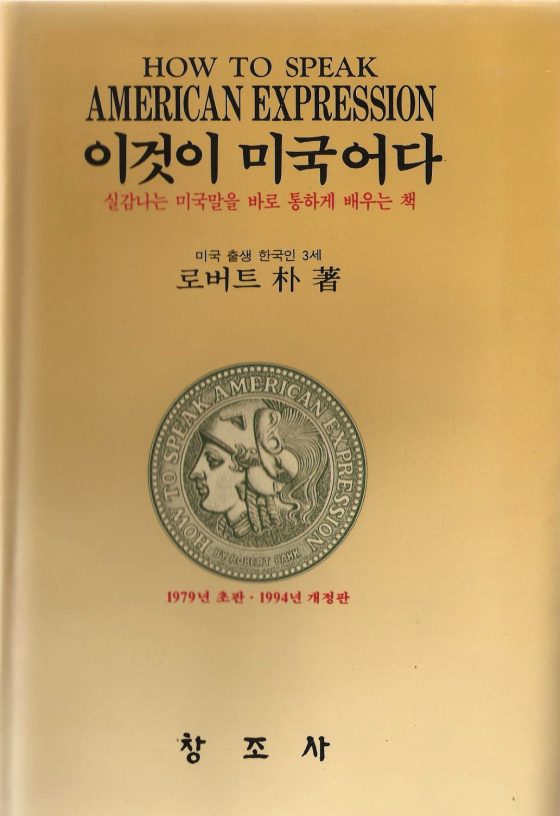

The books are all by one author: a guy named Robert Bahk (1923-1991), about whom I’ve found very little online—though, you know, I haven’t searched too hard. His bio says that he did some school in the USA, and attended some Ivy League school—attended, yes, but no mention of graduation was made in the bio I looked at—and while I can’t see the bio for the author of one piece at Harper’s from 1993 (perhaps his, though it would have been published posthumously, so perhaps it was penned by another Robert Bahk), the title is amazingly fitting nonetheless: English Made Difficult. So fitting, indeed, that I have taken it for the title of this post.
I only managed to get three little books by the late Mr. Bahk: Everyone’s American English, American English Conversation, and the ominously titled How To Speak American Expression. Apparently there are others out there, but not at my local shop. Still, the books I do have are an absolute testament to the insanity of English study in Korea back in the 1970s.
Here’s a sample of a monologue presented in Everyone’s American English (and sorry for the scan quality, but I haven’t time to scan it again and I think you can probably make out most of it):
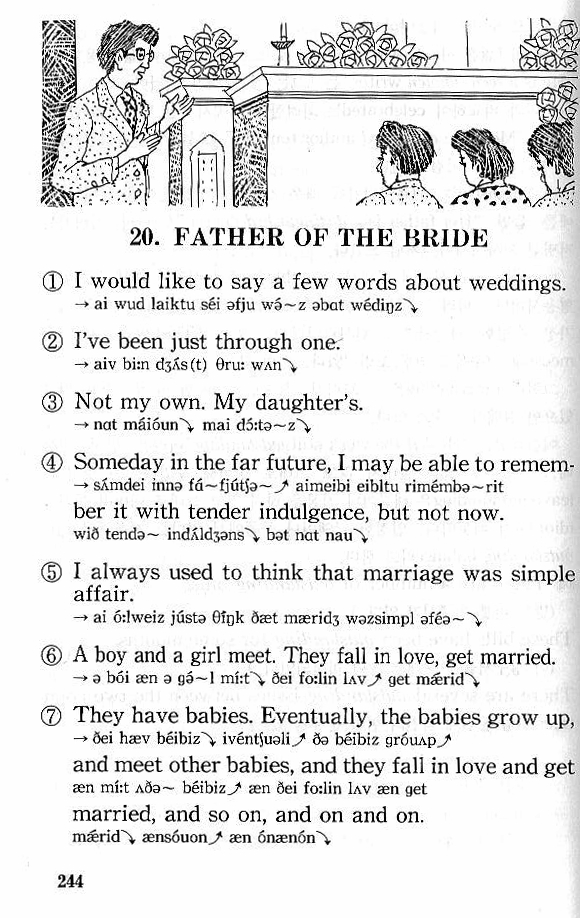

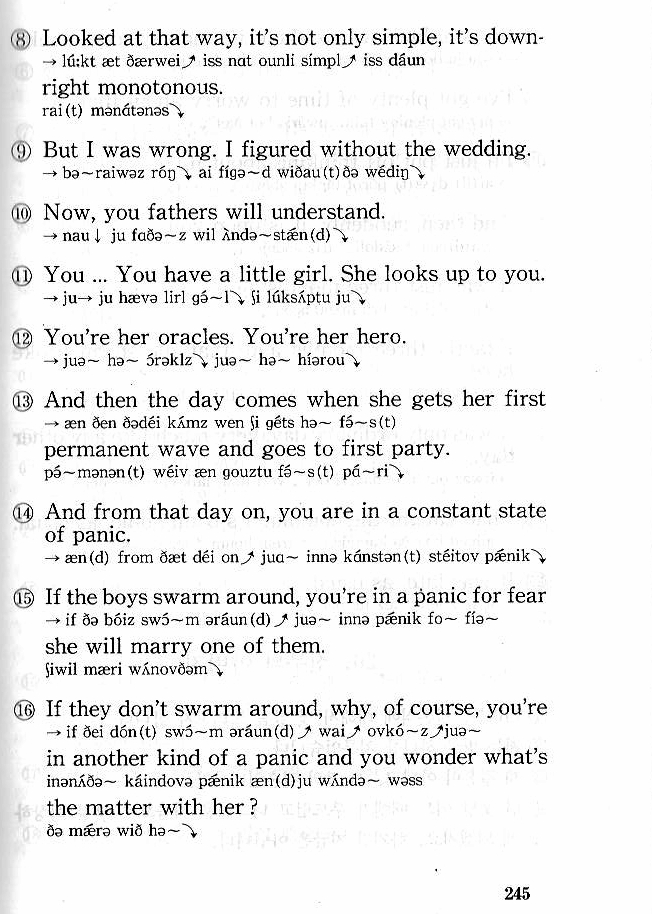

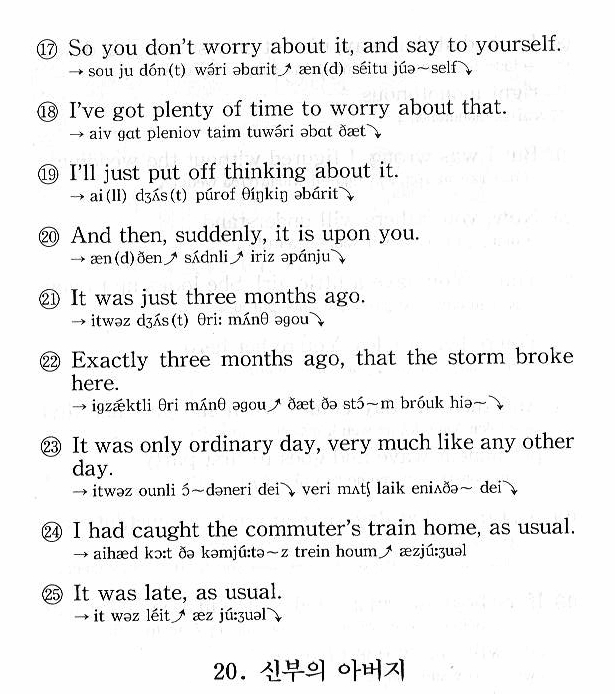

Seriously, that is how the speech ends. I don’t get it either. It’s followed by a complete version (somewhat different, mind) of the speech in Korean, and then several pages of detailed exegesis on specific idioms abd phrases.
Not only does Bahk set the bar pretty damned high, if you ask me, in terms of idioms and colorful speech, but he also mixes in stuff that looks like outright nonsense. How To Speak American Expression has some, er, “American Expression” which baffle me. They might have been expressions once, or they might be now, I’m not sure, but they are bizarre to me. For example, this bit of dialog (from page 198 of my edition):
A: He is always on the spoon.
B: He is spoony on a woman.
Because, really, calling your buddy a horndog is exactly why people in Korea in 1973 were learning English, right? Fascinatingly, Google claims there are 26 instances of “spoony on a woman” online. 24 of them are on Korean websites, and one is in a journal article titled Problems of Language in Cross-Cultural Research. The only other English instance being Dolores, a novel by someone named Mrs. Forrester (see also here), one may imagine that this novel, published in 1875, is quite possibly the source of the idiom.
Or check this little goodie (from page 279):
A: He must be a screw driver.
B: But he ain’t got soaked.
This feels, to me, approximately like putting Yo Mama jokes in a modern TEFL textbook. I swear, some of these are caption contests waiting for photos to be submitted!
And not to be left behind in terms of the pedagogy of profanity, Robert Bahk anticipates English as a Second F*cking Language by a few decades with this little exchange, on 278:
A: What shall we do with this?
B: Stick it up your ass!
A: 이것은 어떻게 하지요?
B: 네 멋대로 하려무나!
The bold bits are subject to rather serious and careful exegesis in Korean, in quarter-page-long tiny-print passages.
However well-meaning Bahk was, he was not really up to the task of writing English language textbooks for people so that they could become proficient speakers of English. One feels at moments he was scrambling to show how much English he knew, and at other times was scrambling for filler. It was more of a buckshot approach to getting the language into people’s heads. And with buckshot, you kind of end up cramming random stuff in. In this case, even stuff that’s not really quite “English” at all. (In the sense of commonly used expressions, rather than colorful idioms that perhaps a handful of native speakers worldwide would understand immediately.)
The scary thing? The lady at the used bookshop told me that back in the day, these were the books from which people learned their English. Bahk was the TEFL kingpin of South Korea back in the 70s, she said… well, in not so many words, and she said it in Korean anyway.
The other scary thing? Recalling some of the national curriculum guidelines I read through for middle school textbooks, there are at least a few serious hunks of nonsense legislated into the EFL curriculum even now.Ask me about that time when I had to find a way of working, “You can’t possibly…” into a textbook chapter, avoiding the incorrect usage that the government expected me to include, at the last minute.1
Plus ça change, plus le spoony on a nonsense….
Textbook standards guidelines are—or at least at the time, they were—issued at the last minute, meaning textbook publishers have teams develop wonderful textbooks following the previous guidelines for a few years, and then have them rewrite sizeable chunks of them over a few short weeks. When a British friend heard about this, he asked me, “Why don’t they just issue the new guidelines at the beginning of the cycle, instead of the end?” Indeed… but then, that would require planning ahead.↩