


- Revisiting Wraith: The Oblivion—Part 1: Overview
- Revisiting Wraith: The Oblivion—Part 2: Core Rules & Expansions
- Revisiting Wraith: The Oblivion—Part 3: “Setting” and “Adventure” Supplements
- Revisiting Wraith: The Oblivion—Part 4: The Guildbooks
- Revisiting Wraith: The Oblivion—Part 5: Faction and “Meta-Splat” Books
- Revisiting Wraith: The Oblivion—Part 6: Alternate Character Concept Supplements
- Revisiting Wraith: The Oblivion—Part 7: “Concept” and Other Books
- Revisiting Wraith: The Oblivion—Part 8: Tie-In Fiction and Comics
- Revisiting Wraith: The Oblivion—Part 9: Other “General” Supplements
- Revisiting Wraith: The Oblivion—Part 10: Orpheus
- Revisiting Wraith: The Oblivion—Part 11: Play Resources
- Revisiting Wraith: The Oblivion—Part 12: Conclusion… for Now
Welcome to my revisitation of the Wraith: The Oblivion RPG book line. I’m reviewing the whole run of gamebooks in this series of posts. If you’re new to the series, I recommend starting with the first post. If you’re not interested in reviews of older RPGs, I suggest you skip it, though perhaps you might find materials here of use in other games… who knows?
This installment of the series links a ton of fan-made play resources for prospective GMs and players of Wraith, or similar games. It’s intended as a roundup of online resources for those who’re returning to Wraith, or interested in giving it a shot. Hopefully, for the latter group, my discussion of the books in the game line suffice as a guide to what books you might want to get, and what you might want to do with them. The below is all supplemental to that. (And, note, most of it is very old: whether Wraith20 will inspire more Wraith-centric websites and fan-made material remains to be seen. If I find any new stuff, I’ll add it here, and I hope to archive copies of all the links below, so I can share them—with appropriate credit, and permission if possible—if and when the linked resources go offline.)
Anyone reading this who has more resources to add is welcome to put them in the comments. I’ll add them to the main post when they come in. Note that links may die as time goes by, and indeed you may discover links that have died between the time I wrote this and when I posted it. The Internet Archive’s Wayback Machine is your friend when that happens.


Before we Begin, Something Personal
Before I dive into the Wraith stuff, I figure I’ll mention it here: I myself wrote some (not amazing) material for Wraith: The Oblivion. I’m not sure if I still have a copy, but it was an expansion to Arcanoi that allowed characters to travel into media (like TV, films, music videos) and a kind of undead “cyberspace” on the internet, among other things. Here it is, but warning, it’s very amateurish and terrible:
Terrible as it was (and jumbled! I think that PDF includes a few different versions of part of the text?), when White Wolf put out a call for submissions, I sent it in. I wonder what the “bad” submissions were like, because I received a letter back notifying me that I’d been added to the list of potential freelances for the line. No kidding! I even scanned it when I last visited home:
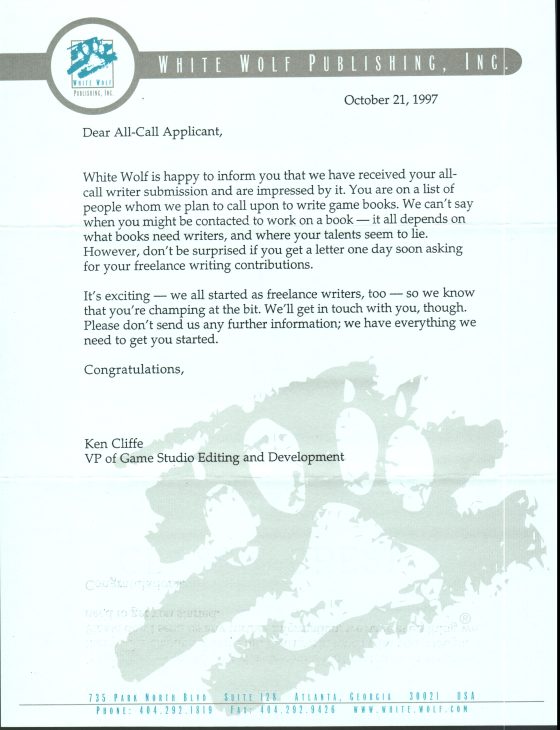

… well, unless that was just the polite form letter they sent everyone they didn’t intend to contact, so that they wouldn’t be hassled by them? (Ha, I don’t know.) I never heard back, anyway, but then, I’d pitched to write Wraith stuff not long before the termination of the game line. Also, I moved from Saskatoon a year later, and it’s completely possible my parents got a letter from them and never forwarded it to me, who knows? Still, I remember feeling very encouraged as a writer when I got that letter!
Anyway, I was soon in grad school in a strange city, without a gaming group, so I never wrote more for Wraith, but I imagine in some other world, encouraged by that letter, I might have done freelance work for Wraith or at least contributed fan materials to one of the sites linked below. Alas, it was not to be. But a lot of other people wrote stuff for the game that never saw official publication, and you can find a lot of it below.
Wraith: The Oblivion Resources Online
The original heyday of Wraith: The Oblivion—such as it was—is long gone, even on the internet (where everything was supposed to live on forever). Still, for those who want to play the game today, some resources remain online, albeit occasionally only through the auspices of the Internet Archive.
Although the Kickstarter for the 20th Anniversary edition of the game got broad support from backers, the fandom for Wraith (and Orpheus) mostly hasn’t played the game actively in years, and none of the the few fansites for the game seem to be actively maintained anymore. (Though I’ve lost track of the link, one old fansite actually had, as its last post from sometime over a decade ago, a posting advertising the website owner’s collection of Wraith books (in mint condition) on sale over on eBay.)
Even so, there’s a lot of support materials out there, if you’re willing to do a bit of digging.
That said, here’s what I could dig up in relevant resources:
Alternate Systems for Afterlife Games With a Similar Vibe

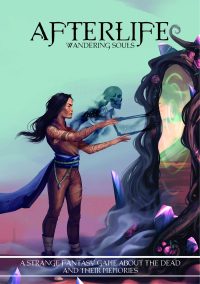


That said, Elizabeth Chaipraditkul’s Afterlife: Wandering Souls game also looks pretty promising in terms of preserving some of the feel of a Stygia game, but with a different ruleset. I haven’t read it or gotten a chance to play it, though I backed the Kickstarter and have the books here on the shelf, waiting for me to dig into them. They look pretty and read smoothly, at a glance.
Getting the Gamebooks:
- Acquiring Wraith supplements in print isn’t necessarily cheap these days, though it is technically doable. (I managed to get them all about five years ago.) If you dig PDFs, then DriveThruRPG has everything.
- Here’s a (rather dated) post on prices one can expect to pay when collecting books from the game line. The prices I paid for my copies of the complete game line were definitely a bit higher, but then I am in Asia and had to rely on the (sometimes inflated) pricing of online sellers. I even managed to get the pin, and for cheap, but from the last shop in the world to advertise it as available online. (It was a shop in Germany, selling it for the MSRP. Had it cost more than that, I would never have gotten it.)
- Though most of the magazines they originally ran in are hard to get now, a bunch of articles appeared in White Wolf, Mind’s Eye Theater Journal, and other publications associated with the company. Facebook user GC Foornyih has shared photos of a lot of these articles, including some play support, a couple of adventures, and some other paraphernalia tied to the game line. You can see the photos here.
Fan-Made Materials (and More):
Some of these resources are probably gone. (More might have shown up online, but probably not many.)
- For character sheets, there’s a massive archive of character sheets for various sub-lines, Dark Kingdoms, and Guilds at Mr. Gone.
- Wraith-LARP is focused on Live Action Role-Playing of Wraith, but it also has a ton of setting and background information, much of which could be used as a resource for players new to the setting who are looking to get oriented quickly. (The Downloads section especially has one-page cheat-sheets for each of the Grim Legions that could be useful to players and GMs alike.)
- The Wraith Project is a collection of materials, fan-written supplements, and other stuff for Wraith: The Oblivion. The site seems to have been resurrected from a backup, and the majority of the links seem to be working now. It was run by J. Edward Tremlett, J.L. Williams, Lauren Watson, and Mike Spera.
- Among the Wraith games written up over at Obsidian Portal, one of the more complete and deeply developed ones is a reworking of Wraith set in the Caribbean during the age of piracy, titled The Rime of the Restless Mariners. Not all the material is openly accessible, but it’s still worth a look for hints on how to rework the game and its mechanics to fit a given setting. The ruleset used, created by Jonathan Rowe, is also available in PDF form, as Wraith: The Seven Seas. (I found it uploaded in the files section of one of the Facebook groups linked below; I think you need to be logged into Facebook and a member of the group to access it, though.) I once contacted Rowe about sharing it in this series, but he didn’t want to make it publicly available without some serious editing. Note: Rowe is the same person listed as Fen Orc above, who developed The Ghost Hack RPG!
- A Finnish fan of Wraith named J. Tuomas Harviainen wrote two Guildbooks for guilds that never got the full treatment (Proctors and Solicitors). (I’d swear I’ve seen them around as PDFs, as well—probably on the Wraith Project. However, it may be those were separate and totally different fan projects, I’m not sure.)
- Knocking on Charon’s Door is a site with some resources for Wraith games, including a Chanteurs guildbook (I think replicated elsewhere), an interesting bestiary for the Tempest, tons of homebrewed Arcanoi, Artifacts, and more. (Warning: the site unfortunately is hosted on Angelfire and includes tons of obnoxious popups.)
- At Freewraith Citadel (the Wraith section of Dreaming Void website), the last update seems to have been in 2004, but it’s still online and offers some fan-made Arcanoi and a campaign writeup. (You can see the archive of the site on the Wayback Machine.)
- The Greater Houston Area Wraith Source Material has brief campaign notes for two games: one set in Galveston Texas around theHurricane of 1900, and the other set in Texas City in 1947.
- Necropolis Hamilton offers a Wraith setting in Ontario, Canada.
- Wraith Government offers suggestions on what could become of Stygia after the Sixth Great Maelstrom, for those who choose not to ignore the events of Ends of Empire, and Wraithpunk is a cyberpunk alternate setting for the post-Sixth Great Maelstrom world.
- This conversion of Wraith to the New World of Darkness is also available in a few different places.
- Less widely-available (and, from what I’ve read, perhaps still somewhat incomplete: I think about 15-20% of it remained to be written when the authors threw in the towel) is J. Edward Tremlett and Chris Jackson’s Wraith: The Arising, an in-depth adaptation of Wraith to the New World of Darkness. Incomplete or not, it’s still over 300 pages long, and I imagine someone could probably complete the job if they wanted to. (Note: Tremlette was also one of the hosts of The Wraith Project, linked above. There’s also what looks like an earlier draft online at Scribd.)
- There’s some stuff (mostly fanfic, but also a rules hack for the Risen) at the Internet Archive backup of De Vita in Excessum.
- The Wraith forum at Shadowessence is gone, but there’s a backup of its sparse content over at the Wayback machine.
- Necroplasm was a surprisingly good introduction to the setting for would-be players, if not quite as a thorough as the Wraith-LARP website linked above. If a “Handbook for the Recently Deceased” hadn’t been made for Wraith20, I’d likely suggest downloading it using wget and recombining it with the stuff from Wraith-LARP as an introduction for players new to the setting. You can see it over on Wayback Mchine.
- A brief but useful discussion on RPG.net about how to run the game effectively.
- Here’s a metric ton of Wraith story hooks, and a few people pitching in when someone asked for ideas for a chronicle, as well as some suggestions from one of main contributors to the later line regarding non-depressing Chronicle concepts. Oh, and a fun black comedy concept where the characters play Spectres running Harrowings, which I think would be the best way to run a game with player character Spectres.
- If you’re running crossover, this Lore resource over on Wayback Machine (for players of non-Wraith characters who know something about the Underworld) might be handy.
- Someone with the lamentable moniker “Predaphile” did up some House rules, a few new Arcanoi (one surviving) and other resources for Wraith.
- Some fun and weird Underworld rumors (from a discussion at RPG.net).
- Here’s a reference guide to the main Arcanoi. (I haven’t checked it to see whether it matches the books, though.)
- A piece of errata for Wraith 2nd edition (though I think it’s covered in a later release, for those with only the core book it might be useful).
- A FAQ from the old Wraith-L mailing list, regarding the game and obscure rules questions.
- Another World of Darkness is an archived Wraith fansite: on the Relics page I linked, there’s a host of links many other Wraith source material not mentioned elsewhere. Most of what’s linked here is pretty basic and simple stuff, but nonetheless I trawled through the Wraith links, to find out which ones work in the Internet Archive, so you wouldn’t have to. Most of them are of minimal interest, but there’s a few nice tidbits here and there among the sites that are still accessible, which include the following:
- Drakken’s Drakken’s White Wolf Stuff: a couple of short entries.
- Wrathful & Melancholy, also very sparse, but by someone named Mark Watson… from my hometown! Looks like he started the site not long after I left town. And here I was, having thought I was the only Wraith fan in town!
- Wraith: The Great War is a general resource for running WWI-era games using the Wraith: The Great War hardback.
- A Quick Guide to the Shadowlands is a guide to the underworld for players of Mage.
- An article by Heather Grove on running Wraith.
- Atlanta Under Siege is a resource on Little Five Points, the setting presented in the 2nd edition core rulebook.
- Shadow Over Dallas is a treatment of Dallas as a setting for Wraith
- Necropolis Los Angeles is what it says on the tin. Mind, the index links are tiny.
- Necropollis Chronicles was a big crossover game setting.
- Necropolis New York is what you’d expect.
- Necropolis: Into Oblivion was a MUD: this is what’s left of it.
- A short piece by Heather Grove about Wraith passions.
- Ex Libris Nocturnis had an in-depth Necropolis: Shanghai project.
- Someone using the handle LabRatFan has uploaded a ton of PDFs to Scribd from several fansites, including PDFs of forum discussions and more. There’s a fair bit of Wraith-related material there, for anyone with download access to the site.
Whew! That may not be every ancient, lost Wraith fansite that’s still accessible on the Internet Archive or some other means, or every major discussion held online about Wraith… but it feels like it’s probably pretty close. With that, I’ll move on to more recent resources.
(Also, note: I linked fanmade Guildbooks back in Part 4 of this series.)
Discussion of Wraith and Wraith20:
- The Wraith20 Kickstarter page (the campaign is over, but the 20th Anniversary rulebook should soon be available for purchase as a Print-on-Demand book if you missed it).
- There’s been a discussion of the Wraith20 book over on RPG.net.
- I found this review of Wraith (of the original edition) to be quite thoughtful and interesting.
- The (very long) “Ask the Deadguy” thread over at the Onyx Path forum: ‘Deadguy’ is a handle/nickname used by the line developer Richard Dansky. There are other threads related to Wraith there too, if you look around a bit.
- The White Wolf wiki at Wikia.com is a pretty good resource for canon material on Wraith, and can be used as a quick reference for setting information, NPCs, and game concepts.
- There are a couple of fan groups for Wraith on Facebook, here and here.
Actual Plays & Game Reports:
I don’t watch or listen to a lot of actual plays, so you’ll have to just try ’em and see. These are pretty much everything I could find available, though:
- Caffeinated Conquests very recently launched a Wraith Actual play, starting with the classic scenario “Weed ‘Em and Reap.”
- Over on Role-Playing Public Radio, the folks who did the “WOD The Heck” series posted a Wraith Actual Play.
- There’s a two-part actual play of Wraith titled Chains over on Youtube, with extra installments including a video-diary discussing game prep. (You can see all the videos here.)
- The Gentleman Gamer (a well-known RPG videoblogger) posted a Wraith session he ran with Mark Rein•Hagen as one of the players.
- A few written-up chronicles: Shadowed Liberty, an untitled one, and Things To Do When You Are Dead. Also, Ferrymen in Stalingrad, which looks to be some kind of PbP.
Podcasts & Audio:
Wraith also comes up regularly on a few RPG podcasts:
- Penny Red—a podcast whose owner has an unmistakeable love for Wraith.
- Midnight Express—a podcast dedicated to the old World of Darkness; named after an early Wraith setting/supplement.
- Darker Days is an older podcast dedicated to the World of Darkness; I think they touch on both, but tend to cover the New World of Darkness more.
- Someone created a Spotify Playlist titled Wraith: The Oblivion. (Note: Spotify’s not available where I live without a kind of VPN that I don’t have, so I haven’t listened to it.)
I’ll add more if I stumble onto anything interesting.
Other Stuff:
If you’re trying to run Wraith these days, here are four things of note that have changed since the late 90s that you should integrate into your game in some way:
- The reality TV show Ghost Hunters (along with all the others like it) is something you need to at least be aware of; your Wraiths will probably run into people like this if the game is set in the present day, after all, armed with all kinds of nonsensical trash gadgets. But Wraiths could make those gadgets “work” for kicks, of course, using just a little Arcanoi… especially the really fallible gadgets.
- For those running any kind of historical game—especially in the late 19th and early 20th century—Spirit Photography should be on your radar, and can make for some cool props in-game. So too the late-Victorian/Edwardian séance, and the general supernaturalism of the time. I agree that a Victorian setting—or early 20th century, before the hangover of the Victorian age wore off—would be an incredible setting for the game. Likewise, something set in the 60s or 70s, in a milieu like that 2009 movie House of the Devil, would be a fun setting. So would be something that jumps back and forward between then and now, especially if it were designed to highlight the cultural disconnect.
- Social Media fame: even after you die, maybe it can net you some points in Memoriam? Might Wraiths, younger ones anyway, consciously use this to their advantage? Imagine having to put up with “influencers” in the afterlife.
- Wraith and Skinlands politics? This “Queer Ghost Hunt” article (set at the house Donald Trump lived in as a kid) is obviously just humor, but it made me wonder how the social changes since the 90s have affected the Shadowlands, assuming the Sixth Great Maelstrom never happened (as Wraith20 does). Questions to ask yourself:
- Has the increasing political and class polarization of most liberal democracies affected Stygia?
- Are Necropoli more divided, or are farther-right and farther-left dead more prone to cross the line into being Renegades now?
- How would the Black Lives Matter movement affect American Necropoli, as new wraiths of black adults and children wrongfully shot by the police flout the Dictum Mortuum to try save others from their fate?
- How about American dead in Iraq and Afghanistan?
- What new Heretic Cults would have sprung up in the wake of kooky conspiracy theory crap (in the mode of Art Bell) becoming closer to mainstream culture?
- For that matter, how has the American military involvement in Iraq and Afghanistan affected relations between the Dark Kingdom of Iron and “Mantaqat Khayal,” the little-discussed minor Dark Kingdom that holds claim to what we mostly call The Middle East?[quote]Mantaqat Khayal is mentioned in passing in an old edition of the setting supplement A World of Darkness, apparently. The whole place is a giant sandstorm, and has been for hundreds of years, from the mentions I’ve seen online.[/quote]
- Assuming Yellow Springs never attacked London, what’s happened in the Dark Kingdom of Jade in the past 20 years?
That’s plenty to consider, I guess! Much of it is quite serious stuff, but then, Wraith was always a game that engaged with more than the usual amount of serious stuff.
Oddities:
I only have a few entries for this, but:
- An interesting-looking academic paper on Wraith: The Oblivion from a law & culture journal. It’s titled Voicing the Shadow—Ruleplaying and Roleplaying in Wraith: The Oblivion by Scott Beattie.
- There’s a VR game for Windows and Playstation set in the world of Wraith, titled Wraith: The Oblivion—Afterlife (Steam link). As I don’t have Playstation VR, I haven’t had a chance to try it, though it looks interesting.
Got More?
If you have more stuff to suggest for this post, please do so in the comments. I’m sure there’s a ton of stuff I haven’t turned up that might interest people.
I’ll wrap up this series in my next post, for now at least.