


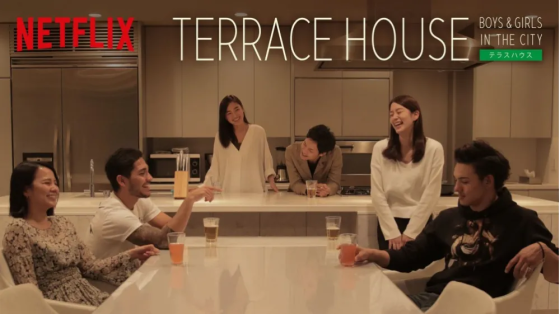
I’m not the last person in the world to stumble upon the Terrace House franchise, but I do kind of feel like it. I’m not much for reality TV, and mostly avoided it until Netflix sucked me in a few years ago with a few reality TV series that I hate-watched. (Love in Blind, which I see not as an exploration of the moronic question of whether love really is blind and more about how easy it is for smarmy, manipulative jerks to to do twisted psychological experiments on lonely, unhappy, and emotionally unstable people living through a massive social catastrophe.)
Not that all the “reality” shows are terrible. My son likes a couple of the baking shows and You vs. Wild, and those are tolerable enough for me to have half-watched them. I also find the concept of The Circle fascinating, even if a lot of the people who’ve been on the show were just boring and tiresome.
However, I’m maybe the last person you’d expect to enjoy a reality TV show about a slowly-shifting group of Japanese people in their twenties trying to navigate all the questions that fill their lives about love, their future career, and how to get along with other people in a shared space. That description actually kind of gives me hives, really. But… well, the show grabbed me. At least, Terrace House: Boys and Girls in the City, which is the only of the various series in this (now defunct) franchise I have watched.
Why? That’s a question I asked myself, and I looked around online to see what other people had to say about it. I ended up baffled: you had people who were “shipping” various couples—which I didn’t do—and people talking about how “cozy” the mundanity of daily life at Terrace House was. That wasn’t it either: I could see narrative arcs throughout, though they were occasionally subtle and took time to build up—primarily, I suppose, because in reality TV you have to work with the footage you can get.
So then what was it?
I’m not sure I can express it exactly, but I think there were a few things at different points that interested me:
- How groups of people deal with toxic individuals. This is something that came up a few times in the series, including very early on. It was interesting how, often, people didn’t tend to do anything until enough members of the group realized something was wrong; likewise, it was interesting how sometimes it was just one person saying it out loud was all it took for people to start admitting they’d noticed the same thing. When they were acting as individuals, groups were really susceptible to manipulation and deceit of all kinds; once they started working together to root it out, they did a lot better at dealing with this stuff. Of course, I would expect this to be universal to some degree, but I wonder if culture plays a role. It’s also suggestive of why manipulators and liars tend so often to sow discord: a group fighting amongst themselves are less likely to catch out the really sneakily toxic members.
- How malleable and manipulable consensus reality can be. This is apparent not just in the way consensus reality got established in the group, but also in how fandom discussions shaped responses to specific characters or situations. One older male character later in the series was especially focal in this: people turned to him for advice, and he sometimes did give good advice, but people were also prone to interpreting his advice as “good” because he gave the advice and people took it seriously and respected him. It goes a bit further than that, too: one of the things about Terrace House is that it has the participants who live in the house, but it also adds some celebrity commentators. This is a formula familiar to me from Korean TV, but what struck me as different was just how snarky, judgmental, and even antagonistic the commentary sometimes was. It was entertaining at times, but it also often seemed built to set up a specific reading of a person or a situation that didn’t always seem self-evident to me. Looking at discussions of the show online, I found that often carried over: people would become committed either to the reality that the commentators created, or to refuting it—all based on a few minutes of footage per week that were included in the final edit.
- How self-defeating people can be, without any compelling reason. There were a few cases where people found themselves interested in one of their housemates—sometimes in a romantic way, sometimes more in terms of a negative fixation. People took those interactions really seriously, even when they were free to leave the house at any time. (I can relate: my upbringing trained me to stay in uncomfortable situations, to “stick with it” to a fault, and it’s something I have struggled with over the years. I suppose also some of the people in the house were there for professional reasons—it’s a stepping stone to minor celebrity in Japan, or used to be, so there was some incentive to stick it out.) Not that this show has a premium on lack of self-awareness in its participants—I feel like that’s a common thing in reality TV—but I think the fact that a lot of the interactions were the kinds of things you’d see in daily life made it more interesting somehow, in terms of driving home, “You know people like this, and so do we all.”
Anyway, I haven’t thought about Terrace House much since I saw it, and I doubt I’ll watch any of the other series from the franchise, but I found this stuff interesting to watch. It’s far from the “cozy” show people seem to think it is, though. It’s about low-key trainwrecks and how people deal with them.