


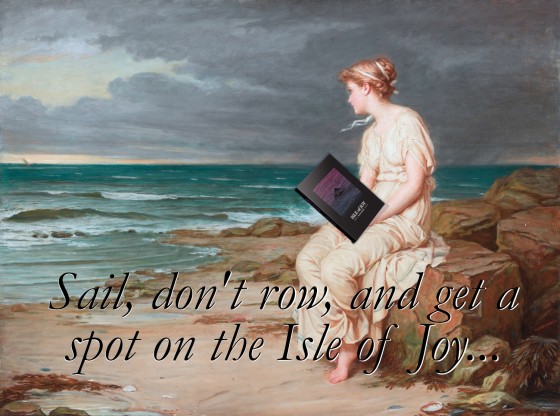
This post is, yes, me trying to convince you to check out my latest RPG project, the Isle of Joy over on Kickstarter right now. However, since I’m not used to selling my stuff, I am going wrap the sales pitch in bacon some short essays on actionable related to RPGs. Maybe they’ll be things most GMs have figured out for themselves, maybe not, but I’d like to share what I got from the experience of designing and playtesting the book.
When we were playtesting Isle of Joy, one thing that came up was languages. The Isle is a weird place, with lots of people from foreign cultures. In old-school RPGs, we often gloss over this with the useful shorthand of a “common tongue” and that’s great, but of course in most historical eras, there tends to be more than one lingua franca in the world, and when traveling to a very remote place filled with people from all over, sometimes a new lingua franca emerges from a combination of bits and pieces of several languages—a pidgin, that is.
In RPGs, languages and especially pidgins that the PCs (and players) don’t know at the start can be fun to play with. Of course, you don’t want to turn it into a big language lesson: people who want to learn a made-up language will do that with Tolkien’s elven or Klingon or something. But in smaller doses, it can be a fun tool in the GM’s world-building arsenal. For example, when we were playtesting, the party encountered one kid NPC who (for specific reasons) did not share a common language with anyone else on the Isle—not the other castaways, not the player characters, and none of the various spirits native to the isle.
https://giphy.com/gifs/season-5-the-simpsons-5×9-3o6MbbbVaxTWKkaj6g
Though they had reasons to keep her around (more about that below), communicating with her was difficult. Players resorted to gestural communication (or, well, since we were playing in a voice-only chat, descriptions of gestural communication) and whatever random words individuals managed to pick up. One word from the NPC’s language that players did manage to learn was “bal,” which they eventually figured out had something to do with stars. (I made up the word on the spot, corrupting the Korean word for star, byeol (별).) As I remember it, the PCs and NPC learned a few more words of one anothers’ languages, too, like words for “quiet” and “spell” (as in “magic spell”).
Restricting communication to a few common words had a funny effect: it added a variable into the mix. The characters couldn’t always know what was going on with the NPC, for example. In one case, she led them into what turned out to be a dangerous locale, because she was addicted to a substance available in that locale. The players might have urged her away from it, or parted ways with her, but because they couldn’t be sure what she was saying to them, or why—and because they were invested in keeping her around, since she was mostly helpful to them—they ended up letting her lead them into such a place.
https://giphy.com/gifs/netflix-language-subtitles-survival-of-the-thickest-1UQatifZkh6G3QaLM6
Likewise, I suspect players felt a strange, small satisfaction from figuring out what certain words meant, and why this NPC kept saying them. The bits of her language they’d learned, and which they began to use when talking to her, were a kind of puzzle: finding where even one piece fit somehow felt like a minor achievement.
The thing to remember is that this is a spice, a flavoring one adds to a setting. During their travels, my player’s characters met members of several groups who either spoke their own creole, or spoke a full-fledged foreign language with no common words to the ones known by the PCs. Most of those interactions relied on gestural communication, or on a random group member who’d picked up a little of the characters’ common tongue. There would be no payoff to making up enough vocabulary to hold impenetrable, one-sided conversations: in this case, the GM just says, “They don’t seem to understand your language.”
https://giphy.com/gifs/twinpeaksonshowtime-season-2-twin-peaks-xUySTGXQsjlXIP3hbW
The two conditions where a foreign language or creole can be useful are when:
- The character interacts closely with the PCs for an extended period, and the players have a reason to bother. It takes time to pick up repeated words, after all, and players tend to only get really invested in communicating with a character they spend time with, or need to understand. For example, the NPC in question was a kid, and they were in the habit of picking up and protecting stray kids. She also was a spellcaster, with the ability to cast one useful offensive spell: this meant she added some firepower to the group. Finally, she knew the Isle and she also could act as a guide, since it was clear to them she knew the Isle well and had survived it much longer than they had. Having reasons to keep her around generated the reasons to try communicate with her, despite the language barrier.
- The words are useful and important to the developing story in the game. It’s not a coincidence that the bits of the kid’s language players learned had to do with locales on the Isle, and its strange features. In real life, they’d probably have learned her language’s word for “fire” or “no” or “go to the bathroom” long before learning her language’s word for “star” or “magic spell”: however, in a fictional narrative, foreign words usually function as a kind of spice. We use them for important things and places unique to the setting, not for mundane words. (Read any novel by an English speaker set in a non-Western setting for abundant examples of this technique!) Sometimes, that foreign word might be the only word for a thing, such as the name of a monster or other creature that is unique to the region. On the other hand, sometimes it’s more a case of the word being important due to its relationship to a nearby locale that might enter the story. The “star” was related to a specific place with a special relationship to stargazing, for example.
As with any spice, it’s possible to go overboard with this. However, if players are using the occasional foreign word, or puzzling over what it means, and it helps drive things forward (whether characters decide to pursue “bal” or avoid it), you’re on the right track.
If this post has you curious about Isle of Joy, it’s currently on Kickstarter and you can back it now. It’s built to be directly compatible to Old School Essentials but works with pretty much any other old-school styled game too.