


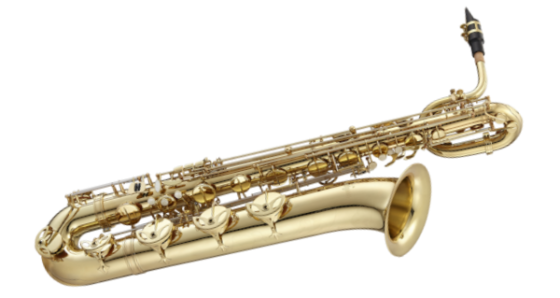
So, for a while there I had a lot going on and wasn’t making it to the practice room, but the place where my son takes piano lessons offered a discount: ₩50,000 a month for family members to use the practice room if there’s a student enrolled with lessons at the music center. That’s way more affordable than the practice rooms used to be, and it takes a lot of the pressure to practice every day (which I felt when access was more expensive), so we jumped at it as soon as I felt up to it, which as it turns out was the start of September.
I’ve given it a miss both weekends since then, but I’ve made it to the practice room most weekdays, and it’s been fun. I’m just recovering my chops, and have been concentrating on baritone saxophone. I’m adjusting to a new (and excellent) mouthpiece, the GS Hollywood Baritone Saxophone, which I got in a “6” facing. This particular mouthpiece is a copy of the Gale Hollywood mouthpiece model for bari. (Gerry Mulligan played on a “5” facing of that model, for what it’s worth.) I’d been trying to play on a Theo Wanne Durga baritone mouthpiece before, and, well… it was just a bit too much mouthpiece for me, I think. But the Gale speaks easily and clearly, and the horn has a nice and rich, deep tone with it. It’s also nice that I can play with 3-strength green Java reeds on it: I was struggling with 2.5 strength Van Dorens of various makes on the Theo Wanne and still finding them too hard, which was frustrating. I’m not quite ready to sell of the Wanne—and I’m not sure I’d be able to sell it in Korea anyway, as bari saxes seem very scarce here—but for the foreseeable future I’ll be playing on the GS Hollywood piece, and, I’m sure, loving it.
Most practice days, I actually bring another horn along, and switch between that and my baritone saxophone. Sometimes it’s alto, sometimes tenor. Occasionally I’ll bring the soprano, but I find the shift between bari and soprano is the toughest, while the switch between tenor and bari is almost negligible. The shift between alto and bari, though challenging embouchure-wise, at least lets me practice stuff in the same key on both horns, instead of shifting from Eb to Bb and back again as I have to do with tenor or soprano.
Another cool thing: this mouthpiece is 3D-printed from dentalin—the same material used to 3D print dental implants. I didn’t have an appropriate ligature for it when I got it, so I sat down and printed up a couple of ring ligatures (and a temporary mouthpiece cap) so that I could use it until I could got a proper ligature. It’s working… well, it’s not bad, but I don’t love ring ligatures. Still, it’s fine for now.
(Hell, today, I brought my flute and did some scales on it as a break from the bari, as well as a few choruses of Blue Monk. It’s funny how much air the flute requires compared to baritone saxophone. I was fine playing bari for an hour, but two minutes on the flute for the first time in a long while, and I was suddenly a little dizzy. It passed, but I felt it for a little while. As you can probably guess by that, I remain pretty terrible at flute. I need to learn the 3rd octave fingerings and spend a few months on scales if I’m to get any better. Which reminds me, I have to find and print out a fingering chart for that octave. I also need to find a good fingering chart for baritone sax altissimo, because the fingerings I’ve been studying for alto and tenor don’t seem to work well on my baritone. I wonder if that’s typical of all baritones, or if the fact mine is a low-A model has something to do with that. Probably a little of both.)
Anyway, I’ve been working on a few things in the practice room:
- scales (because the left hand palm keys are a little in the way and I need to get used to them, plus I’m still awkward with the low-A thumb key and left-hand pinky keys)
- a couple of tunes, specifically “Don’t Get Around Much Anymore” (though those scoops Johnny Hodges does on alto, I find harder to pull off on bari) and “Stella by Starlight” (at a slower tempo, like this performance, and a little less free than this one)—both of which I picked just because they were in my head lately. Sometimes, for fun, I also do a run-through of Blue Monk, trying to evoke the Monkish chromaticism of the head instead of just leaning on straight blues playing.

Yeah, yeah, I should be doing long tones too, but I’m still getting back in the groove and want it to be fun for now. I’ll add long tones and overtone exercises into the mix when I’ve recovered my chops a little more, and once I manage to get my embouchure a little looser, like it needs to be with bari.
I’m finding it so much easier to get around the horn now that I have a mouthpiece I’m comfortable with, to the point where I’m kicking myself for trying to tough it out with a piece that wasn’t working for me for so long. Ah well, live and learn, I guess.
Note: Incidentally, that bari sax up in the picture up top of this post is the same model as the one I play—an Antiqua BS3220—but it’s not my specific horn. I would have a white-colored mouthpiece on it, for one thing. I was feeling a bit low-effort while writing the post, though, so it’s just a stock image from the Antigua website.