

- Readings, January/February 2026
- Readings, March/April 2026
- Readings, May/June 2026
- Readings, July/August 2026
March and April of 2026 were a little rough for reading. The ol’ work schedule is basically flat-out insane, and a lot of my spare time goes into translation work, so the fact that our son’s back in school again has helped less than I thought it might. (We lost a teacher at work and, well, nobody’s hiring anyone these days, so I’m teaching a lot more hours than I’m actually supposed to be.) Whew. Anyway…
I’m still off-and-on reading some of the same things I mentioned last time, like:
- Sir Thomas Malory’s Complete Works edited by Eugène Vinaver.
- Max Bennett’s A Brief History of Intelligence
But below the cut, I’ve only posted properly about things I’ve either finished or given up on—and the latter, only when I’ve read a significant amount of it before giving up on it.
Fiction


First up, I continued trying to read Clive Barker‘s 1991 novel Imajica. I wasn’t sure how far I’d get, because I’ve actually had the book for almost thirty years, and tried to read it several times, always giving up… and yet, as a high-schooler I actually loved other Clive Barker novels like The Great and Secret Show and Weaveworld. 1 However, for some reason, I never got very far into Imajica, and I’ve never been sure why. Anyway, I decided to give it another shot—perhaps the last try I’d be giving this book—and started reading it back in February. It’s a huge book, and I found it slow going, though it has some of what I loved so much in The Great and Secret Show and in Weaveworld: even in the early pages, there are hints of strange otherworldy places and encounters with strange otherworldly beings. That said, I found the book took quite some time to really get going, and I didn’t care so much about the characters, at least not in the first hundred pages or so. The book suffers from a sort of late-80s/early-90s need to be “cool,” I find: I think it has to do with the tone of the narration, but also the way the dialog is written, and most of all the characterization. I really, really disliked almost… no, wait, actually, not almost. I disliked all of the characters I encountered in the book. I stuck with it until about page 250, found I wasn’t engaged, and gave up on it.
It’s disappointing considering how much I liked certain other works by Barker—and I do plan to revisit some of his earlier work, like The Books of Blood and maybe Everville—but Imajica is just not for me. There was a time when I would have pushed onward, and maybe have been rewarded by it, but these days I think it’s just better for me to walk away and just say that this book ended up being not for me.
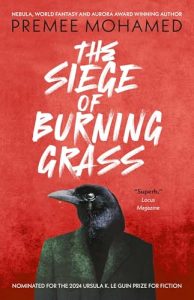

It took me a few weeks to finish, in part because the setting is extremely bleak, and in part because I was very busy with translating work. In any case, it’s the kind of novel that rewards a slow, steady read, which makes sense: I cannot imagine a book that delves as deeply into questions about war, pacifism, and violence that also rips through its narrative at a rollicking speed. But while it’s slow-going, or it was for me, it’s a rewarding read, and in many ways (and I’m sure I’m not the only one) it reminded me quite a bit of Le Guin’s The Left Hand of Darkness—both are slow burns, both explore some heavy questions, and both are pretty unflinching about human nature while still having a very strong moral conviction underpinning them.
Though Butcher of the Forest has stuck with me a little more, I was impressed by The Siege of Burning Grass, and plan to read more of Mohamed’s work when I get a chance. (I already have the ebooks for her Beneath the Rising trilogy, thanks to a bundle deal I picked up last October, so maybe I’ll proceed on to those.)
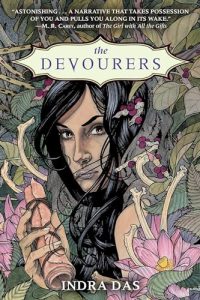

Jumping back and forth between the modern era and seventeenth century India, the book has a number of narrator viewpoints, from Alok (a modern professor) in Kolkata, to a human woman living in the 1600s in various different settlements in the Mughal Empire, to several world-wandering, soul-devouring shape-shifters who cross paths with these humans. The book is about several things at once: it’s about violence and the violence of consumption, but also about the violence of consumption of others’ stories—which makes sense, since Das rewrote the stories in this book from earlier works that were less critical of their male-centric use of sexual and other violence against women; it’s also about liminality, about not being one thing or the other—not human, not inhuman; not (only) male and not (only) female; about being monstrous and not-monstrous at the same time… which is also to say, it’s definitely a deeply queer novel, not just because of the same-sex(-ish, in some cases) relationships that transpire within it, but also because that queerness deeply informs a lot about the supernatural elements of the novel, in particular when it comes to the shapechangers’ culture and taboos.
Anyway, I found The Devourers beautifully written and very hard to put down.
Graphic Novels

For a while, I had a copy of Barker’s Everville, the sequel to The Great and Secret Show, but never got around to it, and now I haven’t got it anymore.↩