

- Coming Soon: Mythic Bastionland!
- Our Mythic Bastionland, Session 1
- Our Mythic Bastionland, Session 2
- Our Mythic Bastionland, Session 3
- Our Mythic Bastionland, Session 4
- Our Mythic Bastionland, Session 5
- Our Mythic Bastionland, Session 6
- Our Mythic Bastionland, Session 7
- Our Mythic Bastionland, Session 8
- Our Mythic Bastionland, Session 9
- Our Mythic Bastionland, Session 10
- Our Mythic Bastionland, Session 11
- Our Mythic Bastionland, Session 12
- Our Mythic Bastionland, Session 13
- Our Mythic Bastionland, Session 14
- Our Mythic Bastionland, Session 15
- Our Mythic Bastionland, Session 16
- Our Mythic Bastionland, Session 17
- Our Mythic Bastionland, Session 18
- Our Mythic Bastionland, Session 19
- Our Mythic Bastionland, Session 20
- Our Mythic Bastionland, Session 21
- Our Mythic Bastionland, Between Sessions 21 and 22: The Feast
- Our Mythic Bastionland, Session 22 and Epilogue
- Our Mythic Bastionland Wrap-Up: Behind the Scenes
If you’re just joining us, you’ll probably want to go back to the first post in this series. Otherwise, read on!
This post contains an accumulated set of notes about what was going on behind the scenes during the campaign we’ve just wrapped up. I have no idea who, if anyone, will be interested in a behind-the scenes like this, but I took notes over the week following each session, mostly for my own benefit, and figured I might as well share them along with my writeups of each session’s events.
Pre-Session 1
I started by preparing a hexmap in HexKit.


I struggled a bit deciding whether or not to create a separate GM map showing barriers and locales but eventually realized that the best way to go about it was to import the map into Roll20 and use the GM layer for things like that, along with subregion names for the realm. That way, I could import markers from the GM screen to the player screen—or not—as suited us at the time. Here’s what my GM-facing map looked like before Session 1, aside from a few small changes I made here and there, with fog of war turned on. You can see the party marker is on hex 0107, and only hexes 0106-0107 and 0207 are visible to players:


(I decided against importing the markers unless there was a good reason, since players were not actively mapping the realm—if they wanted to rely on memory and making markings on the map, that was up to them! Eventually, though, they started making marks on the map, which was fine with me too.)
I took the wonderful Sindraline example realm (prepared by hexhog) as an exemplar for realm prep, but of course my own realm writeup was much longer even before the first session. I no longer have a copy of the version of the document I started out with, but I do still have the “living document” I used for the campaign, a sort of hex key filled with notes on each locale of importance in the region, with some notes on random encounters and Seer-related notes at the end. I had basic information for the western 2/3rds of the map ready for session 1, and built out from there. Some details changed along the way, of course, as I adapted to the emergence of new omens from myths in unexpected spots on the map. I’m not sharing that document for now, in part because it’s a total mess, and in part because who knows whether we’ll eventually return to this realm?
[This is one of the weird things about the game: the Omens for a given myth might all emerge in hexes relatively distant from the Myth Hex. It’s interesting, but also requires passable improvisation skills.]
I also printed out the Myth pages for the relevant Myths places within the realm, from the PDF of the game. I figure that way I can refer to them more easily, cross off the Omens as they’re encountered, and keep track of things much better. (On the other hand, my document for the Realm, I mostly found worked best in digital form on screen, so I could modify it as I went along.)
I specifically prepared a certain number of the pointcrawls ahead of time, because I didn’t trust myself to improvise those completely off the cuff, especially not on the spot. Details on major settlements were also pretty detailed, while Monuments, Dwellings, and Sanctums were more varied in how much detail I included. (Made some Sanctums into pointcrawls as well, figuring that some seers wouldn’t make it easy to visit them.)
With that, I shared the Roll20 link with my players and then asked them to make characters and upload tokens for each of them.
The GM-facing version of this map doesn’t really exist in this form: I’ve mostly set it up on the GM layer in Roll20, which works well since I can adjust it when needed—plus I can easily add my landmarks, barriers, and other map markings from the GM-facing map to the player-facing map simply by moving things between layers. Since the player characters will be relatively new to the region, for now we’ll be using a Fog of War and they won’t know the names of things like mountain ranges, rivers, and so on. (I’ll move those labels onto the player-facing map as they learn them, too.) In fact, since the realm is new to them, I’m actually planning on using Fog of War and revealing more and more of the map to them as they travel about.
Along side this, I have the starting Myths and a key I’m working on as printed documents, along with a few Knights I think would be fun to encounter along the way. (It’s easy to generate Knights, NPCs, Squires, Warbands, Sparks of various kinds, and even entire realms with the Mythic Bastionland Referee Companion. It’s quite seriously an astonishingly good piece of game support software, and I’m blown away by how useful I think it’s going to be during play.)
Another extremely most useful tool I’ve found for the prep stage of the game is the Mythic Site Generator, which generates Sites in the same format outlined in the book. You can adjust them as you prefer, too. I’m using it to generate all the sites that exist in the realm, though I’m not filling in the details until it seems possible I’ll need them. I mean, seriously, look how clean and easily-legible this is:


Well, it’s easily legible if you’re familiar with what the geometric shapes and the various styles of connection lines mean. (There’s a key on the site generator page linked above.) Soon after I started using it, the Mythic Site Generator added key generation as well, for GMs who are stuck having to improvise a locale completely off the top of their heads, I suppose. It’s really an amazing tool!
I also really like this online Spark Generator, and expect to put it to occasional use as well, just for general off-the-cuff inspiration and ideas:


Below are behind-the-scenes notes for every session I ran with the group, at least for every session for which I had any behind-the-scenes notes to make.
Session 1
- Origins: I really wanted this game to involve an exploratory hexcrawl across unknown terrain, so I decided the PCs had come from a neighboring realm at a Seer’s bidding. I asked the players to choose, and one suggested the Twilight Seer, for reasons that made sense, so we went with that. They had some basic information about the ruler at the Seat of Power, but no more than that—no inkling of the political situation at the Seat, or the nature of the ruler, or anything like that.
- The Temple of the Green Woman: The ruined temple the characters happened upon was foreshadowing a Myth of my own devising, from my free Mythic Bastionland supplement Further Strangeness, a Myth called The Ruinous Road. I had a pretty good idea the characters would run across this ruin soon, given that it was close to where they entered the hexmap and that it was along most likely routes toward the nearest active Myth, and I wanted to use the locale to set a kind of vibe into the game, and especially to set expectations and so on—the better to break them when PCs explored further. I actually picked which Myths were being foreshadowed by each of the ruins on the map, so that as active Myths got resolved, players could tackle (or not) newly active Myths in later Ages.
- Ants: We have a running joke with ants in our games. In playtesting for Isle of Joy, a characters died at the… mandibles? … of ants, and ant swarms menaced our Mausritter characters… it’s kind of become a thing. I included these ants without consciously thinking about that, though: I was just looking for a less-deadly Virtue-threat to throw at players and see how they handled it.
- Pacing: We didn’t get as far as I’d hoped in the first session, so we ended on a cliffhanger. This meant prep are a little heavier for the following session, because I wasn’t sure how far and how many possible courses of action to prep for. I decided to steal a trick from our sometimes-GM Justin’s playbook and prepare three options, presenting those as the most sensible options for the players to choose from. I also decided that once they ran across the Myth they’re planning to look into, The Tree, I would include at least one NPC they could run across and question, probably in a position where they first require assistance from the PCs. I have a few random possibilities for that.
Session 2
- Moss Bear: I really like the design of the Moss Bear. I was eager for the players to fight it, but at the same time, it was very wise of them to avoid fighting it. Here’s the stats:
MOSS BEAR VIG 15, CLA 5, SPI 18, 10GD, Armour 2, 2d6 Claws, d8 Bite. Special: Moss infection. Any character Wounded by one of its attacks must make a VIG save or be infected with Moss. They will turn green and sprout patches moss on their skin by the next Season, and in the following Season they will begin to turn into a bear. If defeated, will collapse into lumps of moss, but will re-form at midnight, in a weakened state, recovering its full strength throughout the night. This, combined with the Vision Berries, is the real danger of the moss bear: if characters beat up the bear, ate some berries, then depending on the length of their vision/sleep they could end up being attacked and savaged by the respawned bear before they wake—especially if all PCs consumed the berries. - Creepiness: Funnily enough, I didn’t intend for the description of the outbuilding—the side chapel—to be so creepy. Sir Yorick’s player left the glowing little wooden dolls and the seeds untouched. I’m going to have to work on mood-setting a little bit, I think, though, then again, the creepiness made sense and was compelling in its way.I just don’t want things to be a one-note samba. I think partly because of the horror elements in the last full campaign I ran for the group (the playtests for Isle of Joy), they kind of expect horror in this game too, and I need to work against that a bit. It’s challenging because while, like all RPG players, they’re cracking jokes, I’m mostly trying to play things a little straight, in a more epic mode.
- More Rumbling: I improvised the rumbling and continued growth of the Myth The Tree, even though the characters had not actually moved to a new hex. I felt a little dramatic foreshadowing would be nice, and that it might also throw them off a little, thinking that The Tree might somehow be linked to the temple of Mavrydd, when in fact the temple was a ruin foreshadowing a completely different Myth, one of my own devising detailed in my own Mythic Bastionland supplement Further Strangeness, titled “The Ruinous Road.”
- Between Sessions: I improvised the thing with Sir Augustine’s player Esther about, “You read the book for an hour, come up with three specific questions this week and ask them on the Discord and I’ll answer them.” I think it’s a good solution to the problem of having a character read an imaginary text, and takes some of the pressure off improvising an interesting result during the session. (I’ll just have to come up with something that doesn’t make the characters feel like they should have done something else before leaving the “temple.”)
- Forget-Me-Not-Notes: I made a couple of notes to myself about things not to forget:
- The Green Woman book’s pages went blank the moment the characters left the temple complex. (Sir Augustine will only notice this the next time he opens the book, however.) The text will, however, reappear on the pages of the book when it is read by moonlight.
- The next Seer the characters meet will know about what happened at the temple, and will want the berry Sir Augustine carries in his armour. The same Seer will also know what the seed Sir Yorick took does, and will berate Sir Yorick for not having taken the little glowing “poppets,” which are of great value to seers as tokens from an Otherworld.
- Post-Session Prep: After the session, I spent more time doing general prep. Some of it, I spent on more distant hexes, but most of it I spent preparing characters in Roll20 for the Myths that I’d placed around the Realm, organizing the character sheets into Folders named after each Myth. It’s probably not strictly speaking necessary, but it’ll make me feel less like I’m scrambling in the moment when one of these random Omens comes up, especially in the case of ones that imply the possibility of combat. This is what that ended up looking like:


- Doing Voices: The rest of my prep time was spent thinking about the various NPCs I’ve already created for the realm, those that are likely to come up as well as major ones in the big settlements and keeps. Mostly I was just thinking about speaking styles and voices I could use, as they already have basic personalities and factional associations set up for them.
Between Sessions 2 & 3
- Hiatus: We had to miss
twothree weeks in a row: I was sick the first week, and the second week one of the players couldn’t make it. The third week, an unfortunate miscommunication resulted in one player missing, so we didn’t play. - The Booke of Mavrydd: In the meantime, Sir Augustine’s player asked me the three questions he’d learned answers from while perusing the book. Here follow the questions and the answers I gave:
- How do normal folks contact/beseech her for aid?
Normal folks generally can’t contact her: every instance of contact with her by a normal individual seems to involve her reaching out to them. One motif that often comes up is individuals stumbling upon a road in the wilderness that leads to her. - Who is her biggest adversary that she battles and plots against?
The poem mentions a figure called The Sleeper, whom it is implied is simultaneously her husband and her immortal enemy. Her plotting and scheming mostly seems to involve keeping him “aslumber.” She has enlisted a few figures against him, in the poems, apparently heroes, though the details are patchy about who and where the Sleeper is or why they’re enemies. - Any indication of geographically where she lives?
No clear geographical location is mentioned—and you’re not sure you’d understand the references since you don’t know the area well—but it’s strongly implied that the way into her territory is closed to any she does not wish to trespass. In the poems, a road is mentioned again, which connects her lands to the “stronghold of the Ash Lords” somewhere vaguely to the south of the gateway to her lands.
Looking back, I guess I forgot calling the fae there “the Ash Lords” because I never called them that again. Oops! I also informed the player that the book had gone blank the next time Sir Augustine looked at it, after leaving the temple complex.
- How do normal folks contact/beseech her for aid?
- Inspiration (1): For those keeping score, yes, I was reading the first Black Company trilogy (by Glen Cook) when I wrote that answer to question #2, and very directly ripped off the whole Lady/Dominator character pair for the Green Woman and the Sleeper. It’s totally fae politics, and not something I’d thought would come up: I definitely hadn’t intended on a backplot involving fae animosities, and it may never come up in-game—we’ll see what Sir Augustine does with the information once The Ruinous Road myth is activated, I guess—but who knows?
- Inspiration (2): I’m also reading Sir Arthur Malory’s Le Morte D’Arthur, the version edited by Eugène Vinaver, though I’m not very far into it and mostly the inspiration I’ve found in it has been indirect. That said, it’s given me a few narrative touchstones for the Knightly Epic genre that I can draw on as we go along.
- Inspiration (3): I also watched Excalibur and read a bit more of Sir Arthur Malory’s Morte d’Arthur, which reminded me of a few useful things for the game. Such as:
- Holy crap, knights in full plate armour do lumber about like tanks, whacking at one another and trying not to lose their balance. Elegant combat it ain’t.
- Tourneys don’t need to be high-class affairs—the one in Excalibur is wondrously low-rent—but they do need a bunch of interesting knights on hand. I think I’ll prep a few knights I’m very familiar with for when a tourney comes up.
- Squires: easy come, easy go. I like the young guy who begs to become Lancelot’s squire in Excalibur. He’s a grotty, ignorant “dullard” (that’s what Merlin calls him) and a great prototype for some (occasionally lore-dumping) squire.
- I should look around for some writeups about mages in Mythic Bastionland: not for a Merlin character—that’s what Seers are for—but for a Morgan Le Fay character I can include in local politics at the Seat of Power.
Session 3
- Combat: It was slooooooow. Like, it took up most of our two-hour session! Partly that’s just that we’re all getting used to the Feats/Gambits system, and partly it’s that there were lots of combatants. (From my experience as a player, PCs ganging up on a single opponent, like a big nasty wyvern, speeds things up considerably.
- Yerkin: He was the pathetic loverboy obsessed with Eloesa, the pilgrim group’s leader.
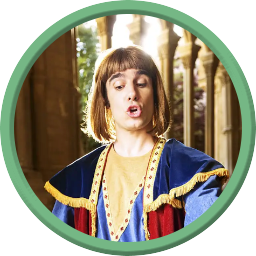
I didn’t play him up as much as I should have after the end of the combat, but I did mention his foiled attempts to save Eloesa enough times during it that I hope mentioning him when the characters are traveling to Caerwyn will make him stick in the PCs’ memories. He’s going to be quite resentful of the group, and especially of Sir Yorick for his having saved Eloesa instead. And yes, he’s totally based on the poet Thomas from the British TV series Ghosts. I’ve never cared for the bard-as-sexy-playboy stereotype that so many D&D people love—I find it unspeakably boring—but the (would-be-)bard as hopelessly lovestruck fool, that resonates with me.


- Century Blooms: This is the setting’s little nod to the Dutch Tulip Mania. Flowers worth untold sums of money, coveted by the rich, and valuable enough for a group of travelers to pay their way traveling across an entire realm: it sounds crazy, but it’s the kind of thing that really could have happened in history. Well, sort of. One of the things about Mythic Bastionland is that money is pretty unimportant to Knights: they get free room and board almost anywhere they go, at least for a while, and most of the things they want they will acquire not through exchange of money, but through either barter or by rendering a service in exchange for the good. However, it’s still fun to throw in treasures, especially treasures that one more more members of the group will deem worthless.
- Eloesa: She might come up again. The cult of the Six Saints is one I haven’t really filled out, but I can do if the players get interested in it. I’m not sure how interested they are in the religion of the realm at the moment, so I’m not sinking too much time and energy into detailing it, but I have a few ideas. The other way she might come up is in relation to her home, Blackwort Castle. I have an opinion ready for if anyone asks her about the politics or the ruler, since Blackwort is the seat of power in the realm. But any time I spend on the game this week, it’ll be spent cooking up some rough ideas and details about Caerwyn Town (which is built upon Great Caerwyn Bridge) and Caerwyn Keep proper, which is on the south end of the bridge.
- Map: I forgot to the do the map reveal at the start of the session, so I cleared the newly-visible hexes and included an image of them in my session log post. Players can check that out, or not, as they wish. (That’s why I posting wrap-up information weekly here, so they can’t see the background until after we’re done.) Anyway, I’ll point out the newly visible hexes at the start of next session and give a little information about some details. There’s smoke and what looks like an enormous white stone tower off to the Southeast (which is actually Great Caerwyn Bridge, but PCs won’t know that till they approach). I’m thinking of having a Knight or two posted at the north side of the bridge to challenge any Knights (i.e. the PCs) who approach to a little sportive one-on-one combat, that they may prove their mettle and worthiness to enter Caerwyn Town and Caerwyn Keep. That’s where the rest of my prep time is going. Hopefully this combat doesn’t take up too much time, as I’m hoping they make it to Caerwyn Keep and have a little social time in the court there before the end of the session. They’re in for a couple of surprises there.
Session 4
- Vengeance is Yerkin’s: Yerk the Jerk will be back… at some point, the Knights will run into people singing about them, and it’ll be clear from context that Yerk wrote a song disparaging them—and especially Sir Yorick.
- The Squid-like Cloud Creatures: These things I rolled up—there’s a random table for the cloud-beasts’ appearance on the Omens page for The Tree— but someone luckily had shared a picture of a cloud that looked like a squid.
- Caerwyn Town: That’s what I’d prepped for, but the players tried instead to lead the Cloud Creature to the tree. I’d expected them to head for town, and figured they’d duel with a knight posted at the gate, and then meet Tresera (the Pearl Knight, who leads Caerwyn Keep), but nope: they traveled into the Tree Hex.
- Timing Trigger: The players couldn’t have reached The Tree before it broke, as night was falling, so instead I made the last omen go off before the end of the phase at the end of which it would’ve been triggered. Giving them them the “drop” on the tree collapsing when they reached it didn’t seem helpful, especially since it would’ve been nighttime by then. I wanted the spectacle to be visible. I also messed up the damage roll, since they were still pretty far from the tree when it fell. (The real damage would have been—er, was supposed to be—much higher, but I missed that detail during play, and then decided, eh, it made sense since they were still pretty far off… and I wouldn’t have wanted to put them at risk of a TPK anyway.)
Session 5
- Caerwyn at Last: My prep last week for Caerwyn Town came in handy this time! I was still flying by the seat of my pants a little bit, mostly because my memory of what I’d prepped was hazy, but it came off alright. I did leave out the advisory council, though: it didn’t seem so likely they’d be with Tresera when she met fellow Knights to learn what she could about The Tree.
- Creepy Knight: I think Tresera came off as a little creepier than intended. Partly this was because one player remembered the Pearl Knight from his perusal of the rulebook, and he knew what the pearl was about, but in-game she said nothing about its powers when she gave it to Sir Augustine.
- Yerk’s Revenge: Not yet, but soon. He’s already started work on his hateful, slanderous song.
Session 6
- Hazing: They really did haze Davith! I left most of it out of the session summary, but it was full-on and nastily funny.
- Creepy Bird: Though the magpie wasn’t intended to be horrifying, I guess it makes sense that that’s how the players took it. They were talking about velociraptors and stuff. Next time, a super-giant talking bird is probably overkill. Maybe a talking bird would be enough. I doubt they’ll make the connection between this giant bird and the acorns that fell from the tree. (Maybe sensibly—I don’t think magpies eat acorns, at least non-intelligent ones. The way I imagine it, the acorns that first dropped from the tree were normal-sized, and the magpie ate one of those, and grew in unison with the tree, which then started dropping giant acorns. The acorns had the same power, regardless of size, though, but to make things a little less insane, I’m assuming the originally small acorns grew in size too.) The fact they gave the Pearl Knight’s pearl to the magpie is something I need to think about. I suspect when they visit, Tresera will offer Sir Yorick armour… with a pearl inlaid somewhere in its design. She doesn’t trust Sir Augustine anymore, and Ser Lyssa looks a bit too wild to gift pearled armour.
- Terro: His story’s tragic, but he doesn’t know it yet. When he gets to Belfin, he’s going to search and find his family deceased…. but some others merely missing.
- The Boar: It was just a boar. Sometimes a boar is just a boar. It was also a change for players to try combat, combining their simultaneous attacks. They did so well, though, that combat was over after a mere two rounds of action, with a gambit spent preventing the boar from attacking back.
Session 7
- The Autumn Pool: Players were lucky not to bathe here on their way to the Tree Crater. The fish were a clue about how the pool affects those who immerse themselves in it: a season could pass while they were there, and by then, I suspect our giant Enkel would have planted more of the Trees, and wreaked more havoc upon the landscape. Or something… “a month passes” is pretty anticlimactic, so I considered just having the affected player become obsessed with returning to bathe in the pool as often as possible, a trap I also included in Isle of Joy but which players never encountered.
- The Church: If the characters had dug a few feet, they would have found the spire of the church. They could have climbed down inside, where they would have found some of the surviving villagers mentioned by Terro, but I didn’t signal that too heavily to them, and they were busy looking for the tree, so I just let it be. I suspect Terro will find them himself.
- Enkel’s Push-Pull: The conversation with Enkel was really a kind of push-pull game; the players wanted to convince him not to plant the acrorns, but struggled to find a reason that could overrule his desire to “live a dignified life.” Finally, they managed to convince him, but his patience is apt to run out if they don’t show up in a month. They also sent him to a stone structure in a devastated hex that might not even still be standing. I’ll roll for that when it comes up, I guess.
- Seer Visit: I do hope they decide to go see the Scarlet Seer, because a little vampire-like fun would be amusing. It’ll be that or the Painted Seer, anyway: the Brazen Seer is on an island and Ser Lyssa hates water enough to refuse the trip.
- Questions Remaining: We ended the session unsure whether players would venture down into the crater to steal some giant termite eggs, or if they’d manage to find a plausible way to transport a beach-ball sized acorn. We’ll see next time. I should lightly prep a hex locale for the termite lair just in case, I guess. Everything else, I’ll be flying by the seat of my pants again… something this game kind of expects GMs to do, it seems.
- Deez Nuts: Regarding the acorns, the “deez nuts” gags were endless. Seriously, they were endless. I didn’t mention all the riffing in the session writeups, but they were amusing. Also, helpful for me in cases where I can to improvise or find some notes about a new hex or NPC or whatever.
Session 8
- Termite Nest: This is the pointcrawl I threw together in case the group decided to pursue termite eggs. It only took maybe 20 minutes to think up, because I’d already done some prep for half the locales last week.


- Fire!: The characters left the tree burning, but that was mostly because we were at the end of the session when they managed to beat the giant termites and get the surviving villagers to safety, so I didn’t make a big deal out of it. My assumption is that the warrior termites sprayed and sprayed their noxious fluids onto it, and that between that and the lack of fresh oxygen further up the tunnel, the fire was put out—though not before the giant termite eggs were destroyed. (Though they can always lay more, if the story needs it…)
- Surprise: Looking at the hex-pointcrawl above, it’s obvious I expected the players to enter the tree much further down, somewhere on the trunk. In reality, they bashed their way in somewhere along that dotted line connecting 3 to 4. That’s player ingenuity! Also, you can see the pointcrawl mentions “sap” but after making it, I ran across a reference to the flammability of tree resin and decided to go with that instead… and to add it to the branch-tunnel connecting 3 &4 on the spot, just for interest’s sake. My clever players used it to deal with the situation in a smart way.
Session 9
- Social Time: This session was very social. Players had expected a travel session, and they did do a little travel, but less than I expected.
- Yerk’s Song: The one thing I’m kicking myself for is not having Yerkin’s song about the Knights ready to go. It’s the kind of thing I should have included in Sir Augustine’s plotline, since he was out in the pub giving Davith etiquette lessons. Anyway, I’ll see if I can’t work it in the next morning: maybe the Knights will hear someone singing it in the street as they’re leaving town.
- A Fine Romance: All the romantic plotlines are of course fade-to-black: no need to play out Sir Yorick’s tryst with Eloesa! Viralag’s flirtation with Ser Lyssa, on the other hand, was played out a little more, mostly because I was trying to drive home that Viralag is very forward and has an interest in members of both sexes. (In other words, if it’d been Sir Augustine around, she would just as likely have hit on him.) Since we play voice-only on Discord, it was funny to hear Ser Lyssa’s player squirm a little, awkwardly trying to avoid the entanglement.
- Spotlight: I’m thinking of the concept of spotlight time, and I feel like Sir Augustine could do with a little more of it. Sir Yorick gets a lot, Ser Lyssa got a fair bit this last session, but Sir Augustine’s time will come. Especially since Davith is slowly morphing from being the group’s squire to Ser Lyssa’s—at least, that’s what feels like it’s going on—I think it’s coming time Sir Augustine gets the spotlight. I’m vaguely planning for The Scarlet seer will take a special interest in him, probably after chiding Sir Yorick for not grabbing the elven dolls from the side chapel at the temple of Mavrydd, and after ordering Ser Lyssa to take Davith outside… because, after all, he’s been prophesied to kill a Seer, so no Seer is going to be willing to be in the same room with him… unless they feel they can Knight him and use him against another Seer, of course. Yes, if he’s not careful Davith (and his Knights, perhaps) seem likely to become a pawn in some intra-Seer political infighting. Muhahahaha.
Session 10
- Yerkin’s Song: I spent a little time doing it up before the session, shared it with the players, and I think it was really worth it. It’ll come back again when the player characters visit other settlements, probably. If I have time, I’d like to do the whole “mouvance” thing where verses exchange order, details get edited or exaggerated, and so on, but who knows if I’ll have time.
- Magpies: I have a soft spot for them, having first encountered them in Korea on a mountain I used to hike regularly. Whisperwing was an off-the-cuff creation, based on the appearance of a giant magpie earlier in this campaign, but my players did not connect her to that giant magpie they’d encountered before, even though I was trying to hint at the following point:
- Other Giant Creatures: I’ve got a vague notion about why a giant magpie and giant termites sprang into being near The Tree: the termites ate the tree while it was growing, and the magpie at some termites while they were in the process of growing under the effects of the tree bark they’d eaten. This only works while the acorns are in acorn form, or while the tree is growing. Once it’s done growing, the effect doesn’t happen anymore. (Same goes for the acorns, once they sprout.) Yes, if Sir Augustine had eaten some of the giant acorn in Session 9, he’d have ended up being a giant. (This may even be the origin story for the giants of old who lived in the area, and built Caerwyn Bridge.)
- Loredump: This session was lore-riffic. The players like to pump NPCs for information. Most of what the monk told them is reliable, though the stuff about a snail kidnapping children is indeed just an old wives’ tale.
- Ser Lyssa’s Death: I could have pulled that punch, but Ser Lyssa’s player was adamant about charging The Beast despite its enormous size and apparent ferocity, so I let the dice (specifically, Roll20’s virtual dice) decide her fate. They decided harshly, rolling exactly the sum of her VIG, GD, and Armor, thus reducing her to 0 VIG. The player took it very well, and started rolling up his (brand new, disgusting) Knight immediately.
- Castle as Pointcrawl: The interior of the Crimson Seer’s castle was another pointcrawl. I like the structure, for adding just a little more of the “dungeoncrawly” feel to locales, without having to draw a dungeon map and detail a bunch of unimportant rooms. That said, it eats up time, and I think I won’t make every locale like this—though keeping a few like this is good for variety, I think.
- The Crimson Seer: Yep, she’s nothing but trouble. As the Abbot at the Garden of St. Bristofast warned the players, she has weird appetites (the blood of the living, specifically) and her own agendas at work. For one thing, she hates all the other Seers in the Realm, and feels like it’s time to shake things up a bit. I’m going to make her a little more terse than the Abbot, so we don’t have two sessions of Extreme Lore Dumping at once. She’s mostly interested in (a) getting Sir Yorick to bring her the rest of the seeds from the side chapel, as well as maybe the dolls; (b) getting her hands on the poetry book Sir Augustine picked up in the same place; (c) getting the Knights to convince Enkel the Giant to plant his acorns on Brass Isle, because of all the other seers in the realm, she most despises The Brazen Seer. In reality, the place with St. Bristan’s Wort (a day’s ride south of the garden) would be a better place, as the wort would fend off termites until the tree could finish growing, but she also knows this would invite problems with Cloud Raiders and Cloud Creatures, so she’ll also let drop that dropping the acorns into the sea would make them someone else’s problem, sometime far in the future. Meanwhile, I think the Crimson Seer is mostly going to be interested in Sir Augustine’s blood, though she’ll taste Sir Yorick’s as well. Oh, and she is terrified of Davith, since she knows he will someday kill a Seer. (I wonder if she knows which one?)
- The New PC: I think it will be the Crimson Seer who introduces him to the group. That seems like the easiest and quickest way to make it make sense for a new guy to join the Knights.
Session 11
- Crimson Seer Creepiness: I don’t think she came across quite as creepily as I’d intended, but that’s fine—it’s kind of nice to be less creepy than intended instead of more creepy than intended. She did come off as weird and untrustworthy, which is funny because at this point I think of her as one of the more trustworthy seers in the realm! Or, well, she’s way more overt and transparent in her machinations, at least. I wonder whether this will make the Knights more trusting of the cagier, nastier seers they might meet later. The players at least now know that there’s bad blood between her and the Brazen Seer.
- Ser Tyack’s Token: I did up a randomized token for Ser Tyack, using some token images supplied to me by her player. The knight is supposed to take on a new and different form each time they emerge from their cocoon, so the player can simply “roll” a random side of the token to get the character’s new look. However, there’s currently only ten sides to the token, and funnily enough Ser Tyack reappeared randomly in the same form she’d had the day previous, when the player rolled a random token side.
- Winterblossom: Nothing like a fetch-quest to get Knights exploring, I guess. I made thus up on the spot, picking a distant region of the map where another Seer lived. Maybe the Winterblossoms will be from around her palace? Maybe she has some competing need for the Winterblossoms? I think the Crimson Seer’s always manoeuvring against some other Seer, no matter what she does, as much for the drama of it all as anything else. I have no idea whether the Knights will help Enkel or not, plant the acorns or destroy them, use them to make the wastelands to the southeast fecund, or what. I guess we’ll see. However, their plans might shift depend on how they respond when they visit Enkel and discover what he’s been up to, because…
- Enkel, Offscreen: Offscreen, Enkel has been busy. He has only a shaky understanding of how families come into being, and has abducted a poor peasant woman and her children to serve as his “wife and children.” This is the mysterious “price” of peace referred to by the Crimson Seer. He is very insistent that he cannot be deprived of his family, as he must “pass on his legacy.” The Knights will be very unlikely to talk him out of this, so it should be interesting to see how they try to resolve this situation.
- Warband Time? I guess I’d better review the warband rules, because the players did at one point a few sessions ago comment about how they’d probably need a warband to take on Enkel. (Also, their recent, fatal encounter with The Beast in Session #10 suggests they’ll need to get a warband together to take on that monster, too.)
- Speaking of the Beast…: The players have no idea they’re so close to the Beast’s Myth hex. They asked someone about that hex specifically, but—unusually for random characters—he wasn’t in a position to know about it, and the players had a lot on their plates already, so I didn’t disclose that to them. I’m going to make sure the information comes to light with the next Seer or likely peasant they talk with, though, once they’re already stuck in dealing with the Myths they’re already tangling with.
- Borran Gladsmere’s Doom: I have no idea where this will go. I was, earlier on, considering having a war break out between knights faithful to Gladsmere, versus knights who contested her claim to the throne, with the Knights having to choose a side and fight. (It seemed like a fun way to work through the warbands system.) However, I’m liking the idea of a power vacuum in the Realm. Long-term, I’m kind of inching towards the domain game, and this could be a way to make that happen. (Another way is the fact that the Pearl Knight seems eager to quit her position as ruler of Caerwyn Keep.) I also like the idea of the Knights siding with Borran Gladsmere. I’m thinking of her currently as a kind of young King Arthur figure, with a contested but valid claim to the realm, bolstered by one or more supernatural phenomena. (What phenomena, I’m not yet sure.)
- Prep: Next session, I really will be flying blind with very little concrete prep ready. I have no idea what the players are going to do. If they go back to the Chapel of Mavrydd, they’ll find Enkel with his newly abducted “family”; if they ride off in search of Winterblossoms, well… yeah, I guess that’s what I need to do, prep hex info for the detailed hexes on the east side of the map, since I never got around to detailing the last (easternmost) third of the map hexes. I guess that’s what I should do this week.
Session 12
- Prophetic Words: Not from a Seer, but in the group’s banter. As they joked about whether Ser Lyssa might’ve had the hots for Enkel, and joked about his having a relationship with a human-sized woman, I had to bite my tongue not to drop a hint about what’s been going on with Enkel. (See Session 11: Enkel, Offscreen above.)
- Laid to Rest: I was tempted to have each player make their character say a few words as they laid Ser Lyssa to rest, but I’ve been trying to tighten up pacing a bit in our sessions, so I didn’t. [SPOILER: I never really did tighten up pacing, but that’s okay. I’ll work on that with the next thing I run, whenever that happens.] I think it’d be a nice thing to do, but the players kind of did something a bit like it on their own by finding a nice place to lay Ser Lyssa’s body to rest. Oh, and yes, the field of flowers? That’s totally me riffing on the mage Freiren’s favorite magic spell from the anime series Freiren: Beyond Journey’s End. It’s a pretty idea.
- Big News: Most of the stuff about the Canker Knight and about the Scab Knight were improvised on the spot. I hadn’t planned for the Pearl Knight to die this session, nor for Garmelia, but it made the most sense when I saw that the Canker Knight was entering the story, and then, the Scab Knight. This is all from a Myth of my own devising, “The Revenge of the Blade” (which was included in my game jam entry for the Mythic Bastionland TTRPG Jam #1). In fact, all the uncertainty about Garmelia’s fate was basically me (a) wanting to drive home that rumours can’t always be trusted, and (b) also not being sure if I wanted her alive or dead. In the end, I rolled to see how well the Canker Knight resisted the urge to kill Garmelia, and the result was… not too well. Therefore, I ruled that the Canker Knight only imprisoned her briefly before murdering her. Hegravayne, the cursed sword he’s under the influence of, is hard to resist, and it hates Knights. I know Mythic Bastionland argues for radical narrative transparency—that PCs should be able to get whatever information they need from any local peasant—but I had a few reasons for withholding in this case. For one thing, no normal person they’ve met has even heard of it: the sword is forgotten and was until recently buried in a barrowmound southwest of Caerwyn Town, and while the Crimson Seer foresaw its unearthing, and the death of the knights of Caerwyn Town, she didn’t particularly care since neither incident could be averted anyway—the Knights could not have reached Tresera or Caerwyn Town in time to do intervene… and, well, she doesn’t give away her knowledge for free, and what they gave her was enough to earn exactly what prophecies she gave them, but no more. Plus, the Crimson Seer likes when things get “exciting” and “interesting” in the kingdom. But mostly, I withheld because I wanted a bit of a mystery for the players to puzzle through and solve for themselves.
- Rousing the Rabble: I’m thinking over what kind of effects Tyack’s rabble-rousing talk might have longer term. The deaths of Tresera and Garmelia—long-trusted Knights and guardians of Caerwyn Town—is going to prove traumatic for the townsfolk. Maybe it’ll make them less easy to rule, too, if they learn the wrong lessons from their experience? This stuff mostly won’t have time to ferment and rise to the surface before whatever goes on with the Canker Knight next session, but it could come up after that, especially in the weeks and months that follow. It’d be fun if somehow one of the Knights is appointed to rule Caerwyn Town and has to deal with that blowback, but it probably won’t come up if Caerwyn Town doesn’t become their headquarters.
- Grossness: Yeah, the Canker Knight and the Scab Knight and the Skin Seer are all pretty gross. I can only take credit for the first two, though: the Skin Seer’s apparently from the book, and was 100% brought up by Tyack’s player.
- Smoke on the Horizon: The Knights, in their wilderness travel, set off the first Omen of a new Myth, which is now in play. That’s The Lizard, the third Myth to enter play so far (if I recall correctly).
- Hex Changes: I should note that I noticed things were a little crowded in spots when I was detailing the eastern third of the map, which I did for prep before Session 12. I moved a few things around to avoid crowding, but also because I’d accidentally omitted something I shouldn’t have in the conversation with the Crimson Seer’s manservant during Session 11. Here’s an updated version of the entire map:


Some more notes, also, because a player missed one week so we didn’t play, but there was some discussion:
- Fear & Loathing in Caerwyn Town: Well, just outside of it. Man, oh, man did my players distrust the Scab Knight. Not just his name and his icky appearance (see right) but also the timing of his appearance. Nobody asked how he knew about the Canker Knight, and there was some suspicion that he might be the Knight with whom the Canker Knight had ridden into town, possibly resurrected after being slain or something. They’re worried about him, and it’s understandable. I bit my tongue rather than tell them that the Scab Knight’s appearance, just like the Canker Knight’s, were Omens from the same Myth. (The vision they had about ruling the land a few sessions back was the first, Canker Knight was the second, and the Scab Knight was the third.)
- One of Us! One of Us!: Earlier in the day, when I thought we’d be playing that day, I prepared some Knights from the Seat of Power. I didn’t prep a Borran Gladsmere token, but I did make some for the highest-ranking Knights at the Seat of Power. They’re… weirdoes, as I’m sure you’ve already seen if you read my weekly session posts in this series. Especially Myghal, who goes around in armor made of straw. Well, or maybe the Mock Knight was the weirdest.
- Warband: Yep, I reviewed the Warband rules, because, well, there’s a few cases where I can see them being used in the next couple of sessions.
- Game Design: We briefly discussed the “balance” of character design in Mythic Bastionland, which is really quite interesting. There are 72 Knights, and designing them relied on making them all unique. Some of that comes from flavorful adjectives—a lot of adjectives—while some of it comes from variations in the potency of each Knight’s Power, belongings, Passion, Armour, Weapons, and Horse. Some Knights come with a magical item, some don’t. Some horses can be used in combat, whereas others can’t. Some Abilities are super-useful or upscale the Knight in combat, while others are less so. What is apparent is that Chris McDowall was going for a kind of “unbalanced balance”: Knights with less potent powers tend to have, say, a better horse or some kind of magical item. Horses that can’t trample sometimes have a special power. Knights with poorer Weapons and Armour sometimes have a cool Passion, or a cool Ability. Knights whose Ability is kickass, or who have a great weapon, might be less Armoured or have a more boring horse. It’s an interesting way to create “balance” between the characters, without being too precious or meticulous about it. I like it. But it also means Knights are sometimes a fair bit more fragile than one imagines from the source material. Then again, one could argue the courtly romances were written about the Knights who survived.
Session 13
- Blind Prep: The group had a lot of irons in the fire, so I didn’t know what to prep. I had notes about what’s going on with the Scab Knight, Enkel, and The Seat of Power. It turned out the group focused on the Scab Knight, so I am going to need to advance the story a little in terms of what’s up with the other threads. Looking forward after the end of the session, I think some Knights from the Seat of Power are going to show up and relieve the Scab Knight of his position at Caerwyn Keep—after all, he was never appointed ruler by the Seat of Power! Enkel… I think I’m going to roll to see whether anyone else is aware of the victims of his kidnapping “family” plan. Annnnnnd… the roll says no, they’re unaware, as Enkel’s kept his distance from Belfin Town. Well, now I need to figure out how Enkel met this family.
- Getting the Sword: Partly it was a result of rolls that the Scab Knight handed over Hagravayne, the cursed sword… but partly it was also pacing. Mostly, it was because there limited time for a fight by that point in the session, but in addition, I figured that his handing over the sword didn’t actually solve the problem, and I was curious how the Knight PCs would go about doing that. The “encase it in an ingot of steel” approach wasn’t one I’d considered myself, and I thought it was actually pretty clever. I don’t think that’s enough of a solution to keep things clear, at least not permanently… and I’m tempted to have the Scab Knight follow them with the express intent of retrieving the sword. (They seem to be planning to go find the Tomb of King Aeldrin and leave it there, which is probably a smart solution but has the obvious flaw that if they can find the tomb, so can somebody else. And we’ve already established that the sword has its hooks into the Scab Knight, so…)
- Landmarks: I once again moved a couple (ones not yet encountered) because their locations felt too crammed together and because it made more sense for some of the lore that’s developing in the background. One thing I didn’t move, but did add, is the nature of the barrow mounds in Hex 0411. I knew there was a barrow-mound there, but having just the one will be ever-so-slightly too easy for the Knights. Therefore, our Rip Van Winkle Knight, Leif, knows that the area is home to a whole series of barrow-mounds of ancient kings. Of course, if the PCs are smart, they’ll search for one that was recently disturbed, and that’ll cut their searching time drastically.
Session 14
- Montage… Not: At the start of the session, I suggested that we do montages of the characters’ action, since I thought the players were eager to get to Enkel again. However, as the play report describes, things did not go that way at all.
- Gettin’ Stuff Done: The characters got quite a bit done in this session, though a lot of it was loredumpy and talky. They figured out that the sword (Hegravayne, though they don’t know its name) is one of the Myths. They got it isolated inside a giant steel ingot. They even got some idea of where they need to take it. Maybe that will make prep easier next time? Hahaha, probably not.
- Scab Knight, Backstage: Though the Scab Knight handed over Hegravayne easily, there’s something the PCs don’t quite realize: it’s got its hooks in him, and isn’t going to give up on him that easily. He’s keeping an eye on the Knights and will move to reclaim the sword whenever he gets a chance. To be fair, through, I’ll drop some hints along the way…
Session 15
- Short Session: This session only ran an hour, because a player had family commitments. Therefore, though I’d prepped for the Barrowmound of King Aeldrin, we never actually got there. Everything in this session was, basically, improvised, just like a session of Mythic Bastionland is “supposed” to be.
- The Campfire: Sir Leif glimpsed a campfire off in the distance outside the Garden of St. Bristofast. Anyone who read my notes for Session 14 can probably guess what that is, but just in case you missed it—yep, that’s the Scab Knight tracking the group to the Barrowmound of King Aeldrin. He’s never actually been there—he came into the story after encountering a refugee peasant fleeing Caerwyn Town, and met the Scab Knight for the first time at the same time that the others did. He’s miserable out in the rain, but Hegravayne (the cursed sword) is calling out to him, and he’ll do anything to reclaim it.
- Research: At session’s end, Sir Yorick’s player asked whether he could do research about the Barrow of King Aeldrin, and I said yes. He’s supposed to send me questions via Discord before next week’s session.
Session 16
- Research: I never got those questions, so I prepared a few notes for the player, in the form of a poem. I like this, having little poems strewn about the place, which provide hints for PCs. We’ll see if they bother with the stuff in the room with the poem about the Goblin myth, though: I suspect they’re going to completely miss it, which is too bad, because the Goblin myth requires the characters to harm the Goblin only using things that have been lost for 100 years, and there’s a few prime candidates in this chamber.
- Barrow-Mound Redux: I wasn’t totally happy with the barrow mound as I’d set it up originally, so I revisited the setup a little, just to revise a few bits. Not a lot, just a few details. They did not help: the Tomb was BRUTAL, even after I scaled down the power of the Tomb Guardians, though to be fair, the players did split the party and one of them was under the mind-controlling effects of that good old cursed sword.
- King Aeldrin & Hegravayne: Ironically, King Aeldrin is harmless undead, or that is how I’ve planned it out. He just wants the sword Hegravayne back. Though that may also mean that (eventually) the Tomb Guardians might be sent to collect wood or charcoal, find an abandoned forge, and melt away the steel on the ingot. But that might happen centuries from now.
Session 17
- Pre-Session:
- Past Adventurers?: Our Knights clearly aren’t the first to breach the tomb. But where are the bodies? Well: the wall of skulls is part of them. The rest of the corpses are piled in the waters in that last chamber where Sir Leif ended up. In fact, I think Sir Leif might end up on a pile of bones, unconscious and awaiting rescue. That seems suitably dramatic, especially if the seventh tomb guardian has used the bones, beaver-like, to construct an underwater home for itself. It’s so small that it fits only the guardian, so she sticks her “kills” (including those not yet dead) on top of the bones, to keep them close (and fresh). There are also some more goodies—coins, a couple of magical items, and a few intact weapons there, though the latter have been adversely affected by water exposure over long period of time.
- Um… What’s Going On?: I assume my players will have finished up with the Tomb of Aeldrin long before the end of this session—though who knows?—but I have no idea what’s next. I’ve already mostly prepped for their visit to the Seat of Power—like, conceptually, though not practically, which is fine because I doubt there’s time for them to reach the Seat of Power before session’s end—and I’ve also pretty much prepped the stuff necessary for their visit to Enkel the Giant, so… session prep was really light, which I guess it’s supposed to be in this game. We’ll see how it goes, I guess.
- Post-Session:
- Outcome: Resolved. The players resolved the Hegravayne Myth, and took a Glory Point each. I was happily surprised that Sir Leif survived, though that was partly down to luck and partly down to my going easy on the group. But really, I was starting to feel like there was too much character death, all told, so I was pleased.
- Looking Forward: Enkel Visit. At the end of the session, the players discussed their plans going forward, and it sounds like the next stop is the Temple of Mavrydd, where Enkel is waiting for news of what to do with the acorns he collected. The players have gotten a hint about what’s waiting for them—an image on Sir Yorick’s scabbard that showed some other, smaller figures around Enkel—but they have no idea exactly what brought those small figures into Enkel’s company. Prep this week is going to focus on those characters, I think.
Session 18
- Enkel’s “Family”: This was the focus of game prep for this session, though as it turns out the session was mostly made up by the trip to the Temple of Mavrydd. That said, it was worth it for the cliffhanger, where the little boy refers to his “Papa Enkel”! I didn’t intend for the session to end on a cliffhanger, but I can’t say that I was disappointed either.
- The Old Nettle-Gathering Lady: This woman was the second omen for a Myth, but I guess I played her a little crazy, because none of my players was completely convinced that she was sane. I made a course correction by having the old man on the ferry back up her claims, and confirm that nettles and thorns really are supposed to ward off the Black Claw.
- Belfin Town: When my players decided to stop by Belfin Town, it got me thinking about how the town might be going about rebuilding. If they ever stop by again, I think maybe they’re run across something interesting there, but for this session we kept it simple: they’re traumatized villagers who are grateful to the Knights—or, well, to Sir Yorick and anyone in his company. What will the find next time? I think maybe the locals of Belfin Town have found some stray giant acorns and have discovered what happens when you burn them. (Trippy visions, as Sir Augustine discovered during their first stay in the ruins of the town.) Which is to say, they’re going to have achieved very little rebuilding, and to have become collectively addicted to giant acorn smoke, as a respite from their trauama and sorrows.
Session 19
- Family Drama: This was sort of a knightly Sophie’s Choice session: the focus was the fact that everyone in Enkel’s “Family” wanted different things. Some of those differences were easier to resolve with a little ingenuity (like Marren actually being Enkel’s proper wife), some not so much (like the Knights wanting not to kill Enkel, and Karola being dead set on it being their knightly duty).
- Enkel’s Naiveté: I had planned for Enkel to have no idea where babies come from, and to have weird (Lysenko-ish) ideas about child development: he believed that women drop infants the way oak trees drop acorns. It was hilarious when one of my players literally said that out loud while the characters were trying to figure out what Enkel believed, and I had to work pretty hard to avoid laughing aloud in surprise. The whole point of that was that Enkel’s “marriage” to Marren was likely in the long run to be disappointing to him, if they could not produce children, given his obsession with having a “dignified” life; a future problem, for sure, but one I thought the my players would probably also want to try solve.
- Teen Drama: I usually don’t like playing teenagers in a stereotypical way, but with Karola it was the demeanour that made the most sense, especially given Enkel’s insistence that she marry one of the Knights. Better she be an annoying albatross around their neck than an actual romance: in chivalric romances, Knights fall in love with women married to someone else, and don’t tend to marry anyone except maybe rich widows (or rich wives of evil old men who need killing). The last thing I wanted to plant seeds for was any kind of romance plot, especially since Karola’s still a teenager (albeit late in her teen years, and certainly of an age where marriage is not unthinkable for her in this setting). So it made sense for Karola to be annoying and resentful, and to be in general unimpressed with the Knights. (Though her attitude may change a little if they actually save her life at some point, to grudging respect.)
- Mavrydd’s Road: Using Mavrydd’s Road as a way for Enkel and his family to migrate to the fae realms is appealing, since it removes the problem of Enkel’s desire to plant the acorns. However, I was surprised how few questions came up about the potential costs of that choice! Of course, we almost certainly won’t get around to playing that out for now, but my players know me well enough to know that there’s always a cost, complication, or unintended side effect to every decision. Well, maybe not always, but often. Anyway, perhaps if we eventually return to Mythic Bastionland for another season or a different age in the lives of these Knights, we can explore the repercussions of Enkel’s family’s trek down that road of Mavrydd’s.
- Missed Opportunity: I realized after the fact that there could also have been more more complication thrown in: what if Marren’s last surviving husband showed up first, and argued that Enkel had kidnapped Marren and the children? But maybe that would have been too much, I don’t know. Anyway, I am happy with how it worked out, so that’s fine. Not every opportunity for drama necessarily needs exploring.
Session 20
- Road Prep: Ha, silly me, don’t know why but somehow I thought the Knights might accompany Enkel and family down Mavrydd’s Road. I prepped a whole thing about the passage from the realm to the fae world, including several road guardians and a passel of “medieval riddles” the players might have to solve. But as it turned out, the Knights were happy to send Enkel, Marren, and Ogban on their way unaccompanied! Ooops. Ah well, no prep is wasted: it may come up or prove useful in a future game someday, especially the way Myths have a way of randomly popping up in the story!
- We Might (Could) Be Giants: Part of me will always regret that the players abandoned their musings about whether they, too, could become Giants. Because they could have, totally. I had notes going way back about what would happen if they ate some of the acorn, instead of burning it and inhaling the smoke and getting high. Hell, that was why they met the giant magpie on the way, and why the Abbot at the Garden of St. Bristofast talked about a talkative magpie but insisted it wasn’t a giant, just relatively large for a magpie. If they had turned into tree-swinging giants, I would really have wanted to sic The Beast on them. But it’s probably for the best, since we only have a few weeks left to play before this campaign must end.
- Glory for Non-Myths: Enkel wasn’t properly speaking a Myth, just something I wove into the story to give the Knights something to discover when they rode out to the fallen Tree. That said, I think of Enkel as a kind of secondary Myth that got triggered into being by the Tree, and so it only seemed fair to aware the Knights 1 Glory when they resolved Enkel and Marren’s situation.
- The Tunnel: The tunnel with the slime and runes was, again, something that came up randomly: an Omen for one of the active Myths in the realm. However, it was handy in that it helped the Knights finally get to Castle Blackwort, the Seat of Power, which they’ve been trying to do for I can’t even say how many sessions. (They constantly found fires that needed putting out, which prevented them from making the trip.) It’s nice for them to finally have arrived, though it’s also a little stressful, prep-wise, because next week they’ll be meeting a number of NPCs. I’ve prepped them in an abstract way, but will need to prep some more to have a good idea what those NPCs will be like in personal interaction. I think probably a feast will be held to welcome the Knights, and that Yerk the Jerk will be in attendance, along with several other local Knights and Borran Gladsmere (the monarch) along with a couple of her advisors.
- YACH (Yet Another Cliffhanger): I didn’t plan on a cliffhanger, but it seemed really unlikely that we’d finish the combat in time, with only twenty minutes left before the end of the session, so we called it off. It’ll give the players some time to think of clever strategies, I suppose, but that’s all for the good. I need to read up on how quickly grassfires spread, though I will note that it’s been pretty rainy of late in the realm, including just the night before. That said, I was thinking about the snail slime being highly flammable, even before one of my players suggested setting the field on fire, so… I don’t know whether to go with that or think of something else. Maybe just balancing the consequences of starting the fire? Like, it would inflict damage on the Helix Beasts, but would also trap the Knights and Karola (and their horses) in the field until the beasts were dealt with? That seems fairer than just trapping them, and seems to suggest a sensible opportunity cost for the benefit they’ll get from starting a fire.
Session 21
- Ooops, Combat’s Done!: It’s actually a relatively good thing it didn’t take long to resolve the battle against the worm-creatures, but I was surprised at how quickly we resolved the combat at the start of this session. I feel like a lot of antagonists in Mythic Bastionland are not all that hard for Knights to defeat. I guess, also, we’re finally accustomed to the combat system and all the dice-stacking involved? That said, it meant that my prep of Blackwort Town wasn’t necessarily a waste of time, since the PCs had some questions to answer before we wrap up, and they got some of those answers.
- A Knight By Any Other Name: I’ve been thinking more about the nature of knights in Mythic Bastionland, and I kind of suspect that not everyone who is called a “knight” is like the PCs. Some knights are possessed of special or magical powers—the standouts—but there’s got to be a lot of “knights” who lack those kind of special traits. Knights like Ezterre, Brayne, and Myghal are like the PCs, but not all of the knights assembled at Castle Blackwort are. Those lesser knights are held to a different standard, are less likely to go off in pursuit of Myths, and mostly pass as advanced fighters. This is a conclusion I’ve drawn in part because detailing many more Knights for Blackwort Castle is too daunting a task, but also because I think of the PCs as unusual in the realm. That said, I plan to cook up a few more Knights for the banquet in the inter-session post, and for the tourney that we’re going to hold in our final session, Session 22.
- Tourney?: Needless to say, I don’t plan for Session 22 to be only a tourney. The tourney will prove a backdrop to other hijinks, and I’ve been planning that for a while now. However, what hijinks is something I need to nail down in the next few days. I know it has something to do with a move against Borran Gladsmere, but I need to nail down exactly what. Since we’re ending the game, I probably will let things go out with a bang, but the details are still sort of congealing in my mind. All I know is that we still want a few tourney battles in the session, since my poor Knights are (quite reasonably) looking to increase their Glory.
- Dole: I mean that subtitle in terms of its medieval meaning, which is close to our modern (if rarely used) “dolour.” I’ve been running this game since last November, and though I’ve had my ups and downs when it comes to my confidence as a GM—I always sort of fall out of practice by the time I am running a game again—I have enjoyed it, and will miss playing Mythic Bastionland. Maybe that’s why I’ve already occasionally referred to returning to this setting eventually.
Session 21/22: Inter-Session Post
- Loredump: Esther (who played Sir Leif after the demise of her first character, Sir Augustine) asked three very good questions, and I thought they deserved good answers, so it became a bit of a loredump. Esther also suggested I could share the info with the players, so I included it in this post. I hope the answers did the questions justice. I’m almost tempted to have the cave lion show up and attack the tourney, but I think I have a better use for the beast.
- Knights and Knights and Knights: The thing about the Seat of Power and the tourney is that a lot of knights are needed. That’s why in some ways this feast writeup reads like a sort of who’s who of the knights of Castle Blackwort. I’m going to throw in a few knights from other places, of course: the ruler of Agald’s Orchard will be in attendance, for example, and I’ll generate a few more knights who come to town, but I figured having this cast of knights would help establish the field somewhat. I’m not sure if I’ll have the time (and energy) to input the Knights into character sheets to make it easier for dueling, though I guess I probably will try get it done, because I’ll need to track some stuff about them better than I can just with scrap paper.
- Player Questions: Boy I hope we can resolve those in a few sentences! I tried to keep the scope limited, so we wouldn’t have to go back and roleplay elements of the feast, but I still wanted the players to at least feel like their characters were not just frozen during the event.
Session 22
- Red Herring Tournament: Of course the tourney is important: I promised it, and it’s a good way for the Knights to earn Glory! But of course it’s also a red herring… ending on a three-day tournament would have been something of an anticlimax, especially given the various prophecies in play. I don’t think Davith will end up killing Sparenot, who may or may not be a Seer—though chances are good that someone kills Sparenot—but that prophecy hanging over Borran Gladsmere’s head at least should pay off, one way or another. But I’ve got twelve (count ’em, 12) knights prepped for the tourney, including a special guest tied to one of the realm’s Myths.
- Prepping the Plot Against Borran Gladsmere: As I write this, a few days before the session, I had only a vague idea about how to run this. Day 1: Tourney starts normally. Day 2: The Knights wake up from a drugging to discover Borran Gladsmere is missing, and then race to her rescue. (Presumably.) In case they don’t quickly figure our where she is being taken, I’ve prepared several encounters in the wilderness for them to encounter (and ultimately get help from) including that cave lion north of town, the Brazen Seer, and that talking fox I’d prepared a few weeks ago for another purpose—a fox who was full of riddles but also knows where Queen Borran is being taken:


Post-Session 22
- Cutting to the Chase: Oops, we ended 20-some minutes later than usual! Sorry! Luckily, they went straight to Goyon, the local scholar, and between him, Leif’s ancient memories of the realm, and Sir Yorick’s magical scabbard, they were able to quickly nail down where Queen Borran had been taken. If they hadn’t, I had all that countryside stuff prepped and primed to put them on the right path, but at the cost of precious time—both game time, and in-world time—so I’m relieved that they could sidestep that so effectively.
- Some Thoughts About Warbands: The fact that the warbands both broke in the same round was coincidence, but I suppose it was also statistically likely: despite having different CLA and SPI scores, they had equal amounts of VIG and similar damage capacities. I like the warband rules concept-wise—it helps to dramatize things that one knight leads the attack, but risks serious damage from doing so—but I kind of wonder how different warbands’ similar VIG scores lead to any outcome significantly different from this. I suppose when one group has the chance to plan ahead, they could get a d8 attack bonus, which could make a difference, and I suppose this is also where the leading knight’s damage dealing capacity—and the armour that each warband is able to get its hands on—makes a big difference. If we were to do warband fights more often, I guess these are the angles both players and NPCs would seek to exploit.
- Dramatics: That said, the fact that both warbands broke in the same round was convenient in that it allowed us to zoom in on a smaller and more personal combat: the PCs saw Gowere manhandling Queen Borran, saw his performance in the tourney, and knew on sight he was a big, tough fighting machine. It took three of them some time to bring him down, but it was a dramatic victory and a dramatic conclusion to the game. We didn’t have much time for an epilogue in the session, which is why I appended one to the final session log post, but I am still pleased at the conclusion we did get.
- The Crimson Seer Mystery: So, if the Crimson Seer prophesied that Davith would someday kill a Seer, did she know it would be her? If so, why did she come to Winterisle at all? Was she actually Ygraine—a long-lived with, or a reincarnated Seer? There’s a mystery there that might unravel a little more, if we return to this setting eventually, but for now, I’ll just say I have some idea why she was willing to show up at Winterisle even if she knew Davith might be present and just might actually kill her there. (Besides the fact that prophesies are about probable futures, not futures-written-in-stone.) I wasn’t planning on it happening, but I couldn’t resist the twist when all the Knights were busy fighting other knights, and Borran Gladsmere was left alone with the Crimson Seer. Having him kill The Crimson Seer offscreen wasn’t my first choice of how to do it—I’d rather have had one player run Davith, after their main PC got felled or something—but it made sense in the moment, since the Knights were all busy with Gowere, and since they’d built up Davith by giving him all kinds of weapons training. (If they hadn’t, I’d have been less sure about his approaching the Crimson Seer with that sword, much less killing her, so it was a good thing they roleplayed their apprenticeship of their squire so consistently.) I think becoming a knight seems much more likely for Davith now than ever before. Anyway, it gave our Davith a fun conclusion to the first stretch of his character arc, and a reason to be made a Knight.
Afterthoughts
- About That Conclusion: I’m pretty happy with how things concluded. My players were good sports and played a little over our usual stopping time, because it took a little longer than usual to get things resolved, but I think things did come around to a pretty fun conclusion in the end. I’m especially pleased that so many characters were able to make a final reappearance in the story, as it made for a kind of gratifying payoff. The big exceptions are Eloesa and the folk of Belfin Town, some of whom are probably at Castle Blackwort, trading their nuts for other goods in the market. It didn’t seem worth forcing that latter connection, though. I did consider bringing Eloesa in, and throwing her and Karola into an awkward interaction for Sir Yorick to have to intervene into, but… well, I didn’t, since we had so much ground to cover, and since that would have been kind of a tangent focused on just one of the Knights. But rest assured Eloesa’s out there somewhere, and her period is late this month, so she’s starting to wonder…
- Thoughts on Starting Things in Mythic Bastionland: Ultimately, if I were to run Mythic Bastionland again with rookie Knights, I would start my players off as locals to the realm, and let my players see the entire map from the start. (I’d still keep the various locales like ruins and monuments and such, as well as barriers, secret—revealing them only as time passed and they explored—but I think there’s potentially more to gain from showing the map than there is from concealing the thing. Which I’m sure is something Chris McDowall advises somewhere in the rulebook, but I wanted to try blind exploration of a hexmap this time around.
- Time Jumps: One thing I regret not doing more of is the kinds of leaps forward in time that are explicitly part of the game. Part of it is just how the cookie crumbled: once we agreed to a month-long pause on Enkel’s efforts to plant himself a giant forest, that kind of locked us into having to resolve that plot thread, or, well, anyway, I acted like it did. Maybe I should have had Enkel give them a week to get it done, or else had Enkel show up impatient after a week, demanding a solution. Of course something else could also have happened—maybe Enkel could have proved more problematic, or could have been slain offscreen by another, more zealous (or evil), Knight from the Seat of Power or something. But I was genuinely curious how the Knights would resolve the Enkel dilemma, and it didn’t feel fair to rush them too much on doing so. Plus, well, the way the rules work, it’s kind of inevitable that the Knights will end up embroiled in the unfolding of more than one Myth at a time, which complicates things. Also, I’m prone to a bit of dawdling, narratively, and my players were having a lot of fun riffing on one anothers’ roleplaying, so it’s all good. But I think if I run this game again, I’ll definitely make better use of the time shifts between seasons and ages. I also think it would be fun to add a kind of intergenerational thread to a game like this, to steal a page from an RPG I’ve never read or played, Pendragon. I’m especially curious to learn how Davith’s prophecy works out, and I think in a time jump he could be an interesting character to have as a PC.
- Online Play: For the most part, I thought the dice pool rules were manageable when knights were each fighting different opponents. It took a little getting used to, and would be easier to manage if players were using physical dice, but once we got the hang of it, it wasn’t so bad for the most part. (I especially think that in games where combat happened more often, players and GMs would probably get a handle on the rules pretty quickly.) However, I struggled once we started having bigger dice pools, like during warband combat (when a knight stepped forward to lead the charge for a round) and when the knights ganged up on one character (like when they ganged up on Gowere in the final battle of the campaign). One player, Justin, suggested that this probably is easier to manage with physical dice, especially if one had a mat on which gambit and damage dice could be sorted as they’re rolled. (Especially if each player had dice of a certain color, I suppose, because the knight who rolled the gambit should choose the gambit it’s used for.) I think that’s a great idea. I think a virtual mat could work, if there was a way to properly rig up the physical dice emulator’s persistence in Roll20, but again, there’s something lost when you’re not handling physical dice in a tactile manner. I also think that someone with more coding skill than I have (i.e., someone with any coding skill at all) could probably put together an improved die roll tracker for the Mythic Bastionland character sheets on Roll20. I’d want it to do the following:
- not combine dice when a weapon roll involves 2dx or whatever. (One character, Sir Leif, had a 2d8 weapon and in the heat of running things, it was far too easy for me to constantly forget to hover over the roll result—which was automatically added together when it shouldn’t have been—to see the individual roll results.) I suppose the workaround would be for the player to always roll 1dx twice as individual rolls, but that’s a pain too.
- have a button or toggle for adding dice to the currently active attack’s tally (see the next point). If not pressed, then a roll would start a new attack.
- have a tracker for the highest individual die roll, as well as the number of dice with a result of 4–7 (and who rolled them) and the number of dice (excluding the highest rolled die) with a result of 8+ (and who rolled them). That way, for group attacks you’d know the likely damage score, plus the number of gambits and strong gambits available. The one flaw with this is that it assumes highest die will be damage, whereas I can see a group wanting to use the highest-rolled die for a strong gambit and settle for the second-highest die being the damage die. (It happened once in our 22 sessions, but it did happen.) I suppose a simple tracker of die roll results for each player participating in the same attack could work, too.
- Visual Resources: I found getting visual resources for some of the weirder stuff in the game really challenging. Not everything, but, like, try to find a picture of a noble medieval lady dressed in red whose heart is visible through her chest, or a monster partway through a transformation between two or three different bestial forms. I often found myself saying, “Well, this is just a rough visual, here’s what your knights are actually seeing…” and then giving a verbal description. But I also suspect that my use of visuals maybe took away from the literary feel of the game, a little bit. Like, I can see the game having a slightly more authentic-to-the-source-material vibe with in-person play, where the primary mode of description is spoken word alone, with the main visual aid simply being the hexmap. (Though I’d be tempted to print up and use minis for the climactic battles in an in-person game, I guess… but I think people are pretty used to minis not perfectly matching the verbal description.)
- Troupe Play?: I think one interesting way to run Mythic Bastionland would be with a troupe play approach: detail the Knights at the Seat of Power, and then players can choose which Knight they wish to run for a given outing. Of course, it wouldn’t quite be like West Marches: you’d have to allow for knights to not return to the Seat of Power at the end of each session, because otherwise they’d never get very far around the realm. But I think the idea of having a pool of, say, twelve Knights at the Seat of Power to choose from would be fun, and would give players a chance to switch characters (and character powers) more often, which could be a fun way of getting to know the system. That said, I think my players had fun digging into and developing their characters, which is also a rewarding way of playing.
- Good Times: I had a lot of fun playing this game with my friends, and I think they had fun too. I am grateful that they could tolerate my quirks and oddities, such as my inability to keep compass directions straight in my head (for some reason, I almost reliably reverse East and West1), and my sometimes unclear descriptions and off-days and occasional scrambling. (As you can see from the above, sometimes I prepped certain things, but we went in a totally different direction, and improvising completely off the cuff isn’t my strongest GM skill—but it is a skill this game demands, and I think running this game helps develop that skill somewhat.) In any case, my players brought an endless amount of fun, imagination, and wit to the game, and for that I thank them.
I suspect I do this because of years of practice inverting left and right. When speaking to a classroom full of students, I’m really good at saying, “The left side of the room” in reference to the side of the room to the left of the students from their point of view, while pointing to what is, from my point of view, the right side of the room. That said, I’ve also seen it mentioned as being common with people who have ADHD, so that could underlie it.↩