


- Readings, January/February 2026
- Readings, March/April 2026
- Readings, May/June 2026
- Readings, July/August 2026
July and August of 2026 were not bad for reading! I did travel some, so I read less than I otherwise might have—traveling with a kid makes reading a challenge—but I still got through a fair bit.
I should note, I’m partway through a few books (including a translation of the Ilyǒn’s Samguk Yusa as well as the still-not-quite abandoned Morte D’Arthur) but my rule is to post about books once I’ve finished them, so those will have to wait. Below is what I finished during these two months.
Fiction
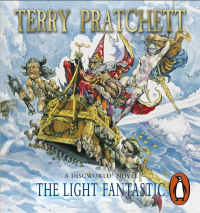

That’s in, since a lot of people say it’s not as funny as his later Discworld books, but anyway I liked it a lot. One thing I’ll say is that Pratchett clearly was influenced by D&D, as well as sword & sorcery fiction, and I imagine he would have been fun to play with back in the 1970s. (Though I think he’d moved on to other things by the time I was starting out playing in the 80s? I’m not sure.) That’s not to say these books read like someone’s D&D campaign: far from it, but they do read like comedic fantasy written by someone who obviously played D&D. Then again, the other day my son told me that later on, Pratchett got addicted to Lemmings, and played it to such a level of distraction that eventually he deleted the game from his computer. I guess he was into games in general.
It feels like what it is—a silly book from the 80s—but mostly in a good way. I had a lot of fun with this, sometimes laughing aloud as I drove along while listening to it, though it left me wondering what “real” Discworld books are like. I guess I’ll find out sooner or later, as I find these books great listening on my commute to and from work.
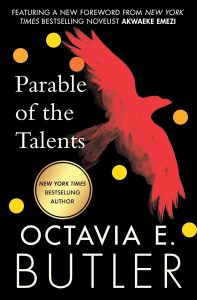

Compared to the previous book, in this one there’s more violence, more cruelty, more viciousness, and, hand in hand with these things, much more religion. A lot of that religion is the kind of fascistic/white-nationalistic Christianity that indeed does seem to be on the rise in the real world. Alongside it, the book manages to show us what an alternative religion, Earthseed, looks like—at least in its nascent form—while also critiquing it. The book manages to be critical of Lauren Oya Olamina, the protagonist of the earlier book, whose journals make up the majority of Parable of the Talents, mainly because there are a couple of other narrators whose point of view we see: a snippet from Olamina’s brother Marcos Duran, and a lot of commentary at the beginnings of chapters from Olamina’s kidnapped daughter (formerly Larkin, renamed “Asha Vere” after her abduction). Asha’s viewpoint is complicated: she’s seen the worst of the Christian America church that Marcos preaches for, but seems nonetheless to be shaped by her experience growing up in that religion, in a typical Christian American family. She’s pretty disgusted with Earthseed, and it’s hard not to see her perspective as expressing some of Butler’s misgivings regarding Olamina and her mission to spread Earthseed.
Olamina is a visionary, mind you. But visionaries are often not the most wonderful people on a personal level, and neither, for that matter, are a lot of badly traumatized people. The horrors that Olamina and her Earthseed community experience are also an explicit critique on Christianity’s role in the horrors inflicted upon the world in our history: slavery, misogyny, witch-burnings, oppression of communities, slaughter of anyone who didn’t follow their religion, and more. So.. Butler seems to be voicing criticisms of both Olamina and of Christian America. Where she comes down on Earthseed, I’m not so sure: the ultimate outcome of the religion’s mission is hinted at at the end of the book, in a way that is, well, ambiguous, or so it seems to me. (This seems to be borne out by the abortive attempts at a third book in the series that Butler started to write, but never finished, as mentioned in this article.)
In a way, I feel like the book is also on some level a critique of SF itself. Science fiction offers a drastically different vision of the world from traditional Christianity, and in some ways that divergence has characterized the split in modern American life: either you believe in science and technology, or you believe in Jesus and repudiate science (if not tech). The role trauma plays in the unfolding of Earthseed and Olamina’s, Marcos’, and Asha’s lives feels like an echo of the unresolved traumas that scar the creation and formation of America, too. The book is a litany of horrors, from sexual and homicidal violence to child-abduction. The little we’re permitted to see of these traumas makes it easier to sympathize with these characters, but also makes it necessary to stand back a bit, to see them with clear eyes, flaws and all, because one gets the feeling that Octavia Butler was, on some level, conveying a clear awareness that sometimes trauma irrevocably screws people up in ways that never heal and cannot be “fixed.” It’s not the kind of story that asks you to necessarily root for anyone over everyone else, or for one outcome over all others, and what would in some writers’ be a happy ending manages to be only sobering and haunting in Butler’s hands.
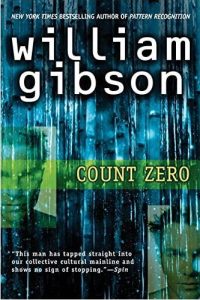

Still, I enjoyed Count Zero a great deal. It’s a twisty, multi-threaded narrative in which what first seem like widely separated plotlines intersect, with a heady mix of the technological sublime (its AIs are posing as deities from Haitian vodou) and the late-capitalist-dystopian, just as one expects from a cyberpunk novel. I got used to the self-consciously “cool” style of the prose, and eventually it sort of melded into the general aesthetic of the story for me in a way I found far less obtrusive than I used to. In other words, I finally “got it” what’s likeable about Gibson’s style, or rather, about parts of his style that I sometimes struggled to really connect with before.
It was especially enjoyable as an audiobook, because the reading by Jonathan Davis is just superb. I am eager to check out Mona Lisa Overdrive, the third in this trilogy.
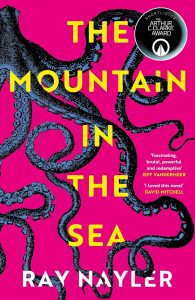

There’s a lot to love about this novel, and it’s stuck in my mind since I finished it—I devoured it quickly before leaving for Canada, and wished I’d brought my ebook reader with me so I could revisit parts of it. The way Nayler explores different nonhuman intelligences—a constructed being on the island, the AI running a fishing slave ship, the octopuses—and the cloak-and-dagger horror of corporate manoeuvring are all sharp as a fine knife’s edge, and even when the author occasionally slips into infodump mode, it was almost always still engaging enough for it not to jolt me out of the story. It’s not so much an optimistic future, but it is definitely whatever cyberpunk becomes when it intersects with biotech. Ecopunk? Biopunk? I dunno what the cool kids call it these days, but anyway, I loved the book.
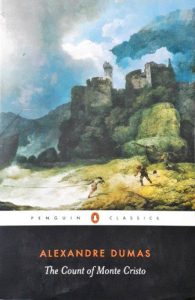
That said, I had only reached about page 150 by the time we arrived back home. However, I leaped straight in, in the hope of finishing the novel by the end of August. It was not that hard, despite the book being 1250-odd pages long, either, not even though that’s the longest book I’ve finished in some time. There are, of course, lots of tangents, and I did skim some parts—especially when I started feeling like, “This would have been left out or summarized if the author hadn’t been paid by the word,” (or line, or installment, or whatever the rate actually was), but I did that less than I expected. It was a pleasure to watch all of the Count’s plots and plans unfold slowly, and while some of them were a little predictable, this novel is a great example of how the pleasure of the tale lies in the telling. Most of the mysteries are easy to guess at, but one somehow enjoys seeing them unfold all the same.
As for the tangents, well, the book was originally published as a serial, and you can tell, not just by the length: there are so many twists and cliffhangers throughout it that I was actually surprised it hasn’t yet been adapted to a Netflix series. Despite its incredible length, and all of the tangents material, it’s still a compelling novel and deserves to be considered a classic, and it feels like it helped set the standard for a lot of popular narrative that followed its publication. I am now eyeing Dumas’ d’Artagnan Romances, to see if they excite and engage me as much as this novel did. Maybe that’ll be a winter holiday reading project, I don’t know. (But for now, I’m in the mood for shorter books again.)
Comics
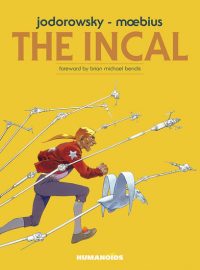

For me, the story was more over-the-top and jumbled than suits my taste, constantly ramping things up to higher and higher stakes and crazier and crazier extremes, and far too often the solution to every problem is, you guessed it, the Incal. Even with those flaws, though, I thought Moebius’ art is just gorgeous and the imagery is fantastic in places, and that made it worth reading even despite the shortcomings of the writing. I did find myself wondering what some of the outlandish titles were in the original French: “emperoress” instead of “empress” sounds weird in English, but I wonder what the French equivalent was?
I managed to pick up an almost complete series of Hergé‘s The Adventures of Tintin for a song—well, for ₩20,000, which used to be kinda-sorta close to $20 in Ameribucks, but now is more like $13.50, sigh—and when I added in a couple of stray volumes I had, we ended up with the complete line except the first two volumes (Tintin in the Land of the Soviets and Tintin in the Congo, neither of which I really want: the first supposedly is just bad and the second is offensively racist) and one later volume, The Castafiore Emerald. We’ll pick the latter volume up when we get to it, as we’re going to read the volumes in chronological order.
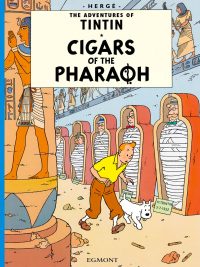

The Cigars of the Pharaoh specifically was a fun read. The art is lucid and fun, the fact that Snowy is a speaking character, the twists and turns of Tintin’s adventures—all of it was really engaging for both my son and for me too. Although we started this because I was trying to kickstart and interest in reading English language comics for our son, and he was somewhat resentfully aware of it, it didn’t take long for the comics to pull him in and get him interested.
Now, if only someone in Korea would sell the full run of Asterix & Obelix comics in English, we’d really be cooking! (I’ve seen full sets in Korean, but only ever saw one English language set, and I only saw that one after it had sold… though it sold for much more than it was worth, and I wouldn’t have bought that set anyway.) I might just have to buy a new boxed set of the series once we finish with Tintin. But that’s still some time away for now, with us only getting through like 10–12 pages a day.
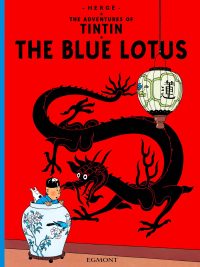
In the end, though, it was a fun adventure and, given some of the problems in some of the earliest Tintin books, it was surprisingly decent ant even arguably anti-racist (for the time) in its treatment of China (and Japan) in the 1940s. That said, I did have to stop every once in a while to talk with my son about how Hergé depicted the racism of the era, and the grandiosely propagandistic ways of the Japanese Empire besides.


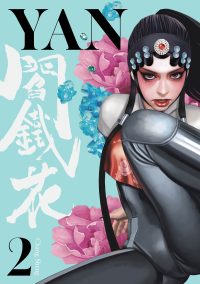



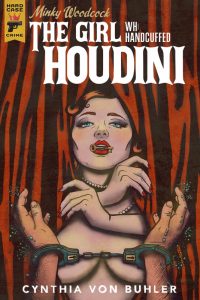
I also read the Cynthia von Buhler’s “Minky Woodcock” series of graphic novels, starting with Minky Woodcock: The Girl Who Handcuffed Houdini, followed by Minky Woodcock: The Girl Who Electrified Tesla and finally Minky: Woodcock: The Girl Who Called Cthulhu. Again, these were available via Hoopla, and I actually read them out of order, not realizing the third book was part of a series.
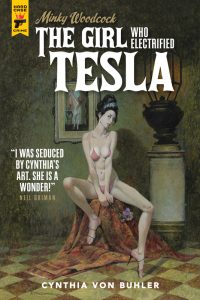
The series’t title character, Minky Woodcock, is a private detective who’s taken over her dad’s detective business. She has brushes with famous historical figures such as Harry Houdini, Josephine Baker, Nikola Tesla, H.P. Lovecraft, and Aleister Crowley, and Ian Fleming. It’s an exuberantly sexual series, it’s worth noting, for those who are put off by such things. Personally, I think those bits establish Woodcock’s character and are only a little gratuitous.
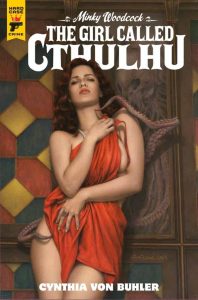

I enjoyed the series, and appreciated Von Buhler’s dedicated research, detailed in the back pages of each volume. While Woodcock is an invented character, the author put painstaking effort into researching the time period and the weird intersections between famous figures of the time, using them as grist for her narrative mill. It was also nice to get a glimpse of the behind-the-scenes process for the art in these books: Von Buhler uses models for drawing, and in the back pages, there were sometimes photos showing how elaborately dressed up her models were for at least some scenes.
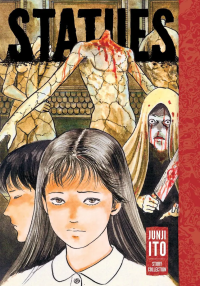

I especially liked the last story, “Suicide Note,” as well as “Town of Maps,” and “Die Young,” and the opening story, “Red Thread.” As always, Ito mines anxieties, especially anxieties of the young, those tied up with being young and worrying about one’s looks, the faltering of early romantic relationships, teen suicide, and relative poverty at the start of a marriage. In the stories I’ve mentioned, I found the anxieties work worked over more effectively than in some of the other stories, that’s all.
RPGs

That’s not to say it’s not a worthwhile read (especially since it’s so short) so much as to say that this is probably a testament to Laws’ insights and contribution to RPG theory. Of course, it’s also because a lot of the GM advice here is pretty sensible and straightforward. If you’ve been GMing for a year or two and still haven’t sampled the firehose of GM advice online, some (or a lot) of it will blow your mind and help you a lot. If you’ve been GMing for a decade and put effort into getting better at it, or if you have sampled from that online content firehose, then a lot of it won’t be so new to you, since you’re not exactly the intended audience. (The original intended audience lived in a world without Youtube and with scant RPG spaces online, of course.) That said, I’m a pretty experienced GM and even I found a few useful reminders of things in its pages.
One of the issues with the book is that a lot of the advice is great, but requires a person who is already a good communicator. If you’ve looked at any of the Reddit subs related to RPG advice, you will see that this skillset isn’t necessarily one that RPG fans universally have. (If you haven’t, take a peek and you’ll quickly lose count of the number of times someone comes looking for advice when the obvious problem is poor communication.) Of course, it would be a bit much for the book to offer a masterclass in effective communication skills, but since so much of the advice assumes good communication skills, it’s going to be a mixed bag for some GMs. That said, if you have decent communication skills and the maturity, I think this can help you along the road to becoming a better GM if you’re in the right place for the advice it offers, probably somewhere early in your GMing “career.”
I’ll note that I definitely have a reprint with a few updates, as the original version of the book dates back to the beginning of the century, but Laws’ bio mentions games he designed much more recently than that, such as Hillfolk. When I noticed that, it struck me that it would be interesting to see aa more thorough and expanded update from Laws, filled with new insights into GMing and what he thinks now, more than two and a half decades after he wrote this book, summing up what he’s figured out since and thought through as a GM and designer.

It’s a pretty interesting game based on the Forged in the Dark system. I say it’s interesting because it’s fairly close to Blades in the Dark in terms of fundamental design, but also diverges in ways that I found quite intriguing. The magic system, for example, I found far preferable to the magic system in the other FitD hack I know well, Runners in the Dark (the not-Shadowrun FitD game I’ve been playing for a year now). Likewise, the play loop is a little different, and there’s a whole territory maintenance loop involving the upkeep and expansion of a dungeon, which is a cool subsystem built off the original game’s turf system, but taking it to a new place.
That said, the book could be laid out a bit better. It’s frustratingly scattered, with organization being… well, haphazard in a lot of places. We ended up spending two full sessions (albeit relatively short ones) creating our characters, populating the local map with factions, and designing our dungeon, and at least some of the reason it took two sessions was because we so often had to hunt around in the rulebook to figure basic things out.
We’ve started playing the game, and are having fun with it, though. If you’re cool with being a bad guy in your FRPG, you could do much worse than Wicked Ones… as long as you’re used to FitD and willing to bear the pain of having to navigate a somewhat disorganized book.