


- Books Read 2025: January–February
- Books Read: March–April 2025
- Books Read: May–June 2025
- July/August 2025 Reading, Part 1: Fiction & Nonfiction
- July/August 2025 Reading, Part 2: RPG Books
- September/October 2025 Reading
- November/December 2025 Readings
- Best Reading of 2025
Here’s what I read in July and August of 2025. Finally, I had the chance to finish up some books I’ve been reading for ages, along with reading some new things I just recently discovered. One note: I’ve separated RPG books from everything else, since some people are not interested in that stuff.
Fiction
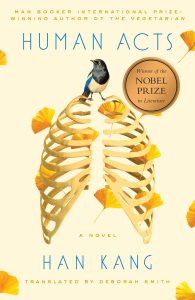

Han Kang’s Human Acts is a haunting collection of linked short stories, all dealing with the horrors of the Gwangju Massacre and its aftereffects on the lives of the survivors. Yeah, it’s a depressing book, which makes it a challenging read: what happened was so terrible, and the son of a bitch responsible basically went on to live out his life with scarcely any consequences for his horrific actions. The book is an indictment of his memory, an indictment of every individual who plays both sides about his dictatorship, and an indictment of every idiot who, yes, even today, defends the massacre—for there are still people who do so, despite all evidence about it being an indefensible crime against humanity. I personally think of such people as akin to genocide deniers and the monsters who oppose any recognition of the legacy of slavery in their own nations. I mean, there was a massacre of civilians by soldiers at the behest of Chun Doo Hwan and his government. That’s not contested: the idiots just argue that the massacre was justified because it was a Communist incursion. (Which… spoiler: it wasn’t one, they’re just the kind of morons to label everything they don’t like “communist”.)
But as enraging and horrifying as the subject matter is, the book is also written gorgeously, which only makes it that much more haunting, and this is part of what makes it “readable.” Kang understands that an enactment of the historical facts is not enough; that a melodrama would not do justice to the injustice; that the Gwangju Massacre is an event the tentacles of which spread through South Korean society and still clench at countless throats even today. In the face of that, and in the face so many denialists, what recourse does a writer have? I think Kang’s answer is that the writer is able to give voice to the lost, to the murdered, to those whose voices were choked out of their throats in secret torture rooms, or under the weight of constant police attention. She gives them voice the best she can, even basing much of the narrative on documents and images from the event itself. The spirits she summoned up haunted me for days after reading the book.
It’s not an easy read, nor is it a light one, but it is one I strongly recommend to anyone even remotely interested in modern Korean history. I fear it also might be a foretaste of what’s to come in a lot of societies worldwide, now that fascist autocracy is back in style and far-right lunacy is somehow back within the pale in too many places.
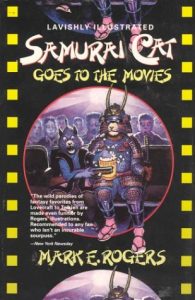
Mark Rogers’ Samurai Cat Goes to the Movies is… well, more Samurai Cat. If you’ve read anything in the series, you know what to expect: dreadful puns, loads of cheesy parody, hyperviolence, and some amusing illustrations, and honestly fairly flimsy prose.
Like The Sword of the Samurai Cat, this one is unfortunately more focused on the flimsy prose and has far fewer pictures than the original books in the series, and the art it does include is only black and white at that. It makes it very apparent that the full-color art in the first three books were most of what made the original books fun, but it’s a light read and that’s what I was looking for that at the time. I found that parts of it aged really poorly. (There’s a particular line about a parody-of-Milli Vanilli group that shocked me, and there’s a lot of racial stereotype stuff—especially the jokey rendering of speech by nonnative speakers of English—though of course this being parody and satire of Hollywood films, and having been written in the 1990s, none of these blemishes is particularly surprising.)
The real sin committed by the book, though, is boring me. Honestly, I was skimming by the last hundred pages. There still were a few laughs to be had, but, like I said, you need to be in the right mood, and I guess these days I find that specific mood hard to sustain for too long. (A faster reader likely wouldn’t have this issue.) I don’t know when I’ll get around to the last book in the series, despite having it right there on my shelf. There’s just so much great stuff to read, after all.
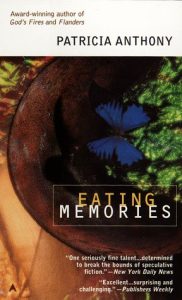

Some of the stories were rather forgettable, but some of them are haunting and I’m sure will stick with me for some time. Hell, that first story in the book, “Blood Brothers”? The concept (of dinosaur humanoids who developed an advanced technological civilization before dying out, millions of years ago) has stuck with me for almost three decades, after all. (I read it in the late 90s, and I’ve never forgotten it.) Another favorite was “Dear Froggy,” a self-consciously Victorian-styled story where a woman meets… well, a kind of amphibian humanoid being in some kind of weird invisible “room” out in her garden. It’s bizarre and memorable. I also loved the last couple of stories in the collection especially: “Two-Bag Goddess” is hauntingly horrible, and “Scavenger Hunt” is weird and familiar all at once. “Lunch With Daddy” was also quite striking, as were “White Boy” and “The Secret Language of Old White Ladies,” though, again, this is stuff that was written in the nineties, and it’s surprising how stuff from such a recent period has aged.
There was a time when I’d have said Patricia Anthony was too soon forgotten by the SF world, but I know she wasn’t completely forgotten: there was some energy put into trying to get the rights to republish her novel Flanders, about a decade ago, for example. (I have yet to read it, but many people say it’s her finest book.) I don’t think the republication ever happened, though. I think most of her novels are available in ebook form, and as old paperbacks, but there are a few later novels—like The Sighting, and something else she worked on toward the end of her life—that don’t seem to be obtainable at all now. (I emailed the publisher of The Sighting, but never heard anything back about it.) Ah well, I still haven’t read all of her available novels yet, so maybe I should worry about reading those first. (Cold Allies, Cradle of Splendor, and Flanders are the ones I haven’t yet read. That said, I’d also like to give Brother Termite another look, as I read it and was impressed by it back in the 90s, and I’m curious how I’d feel about it now.)
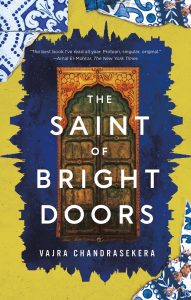

Back in June, I checked out Vajra Chandrasekera‘s The Saint of Bright Doors. I’d seen some buzz about this novel and Chandrasekera’s follow-up, Rakesfall, so I was curious to check them out.
The book was starting to suck me in when, suddenly, my 13-year-old Kindle Paperwhite died. I had to wait till I got a new ebook reader before I could continue, which was a bit tortuous, to be honest, because I was quite interested in seeing where the book headed next…. but reluctant to start reading it on my phone. When I was once again set up with an ebook reader, I realized I’d made a terrible mistake: the damned thing had no backlight, whereas mostly I use Kindles to read in bed, in low light. Argh! So it took me a while to get back to this, but I’m so glad I did.
It’s a bizarre novel, one that repudiates any kind of categorization. It’s “fantasy” set in another world, a world of “chosen” messiahs and magic and devils and the mysterious “bright doors” of the book’s title, a world far different from ours, and yet it is a modern world—one with dating apps and crowdfunding campaigns and concentration camps and many other features of our own world. I’ve seen this before, of course, but never in a way that also manages to blend in aspects of another culture, for there are unmistakeably South Asian elements in the story: some of them material, like the tuk-tuks, and some more conceptual, like the existence of a caste system in the cultural sphere where the story takes place. All of this combines to make the setting really vivid and compelling, lending it all an air of, hm, simultaneous otherness and familiarity, I suppose is how I’d put it? I found Chandrasekera’s willingness to draw on all these things, to include them in his imagined world, quite refreshing. The story also comes with a killer surprise near the end, which I won’t spoil here, but which I feel silly for not seeing coming. (I’m the kind of reader who often doesn’t see things coming, I confess.)
The novel has a lot of dark stuff in it: pogroms, a plague all too reminiscent of the one we recently lived through (and which lingers, though we pretend it doesn’t), political and social chaos of the kind we’re currently living through pretty much all over the world, and familial conflict on an epic scale. And yet it also manages to be fascinating and difficult to put down, as we see the character Fetter wander through life as an expatriate—something Chandrasekera captures wonderfully, by the way—to life as an apparent political prisoner, and beyond to other roles I again am reluctant to spoil here. It doesn’t hurt that Chandrasekera’s prose is just gorgeous, of course. Anyway, it’s obvious to me why this book made such a splash when it was published, and I’m curious to check out the author’s follow-up, Rakesfall, which I have loaded on my Kindle and hope to get to before year’s end.
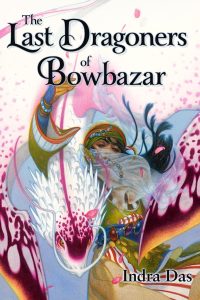

The book is exquisitely written, evocative of the multiculturality of modern India, of biculturality, of youthful love and longing, and so much more. It’s a wonderful book and I recommend it.
Nonfiction
The last couple of months, I only read a couple of nonfiction books (not counting tabletop gaming-related books, which I’ll cover in another post), but they were big, heavy ones that took me a lot of time to get through.
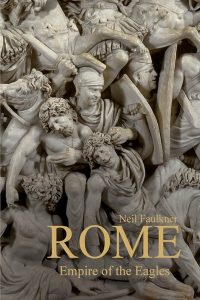
That said, as the book went on, my interest waned somewhat: the last hundred or so pages were, for me, a kind of litany of emperors and battles and corruptions. It all became a bit overwhelming at some point and I began skimming while on the lookout for any more of Faulkner’s trenchant asides. It’s an unconventional history at points, but it still is burdened by dates and places and grand sweep to a degree that I kind of lost focus. Little wonder: covering more than a millennium of Rome’s history in a single book is a tall order, and maybe the problem is mostly with me. But Faulker’s writing shines brightest when he’s telling us how he really feels—and how we should realize it is possible and even important to feel—about the Roman Empire (and by extension empires in general, regardless of their propagandizers), and those kinds of moments are much more pronounced toward the start of the book than toward its ending.
The Dawn of Everything: A New History of Humanity by David Graeber and David Wengrow is one of those books that everyone seemed to be reading for a while (I think it was last year, or maybe the year before). This is my first time hearing of Wengrow, but Graeber’s been on my radar for a long time, although I think this is the first thing by him that I’ve read.
That said, it’s not perfect. I’ve read a number of critiques (and watched some on Youtube), especially of the early sections of the book, about what Graeber and Wengrow apparently get wrong about Rousseau, state of the art thinking regarding anthropology and paleoanthropology, and more. It’s obviously far from a perfect book, which is hard to say because I think its authors’ hearts are in the right place. That said, no book is perfect, and I think there are many useful insights in its pages, especially those in Chapter 10, which is concerned with our obsession with “the origin of the state”: Graeber and Wengrow argue convincingly that we’re far too teleological in how we think about this concept of “the development of statehood,” not just because defining statehood is elusive, but also because the way we tend to do it celebrates particular (often oppressive) kinds of social organization while demoting anything else to “periods of disorder” or “proto-civilization” rather than valid and sometimes long-enduring forms of organization in themselves. A lot of their arguments depend on speculation in the absence of evidence, which always sets my alarm bells ringing, but nonetheless they do manage in places to argue that there’s no more evidence for the conventional history than there is for their unconventional conceptions.
My main issue with the book, as I read it, was an uncertainty about why all of this really matters. Graeber and Wengrow are right that we are “in the presence of myths” when it comes to our historiography and our conception of the ostensible arc of history within the context of the emergence of “civilization[s].” It’s good to disabuse us of myths, of course. But I’m not convinced we need any historical evidence that radically different forms of social organization thrived in order to argue that we need to move beyond the form of organization we have, increasingly globally, ended up with. Even absent the prehistorical and historical evidence they present, we still need to look for, and push for, possibilities beyond what we’re living through, and humans can come up with models for how to do that even in the absence of historical examples, right? Even if precedents and exemplars from the past might be useful, it’s not as if, in the absence of historical alternatives to the narratives and systems we’re used to, we would be obligated to give up the idea that alternatives are possible, after all. I think Graeber and Wengrow’s response to all this would be that, sure, that might be true, but by looking at the past, we can see the genealogy of ideas that have facilitated and promulgated our widespread sense of “being stuck” in our current paradigm, and we can see that history is much less a march towards “civilization” of an authoritarian sort and much more follows a sort of pendulum-swing between the adoption of such systems, and their rejection alongside the embrace of freedoms (to move away or relocate, to disobey, and to choose to reconfigure one’s social relations) that we no longer even realize are possible for groups of humans to share—that we take for granted that giving up those freedoms, and living with top-down power structures, control, and state use of violence, are all inherent costs of admission to a complex, “advanced” society.
This is a very thick book, and it’s a “grand history,” which, if you’ve read any grand histories before, you’ll come expecting problems and errors and a certain tendency to read the world through the authors’ political perspective. I think the liberating thing about this book is that their perspective is dubious of the conventional, deep-down authoritarian/capitalist underpinnings of how our history and prehistory have been written. It would just be more liberating if they had made fewer errors early on, and hadn’t depended so much on what “might” have been in so many parts of their arguments. (Even if, since they’re talking about prehistory, might is all anyone has in a lot of cases.)
Whatever my objections, though, I am impressed and will be looking for more books by these authors, such as Wengrow’s book on monster imagery or Graeber’s more widely-known works like Debt: The First 5,000 Years or especially Bullshit Jobs.
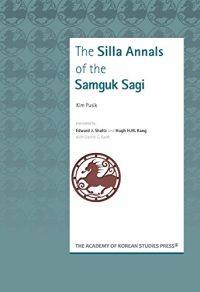

After that—around the time of King Munmu, in the 7th century—things start going into more detail and not surprisingly they also get more interesting, at least if you’re interested in knowing more about ancient Korean history. It’s still mostly enumerations of beheadings and tribute sent to China, as well as the last will and testaments of many of the kings in the era, but there are a lot of “miracles” recorded too: presentations of white animals (magpies, crows, and so on), auspicious mushrooms, celestial phenomena like eclipses and comets and astrological events, the births of triplet boys, and so on. Honestly, I skimmed the whole book, but there were a lot more points to slow down and pay attention after about the first hundred-and-fifty pages or so.
Silla is one of three ancient kingdoms (literally “samguk” means “three kingdoms”) on the Korean peninsula, and I have the volume collecting the Koguryǒ Annals as well. I don’t have the volume for the third kingdom, Paekche, since the last time I saw it, it was quite expensive. Therefore, I suppose when I do follow this up, it’ll be by reading the Koguryǒ Annals next.
Graphic Novels
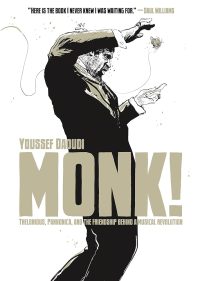

Youssef Daoudi’s Monk! Thelonious, Pannonica, and the Friendship Behind a Musical Revolution was recommended to me by my buddy Marvin Long. It’s a graphic novel about, well, the title kind of gives it away, right? I’m a big fan of Monk and his music, and until my practice regimen was obliterated by way too much work, I’d begun to dig deeper into the Monk songbook. I knew some of the stuff covered in this book, like Monk’s later years, and some of his idiosyncracies, but it was interesting to learn about other bits I knew less about, as well as to learn about his friend and patron Baroness Pannonica de Koenigswarter (“Nica”). I’d heard of her, of course, and noticed the various songs named after her, like “Nica’s Dream” and Monk’s own “Pannonica,” but I didn’t know much about her life beyond that she was a jazz fiend and a major patron of jazz music in New York.
The book is about their relationship as much as it is about Monk’s musical career, and it’s beautifully drawn. Hell, it inspired me to track down a copy of Robin D.G. Kelly’s biography of Monk, because I found myself wanting to know more, even though I knew a fair bit about Monk even before reading this graphic novel. Which is to say, I recommend it!
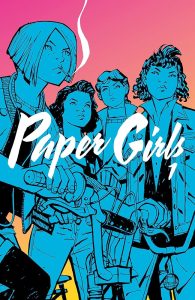
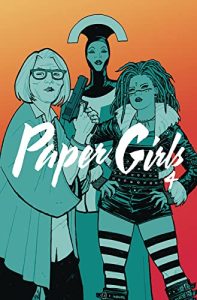

The characters kind of fit the title: they’re not particularly deep or developed, though we do see them grapple with personal issues as they go along… a little. Most of their grappling, though, is with the weirdness of time travel and of encountering their future selves.
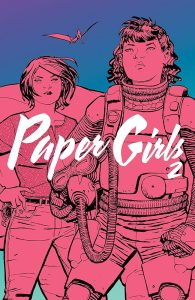
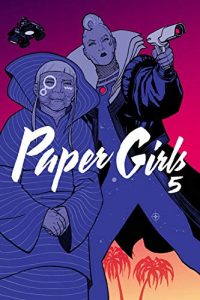
The other thing that’s notable to me is how, given enough action, stuff that I would normally pause and dwell on just sort of disappears in the rearview mirror. Paradox issues? Thin characterization? Cheesy futurespeak? The fact I barely understood what was going on as more and more story threads were tossed in with each volume? Eh, I barely registered any of those things, because the gas pedal was firmly pressed down as far as it goes, driving the engine of this story at breakneck speed toward its conclusion. I mean, it’s not a great revelation to me: action movies work the same way, right? But it was interesting to see it at work in another medium, because I rarely read fiction that feels or works like this.
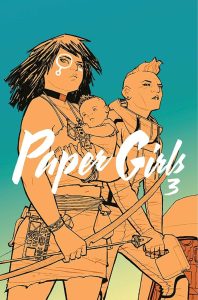

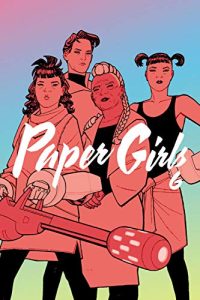
(And I’m still not that much of a comics reader, so it’s really saying something.)
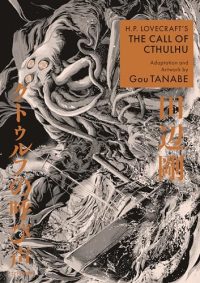

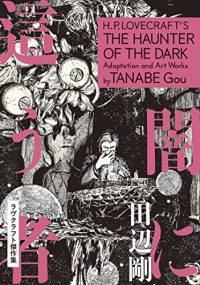

I plan on checking out more of Gou’s Lovecraft adaptations in the near future.
I guess that’s it for now, but I’ll post soon (and update with a link here) regarding the rest of my reading for July and August: the RPG books I read in the last couple of months. There’s a lot of them, and I have a fair bit to say about them, so it turns out it’s a good thing I separated them into a different post!