


I recently posted about the fiction and nonfiction I red in July/August here. That’s only half the story, though: I also tore through a bunch of RPG books this past couple of months—mostly at the end of June and going into August—and that’s what I’m going to discuss in this post.
(I’ve split this the two posts up because I know some people are more interested in reading about RPG books, and some aren’t at all.)
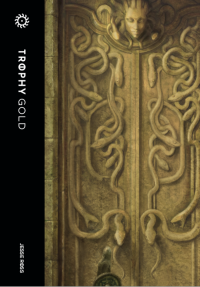

Trophy Gold is an RPG by Jesse Ross that I’ve been interested in running for some time. I’ve had a copy of the print edition for a while, and even ran Trophy Black a couple of times last year (though it seems I didn’t post about it), but Trophy Gold is supposed to be less one-shot oriented that Trophy Black, and it’s supposed to be built to allow for a more OSR-styled sensibility. Characters aren’t doomed to die in a single session, but they are trapped in a probably-unsustainable cycle of needing to go out and forage gold from the dark places of the world.
The system is very familiar from Trophy Dark, though it has a couple of differences. I haven’t gotten to play this, so I’m not sure how those differences work, but I have to say I enjoyed Trophy Dark… yet I’m not sure how well Trophy Gold would work for a group that is focused on OSR play, or how well it’s scratch that itch.
One thing I wish is that it had clearer guidelines—like, say, an actual example—of how to convert an old-school module to a Trophy Dark Incursion. (Aside from this one example, I haven’t actually seen any examples even online.) I’m sure it wouldn’t be too hard, but it just feels like the kind of thing that could and should have been included, even just with something like a unique one-page dungeon built for the example, or something. That said, there is an example of a campaign-length Incursion at the end of the book, and maybe clever GMs can just infer how to do it from that. I suppose the true test of whether it’s needed would be to take an old-school-styled adventure and convert it, and see how the process goes.
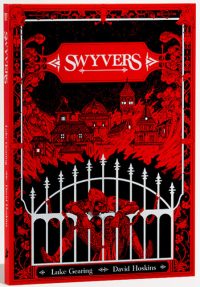
I would say that for people who want to do Blades in a more old-school system, but with a wildly different magic system, this would be the optimal game for you. If you’ve played a lot of that other game and your game group likes that system, you might have trouble getting it to the table, though, because Swyvers promises to scratch a lot of the same itches as playing in Duskvol does, except with the comfort of old-school (nu-school?) mechanics. For me, though, the attraction was basically just having support material for maybe someday running a game in early Georgian London, for which I think Swyvers would be a very good fit.
Included with the hardback was a small booklet outlining the Marlough Docks, also penned by Luke Gearing. Just as the adventure in the back of the rulebook is a good example of what an adventure in Swyvers can or should look like, Marlough is a good example of what your setting notes for various bits of the city could look like, in terms of flavor and dark sense of humor. I think I’d like to run this sometime, maybe as a short season of a game, sometime, especially as I’d like to see how the magic system works in play. But even if I don’t, the tables will be useful for any old-school thing I do happen to run.


The rules seem smooth and fun, and the play cycle will be familiar to anyone who’s played Blades in the Dark or any other FitD game: downtime, here, is time on the road, traveling from one section of the country to another. Yes, “the country”: the game is firmly set in the United States. It’s a little funny to me that the map expressly is marked “No go!” for Mexico and Canada, but of course I understand Bushman’s need to keep things focused, instead of detailing the whole world. That said, it would be relatively easy to homebrew regions for other places. I’m tempted to homebrew some for Canada, just because I’d love to run players through a game where they could start in Boston, end up in Ontario, go through Saskatchewan, and end up in Portland or Alaska.
I’m a little less crazy about the humanoid, and somewhat human-like, aliens: it makes them a little less weird and mysterious to me. (That said, I can see why Bushman went that way with them: a lot of the region/faction play depends on aliens that are at least somewhat comprehensible to humans. If you were to spring something more like the aliens in “Story of Your Life”/Arrival, say, it’d be a lot harder to run things with factions, with aliens who have turned on their fellows’ colonial goals, and so on. Still, I have some ideas about how I would go about reskinning them if I were to run the game.
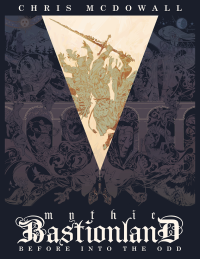

Just as Electric Bastionland was mostly made up of simple character templates that revealed a ton about the world, Mythic Bastionland is made up of two-page spreads that lay out, on the one side, one of the 72 wonderful (and sometimes very weird) player character templates available, and on the other side, one of the 72 compelling (and often also very weird) myths that characters could encounter in their journeys. Those spreads do a ton of the worldbuilding, and are what elevate this from Arthurian roleplaying in the style of Pendragon, into something much weirder and more mythic-feeling. The stories you’re going to get out of these are much more freaky than modern reimaginings tend to be, though if you were a fan of David Lowery’s recent-ish film The Green Knight, that’s pretty close. It put me in mind of Sir Gawain and the Green Knight, the Lais of Marie de France, and other actual Arthurian romances I’ve read. Magic here is freakish at times, and dark and mysterious almost always, and being a virtuous hero guarantees you nothing much when you’re faced with it. Every Knight is connected with a Sage, and all 72 Sages are all truly bizarre, mostly terrible, and important to your Knight character.
I’ve only played a one-shot so far, though I’m gearing up to run it for one of my regular groups. In that one-shot, it was great. The slightly added crunch in the combat didn’t feel like it interfered much with the rules-lightness of it, the roleplaying prompts were solid, and we all got into character very quickly. I will say that the design is quite brilliant, with everything included geared toward being useful at the table while running of a Mythic Bastionland game. The rules are a little heavier than in Into the Odd or Electric Bastionland, but only slightly, and that’s because the game needs to accommodate a few more moving parts than those other games, and to accommodate a more martial style of play—this is, after all, a game about knights, as in, trained killers. For those familiar with it McDowall’s other games, included is a summary of the differences between each ruleset—not to mention a wonderful example of play in the form of an annotated text, at the back of the book. There are also little snippets of imagined play accompanied by author commentary, which I found quite valuable in providing me with a sense of how the author imagines the game to work like in play. (Not that we can’t do our own things with games, but knowing the author’s intention helps us understand the rules and systems and why they are designed how they are, which is useful even if you decide you want to hack it a bit.) I can’t wait to run this and see a mythic adventure unfold before me!
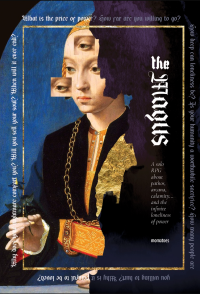

Here’s what I posted about it earlier. It was great fun, and I recommend it to anyone who’s interested in a solo journaling game involving magic.
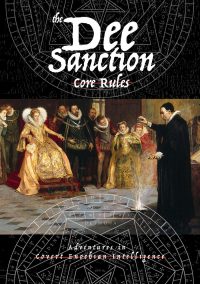

Though its rules remind me in some ways of other rules-light games—randomly rolled characters have three stats, skills are vague, and spells are flexible if weak—it uses its own system that feels a bit like a fusion of the best simple rules from a handful of other sources. For example, there’s an “Unravelling” mechanic that’s a bit like the sanity loss mechanic in Call of Cthulhu or Stability tests and Sanity loss in Gumshoe games, and the way basic stats and action rolls depend on die types (and advantages and disadvantages cause you to step up or step down by a die type) is something I’ve seen in a few indie games—such as, if I remember right, Kids on Bikes, for example. (I think it was in Kids on Bikes that I first saw such a system.) Hit points are abstracted to “hits” and “conditions”; conditions multiply into hits, and hits can leave you incapacitated. (There’s even a kinda-sorta death saves rule.) The introductory adventure provided in the rulebook is much simpler, and gives a pretty good idea of the kinds of adventures you might have in this game, and you gotta love a game that you can read the rulebook for in an hour or two.
It’s a neat little system—and by “little” I’m not being condescending, but rather I mean that it’s quite rules light—even though occasionally I found myself struggling with clarity. Usually, it was that a term that was used on one page, but then explained a couple of pages later, or briefly introduced earlier in passing and then referred to again with more importance. (Baldowski’s working on a second edition of the rulebook after a successful Kickstarter campaign earlier this year, which I’m sure will sort out those occasional problems.) Occasional clarity issues aside, it seemed like it would be a fun, light system, swingy but also built to let characters do a lot of cool stuff. (On your toughest rolls, your chances of failure or complications are just 50%, while on the easiest of rolls, they can be as low as 16.7%!)
Running it, I hit a few snags in terms of rules, though it might just be that I’m not used to the system yet. (The climax of the adventure I ran had a pretty rough win condition, where characters had a roughly 4% per “moment” (round) chance of finding the thing they needed to find to win, though as designed the chances improve slightly with each attempt. Still, we had fun with it anyway.) I like the idea of NPC/monster attacks involving a random element in terms of result—like, you roll or pull a card to see what effect a successful attack has on a character—though the spread between the weakest and the strongest attack is wide, and there’s usually even probabilities of each option, something I’d likely tinker with if I were running the game for a full season or campaign or whatever. But the general rules chassis is quite good, and I especially like the concept of stepped dice tied to abilities, with steps up or down to reflect difficulty for attempted tasks. The backgrounds are fun and weird, and though it takes some getting used to, the angelic gifts (this system’s equivalent of spells) are very open-ended and could potentially be very fun to play with. We had a good time despite being new to the system. (And despite my being slightly scattered while running it, as usual.)
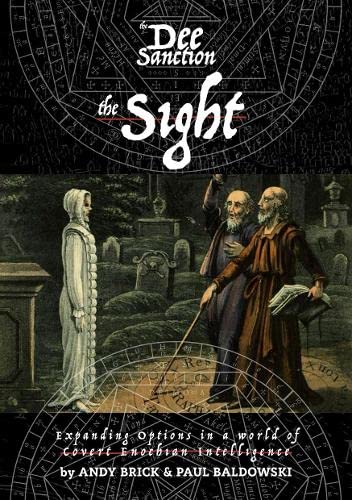
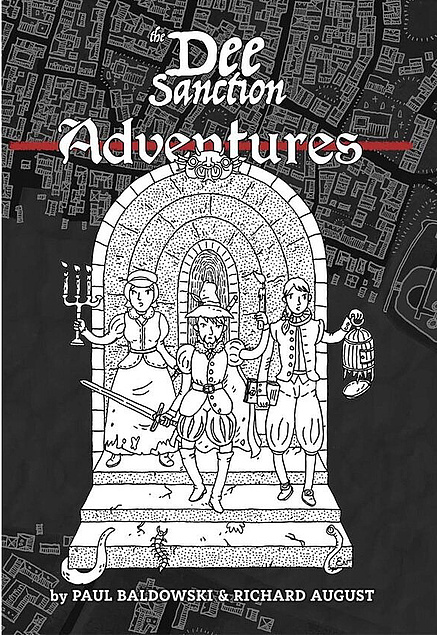
(The thing about these mysteries is that they’re designed so that the PCs have to go to the right location to find the right clue which will send them on to the next location and the next clue. It’s a kind of adventure design that’s a bit more old-school, and depends at certain points on players guessing the right location for a crucial clue, else they hit a brick wall and end up frustrated. I would be inclined to try make a list of available clues beyond what’s in the adventure, and be flexible within reason about where those clues are turned up, just as an insurance against this kind of thing.)
I did, however, appreciate the little writeup at the start explaining how these disconnected adventures could be used within the context of an ongoing campaign, even though they were never written with that in mind. It’s a helpful set of suggestions that really illustrate what a campaign with The Dee Sanction could look like, which is to say that the writeup is useful even if you have no intention of running these particular adventures in a single campaign.
By the way, if you’re interested in The Dee Sanction, be advised that a new edition is in the works. The Monad Edition campaign on Kickstarter back in April was a success, and you can still become a late backer if you want at that page. The new edition is and expanded one, and includes more adventures and details about the world of John Dee, as well as some rules changes that bring the game closer in line with the rules refinements in Sanction. (I’ll have to check out my copy of that soon.) Baldowski has also blogged about the game at its dedicated website.

The game was celebrated back in the oughts, apparently, and even into the following decade. It has a sort of complex, and possibly slightly unwieldy, dice pool system—one complex enough that you can find postings online from people struggling to figure out how to program die rolls for it on Roll20. Basically, your character rolls multiple different-colored pools of d6es representing their Discipline, Exhaustion, and Madness. Every roll under 4 is a success, but the die that rolls the highest number (or the pair, in a case of ties) indicates which pool “dominates” the action, with consequences. Meanwhile, the GM rolls only one kind of die: pain dice, which fluctuate with the difficulty of an action, and which the player has to beat in terms of the number of successes. There’s a push-your luck dynamic, as players can add exhaustion dice (permanently) to their pool—risking a crash if they add too many—or add temporary Madness dice, and reduce their Discipline rating—risking the accumulation of permanent madness dice, leading ultimately to a mental breakdown. Pain dice, when they dominate, manifest as pain for the character. That’s the basics of the rules system, and it looks like someone figured out a decent character sheet/die roller for Roll20. I’m curious about how it runs, but have a sneaking suspicion that the added complexity isn’t necessary to get the same effect in play. (Nothing against giving players a lot of plates to keep spinning, it’s just I prefer to do that in the form of narrative content, rather building it into the mechanics.) On top of the business with the dice, there’s also a meta-currency with Hope and Despair coins—inversely linked luck tokens that can be spent by the players and the GM respectively to ameliorate or worsen the effects of failed rolls. (The GM spends Despair tokens to mess with the player characters, which gives the players Hope tokens they can use to take some of the sting out of failures, improve bad rolls, or rid themselves of accrued exhaustion or madness.)
Personally, I’m very curious about how it plays, and am interested trying the game sometime. I’m prepared for it to be an interesting experience even if it ends up being slightly frustrating or disappointing. Any disappointment ought to be tempered by the fact that the design is almost twenty years old: of course it doesn’t run as smoothly as it might if it were designed now, because it came at a time when its author had much less to draw upon when crafting its mechanics. As far as a trial run, I’d probably rather play it than run it, if I’m totally honest, but chances are that if I want to try it, I’ll need to run it myself. The other thing is that I’m not sure what I think of the default setting of the Mad City: the punniness seems like it could wear a little thin quickly, and I’d be tempted to build a setting that keeps the surreality and horror, but does away with the nudge-nudge wink-wink cutesiness of the setting. It’s not that the Nightmare NPCs in The Mad City aren’t dark, but there’s a kind of grim cuteness to them that comes from the puns in their names, like Mother When and the Ladies of Hating, or the Tacks Man, and so on, and I’m not sure how I feel about it.
(Someone asked me a couple of days ago what I thought of Mörk Borg, and my response was that as someone used to loosey-goosey OSR/NuSR-ish games, it’s just another flavor—a pretty pronounced flavor—of D&D-like system, easy to port over to whatever game one might want to play.1)
And so it is with Fe Borg. I get the feeling it’s a bit like The Ghost Hack, inspired by a certain White Wolf game, but it’s quite different in practice. The rules are generic OSR, but the content is dripping with flavor, and the setting is the Otherworlds—the fae lands, in which your human characters find themselves. The character generation, as with any Borg-like game, is a highlight, with tons of compelling options and details that suggest the wider world without subjecting you to a Lonely Planet writeup.
There’s an adventure included at the end, though without a map, and I found it a bit difficult to really figure out how the locales (called “Rooms”) are linked to one another. I mean, I could probably sit down and draw up a map or pointcrawl for it, but it’d have been nice to have it in the book. It’s a curious omission for a book so loaded with art and with good design decisions. (And, really, other than a couple of letters in the main header font, this is way more readable than Mork Borg, despite following it in being a mad welter of typefaces and page layouts.)
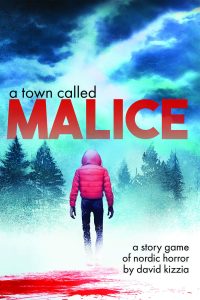
For those who find Fiasco is just a little too freeform for them, I think A Town Called Malice is a cool system. I’ve never had a bad game of Fiasco, but I have occasionally struggled to keep the game on track, and the light but visual and tactile mechanics added by Kizzia’s hack would, I think, help address this. Having only read the rules, and not played it, in my understanding basically dice are used to track the power of The Darkness and The Event (as well as tracking how the investigation of the murder is going), and a resource called Character Points is added that players can spend to add characters or objects to a scene, or to permanently boost their dice pool. Players get Character points in various ways: they get one free in each act of the game, but also get them when they work to improve their relationship with another character or pursue a personal goal.
It’s a clever design, built to play around with characters’ relationships—there’s even a formalized term for positive and negative relationships between characters, and dice colors (dark and light) that correspond to one or the other, with some mechanical effect from the nature of these relationships. The ultimate goal seems to be one of pulling characters in a few directions at once. Like, sure, you can try solve the murder, but you also need to make sure the town’s annual music festival goes off without a hitch; you need to cooperate with the ex who broke your heart in the worst way, but you also are worried about the weird stuff happening around town that might be, or indeed surely is, connected to the murder. There’s a lot going on in any game, and players need to keep the plates spinning with limited resources available to them. I’d love to try it out, though I’ll confess the reason I picked up my copy off the shelf was mostly because I wanted to read an example of somehow who’d hacked Fiasco, adding some win-lose mechanics and more use of the dice in tallying the resolutions of scenes, thus shaping the story arc, because I’m collaborating on a potential project that does that too. But having read it, it’s definitely something I’d be interested in running for my erstwhile one-shots group, were I able to make more than just occasional sessions. (I keep getting scheduled to teach a class on Tuesday mornings, which makes it impossible for me to join the group’s sessions during most of the year.)
The book closes with a few playsets—which are kind of like playsets for Fiasco, sort of, except with their own result outcome tables. The playsets in the main rulebook outline various scenarios in keeping with the original concept of the game, a Nordic horror set in a small town. There’s also advice for playing the game freeform (without any playset) and for some suggested changes to the game when facilitating it for a group of up to six players. (Though that seems a bit much to me.)
In both supplements, the playbooks are short and sweet, get right to the point, and contain explicit guidelines about how to resolve the outcome of the story based on how characters do in their struggles against the Darkness and/or their struggles to make the Event a success. As a stretch goal, I think these supplements are admirable, not just for laying out the basic goods for designing your own playsets, but also for offering some other milieux in which the game could be set, which is something I think designers should always consider doing for very genre-specific games, if the system is flexible and capacious enough to work with other genres.
(Incidentally, there is a third volume to Acts of Malice, penned by Alan Bahr, but as it doesn’t seem to have been a Kickstarter stretch goal—I think it was released later on—I don’t own a copy. Therefore, I haven’t read it and can’t say anything about it.)
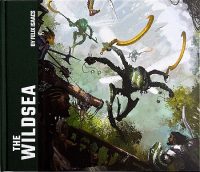

What I knew going in is that it’s another FitD-based system, though with a considerable number of hacks and changes to the ruleset. (Like the more recent The Last Caravan, travel is kind of the equivalent in this game of downtime in Blades in the Dark.) I also knew it was a very weird setting, than that it was a wildly inventive one—a wonderfully weird setting, really. I mean, the character I played was a “Gau”: a fungal humanoid ship’s cook who always had stuff to do despite being the ship’s cook. And like, a lot of that stuff he had for him to do involved harvesting and hunting food, as well as cooking it! (And yes, that was fun.) Our ship was a living centipede machine and its engine was the creature’s still-beating heart. There were times when my character got our ship high (as a combat tactic, no less).
The first thing to say is that it’s an unusually gorgeous book. Like, coffee-table book quality beautiful. It’s also really well-written, as in, each new page I read conveyed useful information in a systematic way, introducing things in a manner that felt comfortable and welcoming. I could really feel myself getting a clearer handle on the setting and the rules with each new page spread that I read. That’s something I value in an RPG: a lot of gamebooks have an excellent system, but leave the reader a little bit in the dark about the setting, or vice-versa. Of course, how much this feeling is due to the fact I have played the game before is an open question—after all, I’d skimmed these pages before, and interacted with a lot the rule systems described on them many times—but I think The Wildsea sets a nice pattern by explaining things in a logical way, providing lots of examples and quirky options, and so on.
This is a good thing, because the setting is gloriously, relentlessly weird. Having an introduction to it that is digestible is important, especially for characters who are assumed to know at least something about this world, having grown up in it. At the same time, mechanically having a ship and crew procedure to deal with for voyages kind of anchors characters: they might constantly be running into weird creatures and wrecks and ruins out on the wildsea, they might constantly be pulling into ports they’ve never visited before, but the ship and the game procedures linked to keeping it going are a kind of “home base” for players, something they can hang onto as the environment and factions and hazards shift and change all around them.
There’s also plenty of useful materials for filling out the world, as well as guidance for the GM (called a “Firefly” in the rules text) in terms of how to run the game, including some good advice I think is applicable to any game. There’s also tips on how to present specific aspects of the general setting, like what to do with the sky or different strata of the world forest (all the way down to the rarely-visited ground) in your players’ adventures, ideas for hazards and how to handle them, and more. There’s a bit more setting info than I’d probably end up using myself, toward the end of the book, but I think for lots of GMs that’s a plus, not a minus, as you can always pick and choose what to use and what to leave out. Also, I think the region writeups are handy for a different purpose: they suggest a prep format for GMs who want to create and detail their own regions, in terms of what a GM would probably like to do up when running the game. Since The Wildsea seems to incorporate a fair amount of improvisation, having a few pages of materials on hand in this format is likely very helpful.
I recall some rules being a little unclear or weakly-defined back when we were playing the game, but not much jumped out at me reading the book cover to cover—if I end up running it sometime, I’ll add my conclusions in a follow-up post, I guess. The art throughout the book is wonderful, and the format of the book—it’s laid out in landscape mode on not-quite A4 pages (maybe letter-sized?)—makes a lot of sense too. Overall, it’s very impressive, and though I know they’ve published an expansion of the world, I feel like someone could run a game for years off just what’s in the core rulebook.
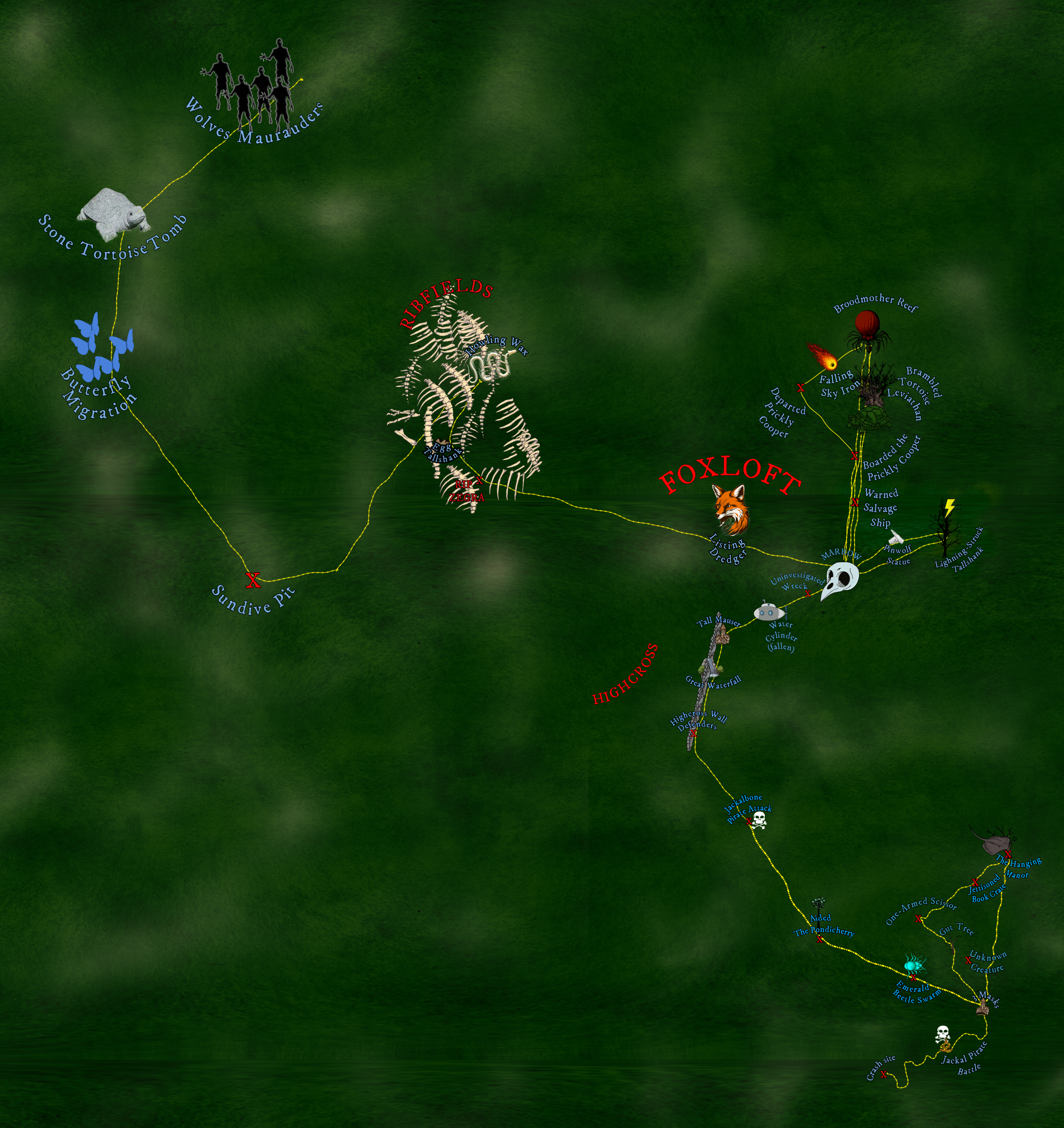
Since I don’t think I’ve posted it anywhere else, I’ll also add one more thing from the game I played in for approximately a year. I created a map in Wonderdraft, and after each session I updated the map with more of the path our characters had cut across the Wildsea. Here is the map (click to embiggen):
In the same conversation, the same friend mentioned Pirate Borg having been quite popular at a con he attended, and I can see why. I haven’t read it cover to cover yet, but a skim convinced me it was a very playable, lucidly written game. I should remedy my failure to read through it soon.↩