


Here’s what I read in September and October of this year! I didn’t really read any RPG-related stuff in the past couple of months, at least not cover-to-cover, so this will be the only readings post for these months.
Fiction & General Nonfiction
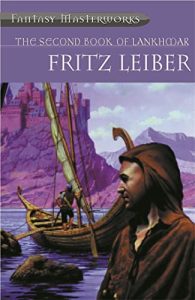

Well, seedier they did grow, and these stories have some issues that are just troubling. I’ll get to those in a moment, but first I’ll mention what I liked in this final volume. For one thing, I enjoyed seeing Fafhrd and Gray Mouser so changed from their previous depictions. The earlier stories, I enjoyed years ago, finding them really evocative of young male friendship and they were both the (imperfect) heroes of their tales. In contrast, Fafhrd is an aging old barbarian who is missing a hand—he has a hook in its place—and Gray Mouser is getting a bit long in the tooth, too; both are dependent not just on their lovers but also others in their little “community” to help them survive what Nehwon throws at them. That’s an interesting and engaging shift in dynamics.
Unfortunately, there’s also a lot of “dirty old man” Leiber in the last few stories, something that isn’t totally surprising given some of the things in some of the tales in the volumes immediately preceding this one. However, especially in “The Mer She” and in “The Mouser Goes Below,” it’s even more foregrounded, to the point that I can understand people bailing on the stories. (Specifically, the sexualization of preteen or barely-teen girls, and the way it’s normalized in Nehwon, was very off-putting.) I was able to grit my teeth and look past that, though, and found some other cool stuff, but… well, these two stories, and especially the final one, were in my opinion marred by that stuff, though even “The Mouser Goes Below” has its bright spots: again, I liked how it took a whole community to save the pair, and how their divergent crises mirrored one another, and I have to admit it tied together certain threads in the series in a satisfying way, which is a tall order for a long-running series like this.
Caveats and reservations aside, the volume does contain a truly great late story from Leiber’s oeuvre, “The Curse of the Smalls and the Stars.” This story is mostly free of the rather off-putting things mentioned above, but it’s also much more beautifully written, both in terms of the prose and the structure of the tale itself, and the “story problem” is really relatable too: as I get older, I also get more obsessively fall down unnecessary rabbitholes, fixating on things that don’t seem to interest others, in a way that actually perplexes others. The story puts the main characters through a really amusing rigmarole in which they’re not quite the heroes anymore, and I loved how it jumped around between perspectives as it explored that.
Anyway, it seems like I’ve finished this series, which many consider the crowning glory of Leiber’s work. There’s still a number of standalone novels and short stories I haven’t read yet, though. I’ll dig into whatever I can find next, but I’m in no huge rush. I get the impression that the Lankhmar stuff is really a lot of Leiber’s best, even though Our Lady of Darkness and Conjure Wife are also major personal favorites.
Maybe someone out there has a recommendation for what Leiber I should try next? Feel free to drop it in the comments if you do!
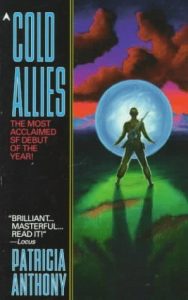

Since this book is almost 35 years old, I’ll also add that I think the text aged pretty well… with one exception: the cartoonish depiction of the “Arab”—contrasted with the much more human depiction of the other side—was a bit much at times. It’s not totally surprising in a text from the early 90s, I suppose, but it did stick out to me somewhat.
That caveat aside, the novel is… well, it’s very military-focused. This is a war story with aliens, not an alien story with war in the background. The aliens come to play an increasingly important role in the story as it goes on—and they grow mysterious and disturbing as the story progresses—but in the end the book is mostly about a future war and the future soldiers and military personnel who are stuck fighting it. If you’re not interested in military stories, you might not care for it. That said, personally I enjoyed it enough to finish it, even if it definitely hasn’t overtaken Brother Termite for the position of my favorite Patricia Anthony novel.
From Anthony’s works, I still haven’t read Flanders or Cradle of Splendor—but I have both on the shelf nearby—and I’m hoping to get around to reading one of the two by the end of the year. Since I’ve heard that Flanders is her best, I’m tempted to save it for last.


The book is a delirious exploration of the aesthetic and sensual life of a complete kook of a French duke named Jean Floressas Des Esseintes. Whole chapters are spent on things like discourses on his taste in literature, the rigorous selection of a wallpaper color for one of the rooms in his house (and how taste in colors tells us about people’s quality as human beings), and how he goes about ornamenting the shell of a poor tortoise perfectly to suit his home. There’s also a discourse on the necessity of constructing the boudoir so that it aesthetically complements both blonds and brunettes, because I suppose one never knows where the night, or day, takes one.
The protagonist is, in other words, simultaneously absurd, ridiculous, awful, and yet he also manages to be quite fascinating in his lunacy. Somewhat to my own surprise, I was enthralled by the lunacy and really couldn’t stop listening to it. It’s funny to be writing about this book so positively right after commenting on the “dirty old man” elements in the Leiber book above, but the thing is, the perversions in this book feel more integral to the story, more organic to the character. He’s an aesthete cranked up to 11, often in a rather adolescent-feeling way, and the sexual elements in the book fit with—and both characterize, and also mock—that aspect of him. It’s not that the mockery is necessary for a credible handling of this material, so much as that the material makes so much sense in the context of the character and his… well, not “story” but his inner life. He’s ridiculous and everything sexual about him is as ridiculous as his obsessed with the “right” authors and the “finest” colors and his religious anxieties and sexual hangups and experimentations with scent and so on. Really, this is a character with some serious issues.
And yet in some ways I could relate to him—at least, his dread of leaving his house and going among the “hulls” (the “normal” people of his land) felt familiar, in the wake of the pandemic, and his enthusiasm for random, weird passions nobody else would understand… isn’t that what makes us geeks who we are? Of course, with Des Esseintes everything is cranked up to… well, on second thought, not up to eleven, so much as cranked up to one hundred and eleven. It makes him a lunatic—but a fascinating and sometimes sympathetic one. (I rooted honestly for the poor bastard to overcome his nervous illness toward the end, and I definitely sympathized with his horror at having to reenter the broader social world after his recovery.)
Despite those sympathies, it’s also pretty amazing how it maps onto your bored, terminally online, wealthy modern techbro. The obsessions and hangups would be somewhat different, but the insanity feels weirdly familiar in its general shape and scope.
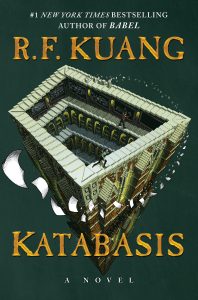

R.F. Kuang‘s Katabasis is a book my wife surprised me with: she’d run across a brand new copy at the city library and borrowed it for me to check out. It just happens to be a… well, I was about to call it a Bangsian fantasy, but it lacks the historical and literary personages, though it is a fantasy of the afterlife. Anyway, I love novels set in the afterlife, or often I do. Kuang’s take on hell was thoughtful, interesting, and unusual—it’s essentially like a university campus, and being a dead soul in hell bears an uncanny resemblance to being a grad student. (Which is, I’ll admit, a funny comparison.) That said, she also draws on the literary depictions of hell in the process of laying out this university-inspired infernal realm.
There’s also some fun magic here, with the “rules” of magic having a lot to do with logic and paradoxes; there are some compelling characters; there’s a… well, I wouldn’t want to spoil it for you, but I will say Kuang manages to start the book making one think it’s a certain kind of novel, and then slowly morph it into a rather different kind of novel. (The fact she mentions the frog being slowly boiled in a pot comes to mind as I state this.)
Anyway, I won’t say it’s a quick read, at 540 pages, at least it wasn’t for me, but it was a pretty enjoyable one.
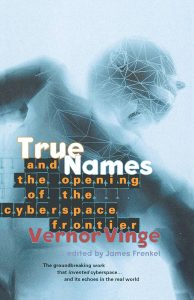

A book I’ve had for almost two decades, True Names and the Opening of the Cyberspace Frontier by Vernor Vinge (and others), edited by James Frenkel, finally made it into my reading. I honestly searched for the book among my things several times before finding it, and when I did eventually turn it up, I figured it was time to read the thing. Incidentally, this book is the reason why I combined fiction and nonfiction on this post: this book would be hard to place if the two categories were split. It includes a couple of pieces of fiction (including Vernor Vinge’s title story), but also a lot of nonfiction essays.
The essays are mostly pretty dated, which is not surprising: they’re mostly about technology, and a lot of them are almost 30 years old now. As a snapshot of the late 90s, they’re interesting, but things have come so dizzyingly far that they’re almost curios now… or, in a few cases, a snapshot of the seed-germ of what we ended up with. It’s really hard not to feel keenly how much commercial social networks screwed the web and the net generally: so much of the optimism about the internet that was felt in this time has since evaporated, as we’ve accustomed ourselves to recursive enshittification and rampant data-harvesting of users. (In particular, we already seem to be locked into the kind of panopticon-world that Alan Wexelblatt predicted in “How Is the NII Like a Prison?”) Then again, maybe the differences between what we have now, compared to what didn’t exist then, it should be salutary on another level: it wasn’t that long ago that we were still optimistic and had alternative visions for what the Net could be, and if things could change as much as they have in just a generation, maybe they could change again—for the better—in an equal span of time, or at least during some reasonable span of time, like say a century. (I’m not holding my breath, given the entrenchments we have on hand now, but who knows?)
Especially interesting were:
- John M. Ford‘s essay “Eventful History: Version 1.X” which humorously explores what future intelligent machines (or, you know, people living among them) might “think” looking back at dawn of the Net and the times before intelligent, conscious machines.
- Patti Maes’ “Intelligent Software” which… well, with everyone talking about AI these days, feels timely. (Maes’ version of “intelligent software” is a more modest sort of thing than we see in SF and techbro discourse alike.)
- Mark Pesce’s “True Magic” is an essay about the singularity and Vinge‘s “True Names” and a fascination analysis of cyberpunk symbolism in relation with the “real world” of the internet of the 90s. A lot has changed since then, and yet a lot remains familiar.
As for the fiction in the book, there are two pieces. One is a short piece by Richard M. Stallman called “The Right to Read” which explores the repressive insanity that the U.S. government had been trying to impose on computers and computer users already by the late 90s. Stallman explores elements of these impositions in a fictional form, imagining a world where control of information and computer usage is top-down and highly commercialized. It’s a dark vision, but one that overlooks a few hitches, especially the fact that it’s hard to run a global economy with manufacturing farmed out abroad where top-down control by one actor is possible. The story feels a bit like one of Cory Doctorow’s allegorical short stories about copyright and freedom, if I’m honest, but Stallman includes a couple of afterwords that explain the real-life basis for a lot of the horrible technologies mentioned in the story.
The other piece of fiction is the longer one, the title story of the collection by Vernor Vinge. It’s a wild adventure that I’d prefer not to spoil, but I enjoyed it even though I could see the big reveal coming a mile away. (As a reader in 2025, that is; I’m sure it was more surprising when the tale was first published in the 80s.) I enjoyed it quite a bit, but being loathe to spoil it, I’ll just note that it evidences a great deal of the “future-proofing” that Vinge mentioned to my Clarion West class—the idea that one could purposefully write near-future SF in a way that made the story’s predictions more impervious to the vagaries of technological change. Anyway, it was fun and wild, and is worth checking out.
The Afterword by Marvin Minsky is a reprint of the original afterword from 1983, and it’s mostly about human consciousness and the prospects for machine emulation of it, and it’s well-written, interesting, and thoughtful—and prescient of a lot of insights into the brain and mind that have been gleaned since. It also makes me want to read Minsky‘sThe Society of Mind, which he mentions in the text as a forthcoming book, and which I assume explores the same territory. (Happily the library system at work has a copy available! That said, I have a lot of books borrowed already, so I’m going to just put it on my list. )
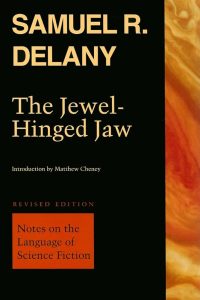

“The Letter to a Critic” that ends the volume is also very much worth a look (tackling, among other things, a timeless topic among SF folks, the perception that mainstream folks look down on SF and assume it’s badly written), and I also enjoyed the other appendix piece, “Midcentury,” though that’s more about how the scope of possible discourses in the 50s was so much more incredibly narrow than it became in the 60s and 70s (let alone today). My one struggle with the book was that I’m not anywhere near well-versed in the specific authors Delany discusses. (I’ve read no Van Vogt, and far too little Joanna Russ, for example, and I haven’t even read The Dispossessed, for that matter, though I hope to do so in the next few months.) Even so, I found this book enjoyable and fascinating, and especially appreciated Delany’s wit and sense of humor even in the midst of some extremely thoughtful (and cerebral) argumentation. The book is well worth seeking out if you’re interested in SF.
I got this one through the library at work, and they have his later book of SF criticism, Starboard Wine, too, so I’ll be requesting that soon and giving it a look sometime soon(ish). However, I think based on the longish essay by Delany in this earlier volume, I’ll likely first read Le Guin’s The Dispossessed for the first time (I know, I know) and Delany’s response to it, his novel Trouble on Triton: An Ambiguous Heterotopia (aka Triton).


The Judge Pursuivant stories are entertaining even if the “mystery” element is a little rushed in a couple of them; they read like early works by a talented author who is starting to master his craft. Wellman clearly calls out at least one of his influences in the first tale, a kinda-sorta werewolf story titled “The Hairy Ones Shall Dance”: one of the characters specifically mentions the John Silence stories of Algernon Blackwood, which are an earlier (if not the earliest?) iteration of the occult mystery/psychic detective genre. In that tale, characters sometimes figure things out just a tad bit too easily, but Wellman is clearly already capable as a writer in general, and is just working out how to set up the chessboard for the story’s big finish.
The Professor Enderby story is… well, it’s from the 1930s, and you can tell: Professor Enderby has a stereotypical “Chinese servant” who speaks in off-putting “Chinaman” (ugh) talk. The rest of the story is fine, but it’s not as interesting or fun as the Pursuivant or Thunstone stories, and while I understand why it was included in the collection—it’s probably not just a one-off, but also a sort of transitional tale between types of protagonist—it’s kind of easy to see why Wellman doesn’t seem to have done much with the character: he’s just a bit dull as characters go. Happily, it’s just the one tale.
Finally, there’s the John Thunstone stories. These are the pulpiest in the book, and the most accomplished. Thunstone is the most Silver John-like figure of the three, though not in an overt way. Thunstone is urbane, his antagonists recurrent—Rowley Thorne in particular, a stand-in for Aleister Crowley, but also the Shonokins (a strange prehuman species who occupied North America aeons ago, and has mastered telepathy and some kinds of magic), and the School of Darkness (which is linked to Thorne, but goes beyond him)—and his tastes a bit more sophisticated, and he’s more physical in his battles, where Silver John is likelier to use lore or music to overcome the evils he fights, and lives for a good evening’s singing at a campfire. Still, there is something vaguely similar in these characters, enough for a kind of echo to resound between them here and there. The Thunstone tales are the most muscular and accomplished tales in the book, which is no surprise: Wellman was older and more experienced (as a writer, and in life as well) when writing them, the baddies are somewhat more engaging, and I enjoyed them most of all from the volume, enough that I’m considering picking up the Thunstone novels sometime.
I should take a moment to mention the black-and-white pen-and-ink illustrations by George Evans, which are mostly in the same style as the cover art. There’s not a lot of them, but they’re great in the spots where they’re included, mostly at the beginnings and ends of stories.
While reading up a bit on Wellman’s mysteries—I was curious about whether he’d written non-occult ones as well as the ones in this volume—I stumbled onto a little discussion (like here) of how Wellman once beat William Faulker out for first prize in a mystery fiction contest. (It’d been a three way tie and Rex Stout, the tiebreaker, chose Wellman’s story to win.) Faulker was disconsolate, writing:
What a commentary. In France I am the father of a literary movement. In Europe I am considered the best modern American, and among the first of all writers. In America, I eke out a hack’s motion picture wages by winning second prize in a manufactured mystery story contest.
One assumes Faulkner took consolation in winning a Nobel a few years later. Wellman was apparently offered Faulkner’s teaching job when he at the University of Virginia in 1962 when Faulkner passed away, but turned it down.
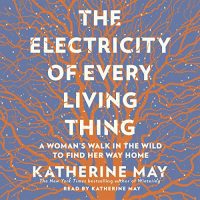
I especially appreciated the momentary side-trips into the lives of various creative individuals—Ralph Vaughan Williams, Jean Rhys, T.S. Eliot, and more—who moved through the same landscape that May walked through on the hikes she describes.
Verse
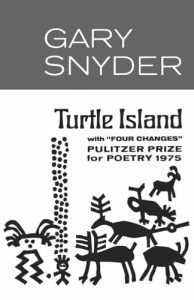
The book is as old as I am: the last date on the copyright page is 1974, my birth year. It was a far different time, and that shows in places. Snyder’s poems are of their era in the way they address and describe Native Americans, for example, and his opposition to nuclear power as a straightforward push for valuing the environment feels like something that’s a less straightforward conclusion now. (Some environmentalists pretty much acknowledge that we’re not going to stop needing electricity in massive amounts, but suggest modern nuclear power is better than some of the other ways of creating it.) There are a few spots where he mentions “longhairs” and, those feel like stepping into an ideological time machine, and that sensation is even more elevated when reading the prose section at the end of the book.
But in other ways, the book feels downright prophetic: he calls out the oil companies, and they’re the same ones that, fifty years later, still are raking in oil profits and pretending climate change isn’t a worry. He mentions fossil fuels repeatedly, and even touches on global warming briefly.
Still, those prophetic moments are not a really a compelling reason to read the book. A far more compelling reason is that the verse here is sinuous and muscular, beautiful and worshipful. He’s a nature poet, and a really attentive, rhapsodical one. The glimpses we get of nature through his eyes have stuck with me since reading the book—though not specific lines, more the sensations I felt reading it. I’m sure a non-aphantastic reader would also say the imagery stuck with them. Snyder’s rhetoric sometimes feels slightly archaic—as we should expect from a fifty-one year old book—but the energy and passion, and compassion, in these poems are all quite timeless. If you like nature poems, they’re worth a look.
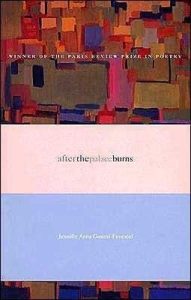

Maybe I’m out of practice reading verse, but then, I haven’t felt this way about a lot of the verse I’ve read in recent years. I think I have to confess that this book just isn’t for me, Paris Review Prize in Poetry winner or not. That’s a shame, because I really wanted to enjoy this book, but aside from a few poems, most of them in sequence in the book—”Minute Observations on the Beautiful and the Sublime,” “Love as a Duration,” “1812 Overture in Two Movements,” “A Realm of Vague Delights,” and “A Certain Slant of Light,” all of which are interesting and memorable—I found most of the book just didn’t resonate much with me, or stick with me after finishing the book. That’s not to say others won’t like it: it won a big, serious poetry prize, after all! (I looked for another review online, something more positive I could link here, and couldn’t find one, but maybe that’s not surprising for a 22-year-old book of poems by an author who seemingly never published another book of verse.) But try as I might, it just didn’t work so well for me.
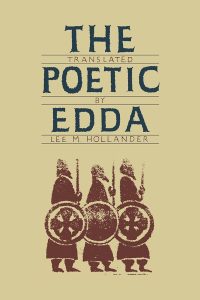
Challenging though it is, I enjoyed reading this. The poems run the gamut from lays about great heroes and valkyries and acts of revenge, to tales of the gods (with Loki and Odin and Thor being the most heavily featured). A lot of the stuff at the end is related to the Niflungs (Niebelungs) and the Volsunga Saga, which are less interesting than the mythology stuff to me, but that’s probably because I’m less familiar with the latter narratives and characters—and it’s a lot of characters. 1
For those who find themselves struggling with the diction—at times, I honestly found this more challenging to read than an unmodernized edition of Malory’s Le Morte D’Arthur, for example—or more interested in a slightly more modernized English version, I would not hesitate to recommend Edward Pettit’s translation, which happens to be available for free online! Hell, even if you stick with Hollander’s version, the Pettit makes for interesting comparison and a useful reference, with rather different (and interesting) commentaries on each of the poems.
Graphic Novels
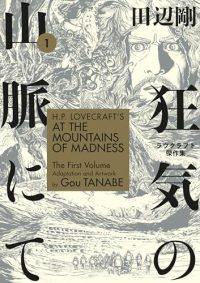

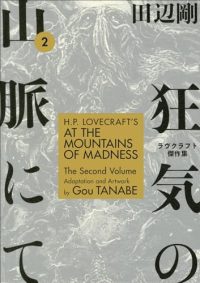
In any case, this two-volume manga is a serious achievement, and worth checking out.
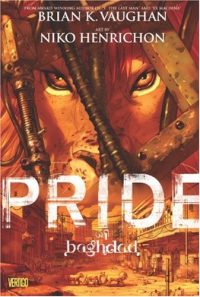

It’s a short story because the lions’ brush with freedom was short-lived and, ultimately, ended in tragedy. That’s not spoiling the comic for anyone who’s interested in it: the back cover tells as much. The story isn’t about the ending, through: it’s about imagining what the lions experienced in the hours after escaping the damaged zoo during a violent invasion, and what they might have encountered outside of the zoo. Though the ending is sad, it’s interesting enough, though I found myself wishing the narrative could have stretched out beyond one volume. I’m a sucker for animal stories, though, probably because I grew up with Geraldine Elliot’s retellings of African folktales being read to me.
Anyway, Pride of Baghdad is worth the hour or so it takes to read it, if you like animal stories and are okay with a depressing, abrupt ending.
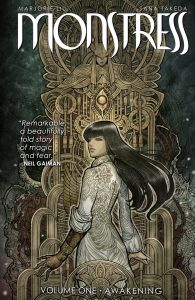
It has a very weird setting, a few extremely weird characters, which are things that I really like… and yet somehow I’m not sure how I feel about any of them, which might be part of my hesitancy with the series. Or maybe it’s just not for me, I’m not sure. I do plan on giving the second volume a try, though.
Parenting-Related Nonfiction

And that’s it! One more installment is coming for this series, which I’ll post in January (or maybe late December, we’ll see).
I guess I should watch that DVD set of Wagner’s Ring Cycle that my ex got me for my birthday long ago, huh? I’ve been meaning to get to it, really I have…↩