



- Series: Paranoia XP Reviews, Book-by-Book
- Reading Paranoia XP: Paranoia [XP], Service Pack 1 (Core Rulebook)
- Reading Paranoia XP: The GM Screen, Mission Blender, and Mandatory Mission Pack
- Reading Paranoia XP: Citizen’s Guide to Surviving Alpha Complex and The Little Red Book
- Reading Paranoia XP: Service, Service!
- Reading Paranoia XP: The Traitor’s Manual
- Reading Paranoia XP: STUFF and STUFF 2: The Gray Subnets
- Reading Paranoia XP: The Mutant Experience
- Reading Paranoia XP: Extreme Paranoia
- Reading Paranoia XP: Criminal Histories
- Reading Paranoia XP: Big Book of Bots
- Reading Paranoia XP: The Thin Green Line
- Reading Paranoia XP: The Underplex
- Reading Paranoia XP: Flashbacks
- Reading Paranoia XP: Flashbacks II
- Reading Paranoia XP: Alpha Complex Nights
- Reading Paranoia XP: Alpha Complex Nights 2
- Reading Paranoia XP: Crash Priority
- Reading Paranoia XP: Sector Zero
- Reading Paranoia XP: War On [Insert Noun Here]
- Reading Paranoia XP: WMD
This is another review of a Paranoia XP book, for those interested.
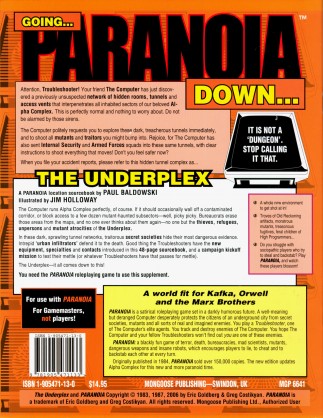
This time, I’m dealing with The Underplex, which is basically the only real setting expansion for Paranoia XP.
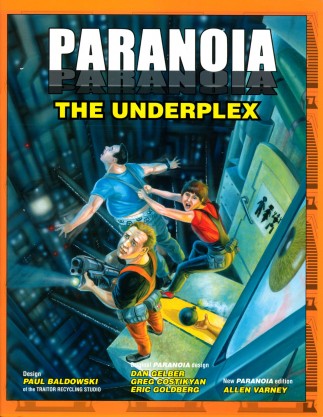

It’s a fun supplement, and for my money it definitely feels like it’d be useful to any GM who has run Paranoia enough times that their players are ready for some new twist on the setting. If Paranoia were a less-fun RPG (the term used in all Paranoia RPG books to refer to any other RPG) from the era, I feel like The Underplex would be a giant setting supplement detailing way more NPCs than you could ever use, mapping out every last village and cavern of the Underplex (but of course without any specifics on what a given building or weird spot in that cavern contains), and would have been hundreds of pages long. Baldowski (and the other contributors) manage to make a more useable setting supplement in only 48 pages.
The reason it works is partly because Paranoia trusts the GM to improvise and to make up their own stuff. If you wanted canned adventures, you could go get one of the Flashbacks collections: GMs buying The Underplex are assumed to be people who want to expand and build on Alpha Complex on their own. (There’s even a side note that mentions in passing some ideas for GMs who have set their Alpha Complexes on the moon, underwater, and so on, which I appreciate… if I ever manage to run Paranoia, I’m likely to set it in an alternate setting of this sort, after all, but even if I weren’t, the way it signals to the GM that creative work is welcome and expected for use with this supplement is heartening.)
As always, there’s a ton of stuff that you could use in your game, but the design is so modular that you can pick and choose what you like while excluding things that are less central to your game. For example, the first chapter presents a sort of overview of The Underplex by covering a number of different subregions within it. The Tranz is basically, er, “a series of tubes” and ducts and pipes that characters can explore; there are mines, a “dungeon,” a decommissioned missile base, abandoned sectors of Alpha Complex that are almost in a usable state, caverns full of phosphorescent, radioactive-but-edible fungus, a zone called Area 31 (where R&D dumps the worst of its failed experiments), The Deeps (huge caverns beneath the Underplex), an insane alter-Alpha Complex called Mezcalinzan (which is basically the same as Alpha Complex but run by a crazy human instead of a crazy AI), and more. The chapter includes a few NPCs, a little info on Underplex-specific gear from R&D and “Wyrms” (monsters resulting from R&D’s genetic experimentation), and more. All of this is way more than anyone would ever include in a single mission, so unless you’re playing a “Straight” mode game with a single extended storyline, it’s best to think of this chapter as a kind of grab bag of nuttiness to use how you see fit.

(I especially enjoyed the bit on “Revolutionary Communities” set up by the Humanists in disused sectors in the Underplex: it’s deliciously ironic that a crazed secret society could actually manage to set up a truly utopian community simply by scaling down the autocratic power of the Computer node they’re using and involving humans in the running of their community. Likewise, Free Enterprise has a very amusing writeup, and it’d be worth including even if you almost never do anything with Service Groups in your regular game. The last one I’ll mention is the Romantics, who, very appropriately, stage massive underground LARPs and rock shows in the Underplex, believing them to be reenactments of history that they’ve learned about through ancient documentation—that is, computer games, RPG books, and music videos.)
Throughout, there are adventure seeds and touches of worldbuilding that are, as ever, both generous and light to the touch. Consider the NPC on page 27, who is an agent of “an Alpha Complex across the ocean.” Just the little bit written about him suggests a lot about a very compelling alternate Alpha Complex, what it might be up to in terms of its efforts to inflitrate the PCs’ Alpha Complex, while still ensuring that the tone is consistent in terms of those other Alpha Complex people believing stuff just as silly as the stuff believed in plain vanilla Alpha Complex.
If the idea intrigues you, well… we never did get that Alternate Alpha Complexes book from Mongoose, but there is a pretty wonderful, idea-packed site that explores the concept; it’s also still being updated, as of November of last year, so it’s worth checking back to see what’s new if you’ve seen it before. I really wish that the drafts for the planned Alternate Alpha Complexes book were somehow available, since Paul Baldowski’s contribution sounds like it would have been amazing. It was titled “The Avignon Papacy,” and as Baldowski put it, it was designed with the following idea in mind:
… the characters take on the role of Papal Investigators seeking out treachery and intrigue along the stone corridors and seedy back streets of Avignon in the late 14th Century. The Church has elected two separate Popes – and that means trouble for everyone. You live for trouble – even though sometimes you might get stabbed, burnt, damned, imprisoned, poisoned, drowned and defiled in the process. Long live Pope Benedict XIII – down with the Roman anti-pope!
That’s a bit further off the beaten track of Alpha Complex than I expected, but I can see it working really well. Hopefully it’ll see the light of day eventually. (I rather think it could make a cool skin for Legacy: Life Among the Ruins or Blades in the Dark, in fact, especially if the inquisitors were aligned with different subfactions of different branches of the church!)
Er, back to The Underplex…
The next couple of chapters are short but sweet: the third (“Hook, line, and sinkhole”) deals with the environment and hazards, providing guidance on how to apply some of the mechanics of Paranoia XP to the Underplex as well as discussing new survival skills that characters could acquire and use there which aren’t included in the standard rules, as well as providing a random table for generating the local environmental conditions for a given locale. The fourth chapter, “Gear,” is just a couple of pages and covers possible problems and complications that can emerge regarding Troubleshooters’ gear (specifically light sources and radio transmissions), specialized gear that could be issued to Troubleshooters dispatched into the Underplex, as well as some coverage of random “treasure” that can be found there (in the form of some wacky Old Reckoning artifacts that include “grip socks” and a Season 1 DVD compilation of Logan’s Run, presented, of course, as a historical documentary). There’s also an amusing random table of toys that players could discover and be baffled by, though of course if you’re looking for Old Reckoning junk, there’s more comprehensive tables out there to use, too. (The most comprehensive one out there for modern junk seems to have been the d1000 Grand Unified Junk Table, originally posted at this blog; though it’s no longer available there, it survives in other places like Chartopia and in various corners of the net; since the original author was giving it away for free, I’ll assume it’s okay to provide a copy of the original for anyone who still wants it.)
Finally, there’s a fun adventure set in the Underplex, titled “The One,” which as the author notes actually isn’t so much an adventure (or “mission”) as the setup for a series of Underplex adventures. It’s basically a way of introducing the Underplex by setting up a wild goose chase into the Underplex after a MacGuffin, along with some notes about different possible conspiracies that involve one or another Secret Society or Underplex group, the MacGuffin, and missions into the Underplex. I enjoyed the fact that it’s a balance of being open-ended and having clear options for the reader to choose from; it also has one of the funniest slapstick combat scene setups I’ve ever read in an RPG book, and though it would require some work on the GMs part to build the rest of the campaign series (or whatever we’d call in in Paranoia), I’d run it without hesitation as a way of introducing the Underplex sub-setting into a game.
The book is rounded out by a couple of short appendices: the first is essentially the equivalent of the Random Dungeon Generator that existed in the original 1st edition AD&D Dungeon Master’s Guide: you roll some d20s and it generates a stretch of Underplex for you. Presumably most GMs would use this for generating a map on the fly, though it could also be used during GM prep if you’re stuck for ideas. The second appendix is a grab bag of thoughts on using the Underplex: how to get players to want their characters to go back to Alpha Complex (if they decide they want to stay down under), an (of course, dangerous) automated training system that can add Underplex-specific skills to player characters via MemoMax injection (called the AptiTap), a couple of Service Services written up in the same style as in the supplement Service Service!, and a baffling note about Comm-victs that feels as if it were recycled from elsewhere, but which technically can be used in adding one more odd encounter to an abandoned Tube station in the Tranz.
All in all, I found The Underplex a very quick and light read, something I like in a Paranoia supplement: by comparison, books like Service, Service! and The Traitors’ Guide feel almost over-detailed. It’s easy to pick and choose what you want to use, and despite the (inevitable for Mongoose, apparently) occasional proofreading errors (it’s Teela-O-MLY, not Teela O’Malley or Tella-O-MLY, fellas, and see Baldowski’s errata for some of the tables in the book, linked and copied below), it’s one of the supplements I’ve most enjoyed reading so far, so much that I think it’s a great addition to the library of any GM running Paranoia XP. (Or, for that matter, any edition of Paranoia, yes, including the new edition).
While I’m discussing supplements for the XP line, I think it’s worth noting that there was never a supplement for the Outdoors—the world outside of Alpha Complex. That could be considered a good thing: the last thing Paranoia XP needed was a detailed world map and travel guide or anything like that. However, I think a sourcebook crammed with random tables and mission ideas would have been fun and nice. Part of the fun of classic Paranoia seems to have involved the occasional trip to the Outdoors, as a kind of contrast with the dystopian funscape within Alpha Complex. It’s not a crucial omission, but it would have been a cool supplpement, I think. That said, more than enough of the published missions have one or more Outdoors segments, so an enterprising GM could probably build such a resource for themselves, given enough time and horrible ideas.
Note:
Incidentally, ages ago Paul Baldowski posted some very minor errata—missing table results—for the book here: in case that ever disappears from his blog (or, rather, in case his blog ever disappears), the errata is as follows:
DEFECTIVE LIGHT SOURCE (p 31)
20 Nuclear battery eventually explodes (V1V energy, 50m radius).STAIRWAY (p 45)
19-20 Drops sharply downward (descends into Underplex or The Deeps, depending on current level)SHAFT (p 45)
20 Shaft drops sharply downward (descends into Underplex or The Deeps, depending on current level)SMALL ROOM (p 47)
18-20 Guard post (1-5: Armed Forces, 6-10: Secret Society, 11-15: Myconaut, 16-20: abandoned)