



- Series: Paranoia XP Reviews, Book-by-Book
- Reading Paranoia XP: Paranoia [XP], Service Pack 1 (Core Rulebook)
- Reading Paranoia XP: The GM Screen, Mission Blender, and Mandatory Mission Pack
- Reading Paranoia XP: Citizen’s Guide to Surviving Alpha Complex and The Little Red Book
- Reading Paranoia XP: Service, Service!
- Reading Paranoia XP: The Traitor’s Manual
- Reading Paranoia XP: STUFF and STUFF 2: The Gray Subnets
- Reading Paranoia XP: The Mutant Experience
- Reading Paranoia XP: Extreme Paranoia
- Reading Paranoia XP: Criminal Histories
- Reading Paranoia XP: Big Book of Bots
- Reading Paranoia XP: The Thin Green Line
- Reading Paranoia XP: The Underplex
- Reading Paranoia XP: Flashbacks
- Reading Paranoia XP: Flashbacks II
- Reading Paranoia XP: Alpha Complex Nights
- Reading Paranoia XP: Alpha Complex Nights 2
- Reading Paranoia XP: Crash Priority
- Reading Paranoia XP: Sector Zero
- Reading Paranoia XP: War On [Insert Noun Here]
- Reading Paranoia XP: WMD
This is another review of a Paranoia XP book, for those interested. If you’re not, well… skip it!
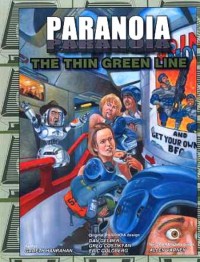
This time, I’m digging into The Thin Green Line, a supplement for Paranoia XP.

The departure of Holloway from the Paranoia XP line is something a lot of the game’s hardcore fans lamented, and still lament: all the way back to 1st edition, Holloway’s illustrations had defined the look of Alpha Complex. This wasn’t the first book in the line where someone else—Alison Blackwell, specifically—did the interior illustrations, and I have to say, I feel bad for Blackwell: I’m sure it wasn’t easy to hear everyone bemoaning her work, which absent the fact it’s not-Holloway, is mostly perfectly serviceable. But, even so, I do miss the Holloway art. That said, it’s nice at least to have properly scanned art.
That said, I think there’s another departure that was just as devastating to the line, one you don’t hear people opining quite so loudly about. I’m talking about the end of Varney’s tenure as the “packager” and effective line editor for the Paranoia XP line.
The book I read just before this one was Service, Service!, and I was honest about the ways it disappointed me: it felt overlong, and was stylistically a little disjoined between sections. But I feel almost embarrassed at those complaints, after taking a look at The Thin Green Line. It’s not that I don’t think the author didn’t do a good job: I’m sure he did, but the layout and editing went from being very professional to being subtly wrong. I mean, the it still looks like the Paranoia XP layout, but look at the forms and you notice that nobody put any effort into creating Forms (as in, the legendary paperwork that’s part of the game) that even remotely resemble actual bureaucratic paperwork. Seriously, if I were wanting to run The Thin Green Line, I’d probably have to redo the forms myself, they’re that ugly.
The content, too, needs some editing; there are consistent spelling errors, typos that got into the published book, and more. People say, “That’s Mongoose!” but honestly, that’s also the absence of Allen Varney. Allen never let much of that through. When he disappeared, so, it seems, did much Mongoose’s editorial oversight, because Varney appears to have been Mongoose’s copy-editor on the Paranoia line.
But the real issue is a kind of looseness of the content. It’s… baggy. Some people would blame the writer, but it’s actually the editor’s job to tighten things up in this way, just as it’s the copyeditor’s job to catch and correct the misspellings and typos in the text before it’s laid out, and the proofreader’s job to find them after it’s laid out. (Sure, often the same people wear those hats, but they’re different jobs.)
Am I being shallow, spending that much space and time talking about how the pages look? I dunno, maybe, but here in 2018, RPG books are products in which layout does matter, and does make the difference between a great book and an okay one… and, I think, that was true even in the mid2000s: I am, after all, talking about a decline in quality between the Varney-era books and those that were published without him on board.
But I would be remiss saying nothing about the content as game material, so here goes: er, it’s okay. I think it probably set the stage for the Internal Security book that Hanrahan put together for 25th Anniversary edition of Paranoia, for one thing, and that book is a fun and interesting one, no doubt about it. (Yes, yes, I know that IntSec was also adapted from the long ago, earlier-edition HIL Sector Blues adventure and supplement, but Hanrahan’s first go at reformulating Paranoia for a subgroup of Citizens with different concerns, a difference social ladder, and a different amount of power was The Thin Green Line, and after all, in the Alpha Complex setting it’s canonical that Armed Forces and Internal Security are rivals… mostly because of how much they have in common. (The main difference being that Armed Forces operates, quite often, outside Alpha Complex.)
Beyond that, I’ll say that it feels as if it were drafted in a hurry, but also contains a lot of workable material. Gareth Hanrahan definitely has an old-schoolish touch here, providing heaps of tables for randomizing the character-generation process (what happened in boot camp, what happened when a character was training to be a Vulture Squadron member, etc.) and for the GM (mostly for determining things like where a character could be posted to stand guard and what they’re guarding, mission complications, random hostile forces, randomly determined marches, how provisions drops go wrong, and other things like that).
The book closes with and adventure titled “One Man Army” that’s pretty clever, and explores just how wrong things can go with Alpha Complex’s cloning system even when the cloning itself comes off without a hitch. It’s a fine adventure and would work perfectly well for Troubleshooter characters too, if you didn’t want to have Armed Forces characters—though of course, if you didn’t want those, you probably wouldn’t bother with this book.
In summary, I think what people say about the later Paranoia XP books is right: they are a little disappointing, cosmetically: the internal art, the layout, and the editing all leave one longing for when Allen Varney and Jim Holloway were still directly involved. (Ryder-)Hanrahan seems to have drafted the book in a little bit of a hurry, but I honestly suspect that this is mostly a function of poor editorial oversight. (A problem that, apparently, persisted with Mongoose into the second-most recent version of Paranoia.) That said, if you were looking for a twist on the usual approach to Alpha Complex, The Thin Green Line could easily provide you with that, as long as you’re willing to do a lot of the work in terms of adventure design and prep. There are enough parallels between a Troubleshooters game and the kind of Armed Forces game this book suggests is possible, but ultimately Hanrahan does the concept (like Troubleshooters, but even crazier!) a fair bit better in his later Internal Security book for the 25th Anniversary edition of Paranoia.