



- Series: Paranoia XP Reviews, Book-by-Book
- Reading Paranoia XP: Paranoia [XP], Service Pack 1 (Core Rulebook)
- Reading Paranoia XP: The GM Screen, Mission Blender, and Mandatory Mission Pack
- Reading Paranoia XP: Citizen’s Guide to Surviving Alpha Complex and The Little Red Book
- Reading Paranoia XP: Service, Service!
- Reading Paranoia XP: The Traitor’s Manual
- Reading Paranoia XP: STUFF and STUFF 2: The Gray Subnets
- Reading Paranoia XP: The Mutant Experience
- Reading Paranoia XP: Extreme Paranoia
- Reading Paranoia XP: Criminal Histories
- Reading Paranoia XP: Big Book of Bots
- Reading Paranoia XP: The Thin Green Line
- Reading Paranoia XP: The Underplex
- Reading Paranoia XP: Flashbacks
- Reading Paranoia XP: Flashbacks II
- Reading Paranoia XP: Alpha Complex Nights
- Reading Paranoia XP: Alpha Complex Nights 2
- Reading Paranoia XP: Crash Priority
- Reading Paranoia XP: Sector Zero
- Reading Paranoia XP: War On [Insert Noun Here]
- Reading Paranoia XP: WMD
This is another review of a Paranoia XP book, for those interested. If you’re not interested in a review of a 20-year old game book, well… skip it!
One thing I haven’t made much of is the fact that this series of reviews of Paranoia books petered out when I started writing it, back in 2017-2018. I actually got stalled after reaching Paranoia XP: Flashbacks. I found the density and bulk of the text—there’s so much verbiage, seriously—was overwhelming me, and with a toddler kid in the house, it was just more than I could do. I set aside this review series, and didn’t return till I had more time and space to give the adventures in this game line a fair look.
I guess now that time has come, because, without further ado, I give you:
Paranoia XP: Flashbacks
By 2005, Paranoia was a game with a history going back decades. While Allen Varney, at the time acting as captain of the ship, knew that the game could use some updating, development, and diversification (for example, in the way the setting’s economics and Service Groups were more deeply explored, and the way different playstyles were introduced), I think he also understood that the game’s history had a lot to do with the interest in the line. In other words, he didn’t fail to recognize that nostalgia for the good old days of Paranoia prior to the line’s collapse when things all went wrong with West End Games (a nostalgia he clearly shared) could also drive interest in the relaunched line.

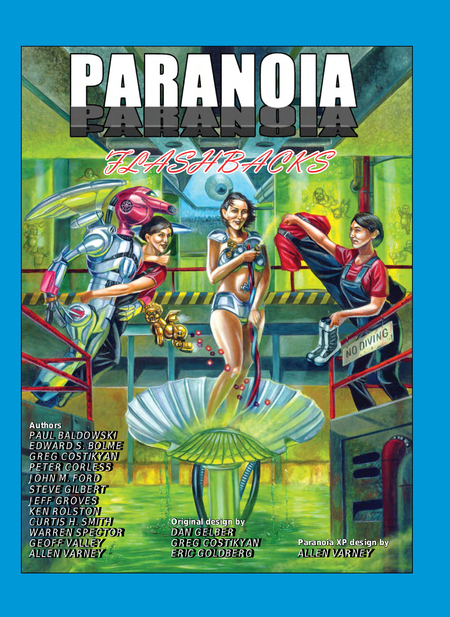
And so: Flashbacks, edited by Varney and Beth Fischi. As the introduction makes clear, the point of the book was to update the best of the old 1st and earlier 2nd edition-era adventure supplements released for Paranoia, which most fans of the game agree were the best. Following the style outlined by the core rulebook for XP-edition Paranoia, punny character names were removed, as were no-longer-topical pop culture riffs and references, and a certain amount of tidying-up happened, but from a brief perusal of a few original versions of the adventures presented here, the editing wasn’t too extensive. The point was just to update the classic Paranoia adventures, so that they could be run straight from the book using the XP ruleset… but, I think, also so that they could serve as exemplars for aspiring Paranoia GMs who wanted to develop their own mission materials. It didn’t hurt that the book collected a number of older modules (originally published in softcover or detached-cover and paper booklet form) into a single, sturdy hardcover book that felt much better-designed to last.
The adventures included (and their original dates of publication) are:
- Three “Mini-Missions” (1985), all by Ken Rolston:
- Robot Imana-665-C
- Trouble with Cockroaches
- Das Bot
- Vapors Don’t Shoot Back (1985) by Curtis H. Smith with Geoff Valley
- The YELLOW Clearance Black Box Blues (1985) by John M. Ford
- Send in the Clones (1985) by Allen Varney and Warren Spector
- Me and My Shadow Mark 4 (1986) by Steve Gilbert and Peter Corless
- Alpha Complexities (1986) by Edward S. Bolme
- Code 7s (from 1986)
- An Ard Day’s Night by Allen Varney
- Reboot Camp by Allen Varney
- Whitewash by Greg Costikyan
There was also a small amount of new material at the end of the book, including conversion notes for different editions and an appendix on pun names used in earlier versions of the adventures, but also one new adventure:
- Pre-Paranoia by Jeff Groves
It’s interesting, by contrast, to look at which adventures ended up in Flashbacks II, a much slimmer tome reviewed elsewhere in this series of posts. In fact, Varney’s introduction to the original Flashbacks mentions all three of the adventures that would see republication in the latter collection: Ken Rolston’s Orcbusters, Eric Wujick’s Clones in Space, and Edward S. Bolme’s The People’s Revolutionary Adventure. (Varney also mentions HIL Sector Blues, but notes that the good stuff in it was effectively cannibalized for use in the then-still-forthcoming Extreme Paranoia sourcebook, also reviewed elsewhere in this series.)
Varney’s selections definitely do showcase a lot of what was great about what was unique, special, and different about Paranoia back when the game first appeared, and set the stage for a flurry of new adventure collections which, unfortunately, never got collected into hardback form in the same way. I’ll be working through those newer adventure collections in later posts. As for this post, I’ll just share some notes I made while studying each of the adventures in Flashbacks.
Mini-Mission: Robot Imana-665-C
This feels like a kind of protean form of the Paranoia screwjob adventure. There’s no trip to R&D, or rather, not real outfitting: the adventure takes place at R&D but the characters are given no equipment. Still, there’s the abusive briefing; the mission where failure is expected; the core task hinges on bureacratic safeguards that failed to take into account failure modes for those safeguards (and on finding more such failure modes); and a broken hierarchic structure is the key. It feels very much like what I’d expect a nascent mission structure to look like.
The result is a sort of ur-mission, which is hardly surprising since it (along with the other Mini-Missions here, and a few others) were in a booklet accompanied what I’m guessing was the first supplementary product for 1st edition Paranoia: the GM screen. And yet the old Paranoia screwjob-mission is there in all its glory: the abusive kook who briefs the Troubleshooters; the mission that’s expected to both fail and be fatal; the intractable technobureaucratic idiocy that renders the obvious and easy both obscure and impossible; the malfunctioning machine in a malfunctioning setting. In fact, it feels a lot less railroady that some Paranoia adventures, and in fact seems to have at least some of what people call the “Old School” spirit: it’s a scenario, featuring setup, description of the locale, and lots of advice about handling contingencies that characters can bring about by making this or that decision… and there’s nearly zero assumption about plot or story or a given sequence of events.
It’s also pretty reminiscent of a modern-day Puzzle Room, and I feel like in fact it’d make a pretty outstanding basis for a one-hour Escape Room scenario.
Trouble with Cockroaches
Not to be confused (as I did, from the title) with the mission included in the 2nd edition core rulebook (which featured a giant cockroach, but was actually titled “Into the Outdoors With Gun and Camera”). This one, another apparently from the 1e GM screen booklet, features members of the Sierra Club secret society (working with the Humanists, Mystics, and Romantics in) plotting to introduce “wildlife” into Alpha Complex. It’s a fun riff that probably served as many early players’ first acquaintance with all the havoc a single secret society can wreak within Alpha Complex. There’s also the familiar horror of crazy, bad-idea gear from R&D, and comes with some solid advice about how to run the scenario.
Das Bot
Another short adventure, in which you should expect torpedoes to fire at the worst possible moment. There’s an underwater lab staffed by some “Oceanians” but mostly the adventure is about dealing with inadequate, inappropriate, and baffling gear, and putting up with an obnoxious, arrogant NPC who is sent along for the ride. The centerpiece of the adventure is a one-way version of what we language teachers call an “information gap exercise”: players have an image of the sub’s control systems, but have no idea what button or lever does what, and they have to figure it out through trial and error, narrating their actions to the GM. The GM has a reference sheet with the missing labels, and narrates what happens after each experimental attempt to use one of the sub’s controls. This is the kind of thing you just never see in mainstream RPGs and I think it’s kind of brilliant, though it requires a little panache as a GM to make the process remain entertaining after the first few surprise mishaps.
Vapors Don’t Shoot Back
This classic adventure takes the form of an illicit tournament between two Ultraviolet-Clearance High Programmers, though the PCs are told this. As far as the PCs know, it’s a series of semi-unconnected missions to root out traitors. There’s a combat in a warehouse, a trip Outdoors to retrieve their patron High Programmer’s independent computer before the enemy team can get it, and a fight with a drugged-up high programmer cosplaying life as a pirate captain on a bot-powered funhouse pirate ship. It’s pure lunacy and is sneakily revelatory about the nature of Alpha Complex, specifically about how there’s a whole different world that exists among the High Programmers and it operates in ways very different from how Troubleshooters experience the world. I think would be great for semi-new players.
The YELLOW Clearance Black Box Blues
This is a fetch quest mission: there’s a mysterious black box, and everyone is after it. What’s in it, nobody seems to know, but getting the damned thing is imperative. This adventure was apparently rated very highly on some lists of best adventures for RPGs, as the back cover of Flashbacks informs us, and it was also remade for the Red Clearance edition. (Which is to say the adventure’s shown up in at least three editions so far.) This one was by World Fantasy Award winner John M. Ford.
The adventure write up is really long and detailed—in ways I’m not sure are totally necessary—and at least one of the resources referenced at the start (a player-facing map on “page 115” is missing from the book. (I think you can get a copy here, though.) It’s also a weird mix of railroad and grab-bag-of-random possibilities; I appreciate that it offers a lot of freedom to the GM and a lot of options to choose from, and that it periodically reminds the GM not to railroad too hard.
Still, in all honesty, I think something simpler would probably have been sufficient to achieve the same effect at the table. That said, the introductory text to the adventure outright states that one of the design goals was to make for fun reading, and suggests that GMs would just as easily strip-mine the adventure for parts as run it straight. I know at least some GMs do, because I’ve had one GM who ran sections of this as part of a homebrew adventure. (I’ve never actually played or run this adventure as written, so I have no idea how it goes at the table, though I can see why it’s famous, especially for the time.)
Send in in the Clones
This is an adventure I actually read, a few years ago, in its original edition. This one is Teela-O-MLY centric (PCs are sent to terminate her, but she’s joined a secret society with cloning capabilities, so it’s not that simple). I think it benefits from having players who know a bit about Alpha Complex’s lore, and it’s definitely something to run after players know a bit about the setting rather than as a first try with a group. It has three parts: a shoot-em-up in the sewers, a bureaucratic nightmare, and a harrowing journey that starts as part of a game show and only gets worse from there. It’s goofy and silly but with moments of true horror scattered throughout, which is about right for Paranoia. Allen Varney’s style here is also stronger than the style of some of the other, earlier contributors: there’s more bolded text and bullet points, which makes me think that it’d be much easier to run this adventure from the text, though it’s still a long schwack of pages through the middle of the book and I probably would need to take notes just to internalize it all. Of course, maybe it’s just that by this point in the book, I found myself skimming, since I don’t actually intend to run the adventure anytime soon.
Me and My Shadow Mark 4
This is an infamous mission where characters have to guard an enormous (and enormously dangerous) warbot, whether the warbot likes it or not. (Spoiler: The Warbot doesn’t like it at all.) It’s notorious as one of the great screwjob adventures of Paranoia‘s long history of screwjob adventures, and one I remember clearly both from an experience of having played it, and from having then subsequently read the original adventure text in the old supplement Acute Paranoia. I think it might be my favorite of the Paranoia adventures in this book, because it’s so pure in its presentation of the insanity of being a Troubleshooter and of living in Alpha Complex.
Alpha Complexities
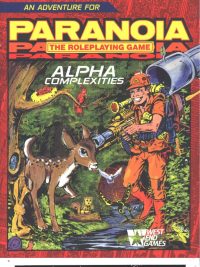

Though I have a copy of the original edition of this adventure, I’d never read it. The cover, though (see right) makes clear that it’s an adventure set in the Outdoors. It has a lot of episodes within it, but highlights include an assault on a supposed Commie facility outside Alpha Complex, and a trip through the guts of the Mark 4 Warbot—yes, the warbot from Me and My Shadow Mark 4, discussed above.
Code 7: An ARD DAy’s Night, Reboot Camp, and Whitewash
“Code 7” adventures are supposed to be extremely tough: the “7” refers to how many clones you probably need to reach the mission debriefing, and of course everyone knows that in Alpha Complex you only have six clones.
- An ARD Day’s Night involves the Computer’s timer for day-nightcycle shifts being tampered with by Sierra Club, in order to simulate an eclipse, but then the changes stay permanent, possibly resulting in a full wipe of the Computer’s memory.
- Reboot Camp follows on An ARD Day’s Night, and suggests that when the Computer is booted back up, something’s wrong with it. The most entertaining version is that the Computer is still paranoid, but it remembers nothing.
- Whitewash imagines how things could spin out of control if a paintbot were accidentally loaded with nothing but white paint, and a formerly Infrared clearance hallway were suddenly painted white and became Ultraviolet clearance.
These are not full-fledged adventures so much as inspirational sketches of possible scenarios, with lots of goofy suggestions. (I found them much more digestible than the full-fledged adventures, if I’m being honest.)
The book ends with some bonuses:
Pre-Paranoia is an oddball mission designed to introduce players to the Paranoia setting. It’s basically training hijinks for Red Clearance citizens who have been recruited to Troubleshooting, and of course it looks like an opportunity for absolute chaos. I think it’d be a good way to start a team who have no experience with Paranoia, especially if you were to help them out a bit in understanding that, yes, this game does have a PVP element to it.
The other bonus material includes a conversion guide for other-edition old Paranoia modules for those GMs who want to run them with the XP system, and an appendix giving the original (bad-pun) names for all the characters in the modules, which in the XP edition have been swapped out for less terrible and punny names.
All in all, this is a solid re-presentation of a lot of classic adventures from earlier editions of Paranoia. My one gripes are that the writing is inconsistent from adventure to adventure, and many of the adventures are written in an unnecessarily verbose style. That’s tricky, of course: part of Paranoia‘s selling point is the gags and jokes peppered through the text, and those do add to the bulk of the text. But the verbosity goes beyond that, and I ended up feeling like for many of the adventures, I’d have to do up my own “bullet-point” styled condensed versions in order to run these adventures without getting flustered or bogged down by the weight of the text. It’s not that the content isn’t great—these adventures are rightly considered classics—but we’ve come a long way in terms of how we think about usability at the table in the 20 years since. (And maybe some of it is just how my brain works.)
Personally, I think maybe the “mini-mission” approach is the one I’d take in writing my own Paranoia adventures: stringing several of them together could easily result in a similar play experience to the longer mission style, without the demands on the GM’s brain. Maybe I’ve been spoiled by all the one-page dungeons I’ve seen, but my eyes just glaze over after reading 30 pages of adventure writeup, only to discover there’s 20 more to go.