



- Series: Paranoia XP Reviews, Book-by-Book
- Reading Paranoia XP: Paranoia [XP], Service Pack 1 (Core Rulebook)
- Reading Paranoia XP: The GM Screen, Mission Blender, and Mandatory Mission Pack
- Reading Paranoia XP: Citizen’s Guide to Surviving Alpha Complex and The Little Red Book
- Reading Paranoia XP: Service, Service!
- Reading Paranoia XP: The Traitor’s Manual
- Reading Paranoia XP: STUFF and STUFF 2: The Gray Subnets
- Reading Paranoia XP: The Mutant Experience
- Reading Paranoia XP: Extreme Paranoia
- Reading Paranoia XP: Criminal Histories
- Reading Paranoia XP: Big Book of Bots
- Reading Paranoia XP: The Thin Green Line
- Reading Paranoia XP: The Underplex
- Reading Paranoia XP: Flashbacks
- Reading Paranoia XP: Flashbacks II
- Reading Paranoia XP: Alpha Complex Nights
- Reading Paranoia XP: Alpha Complex Nights 2
- Reading Paranoia XP: Crash Priority
- Reading Paranoia XP: Sector Zero
- Reading Paranoia XP: War On [Insert Noun Here]
- Reading Paranoia XP: WMD
I’ve been working my way through the collection of Paranoia XP gamebooks I amassed in 2017: this is a review of the pair of volumes titled Stuff and Stuff 2: The Gray Subnets. If that interests you, continue on. If you’re not interested in an old line of a cult-classic RPG, you may wish to skip this post.
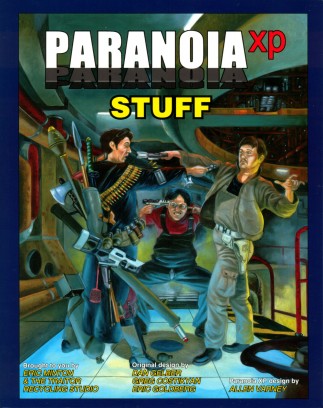
This time, I’m covering Stuff and Stuff 2: The Gray Subnets, the supplementary equipment books for the Paranoia XP line.
The “gear” supplement is a genre classic in RPGs, possibly in part because of the extended, crazily detailed section on pole arms in the AD&D 1st edition hardback Unearthed Arcana:

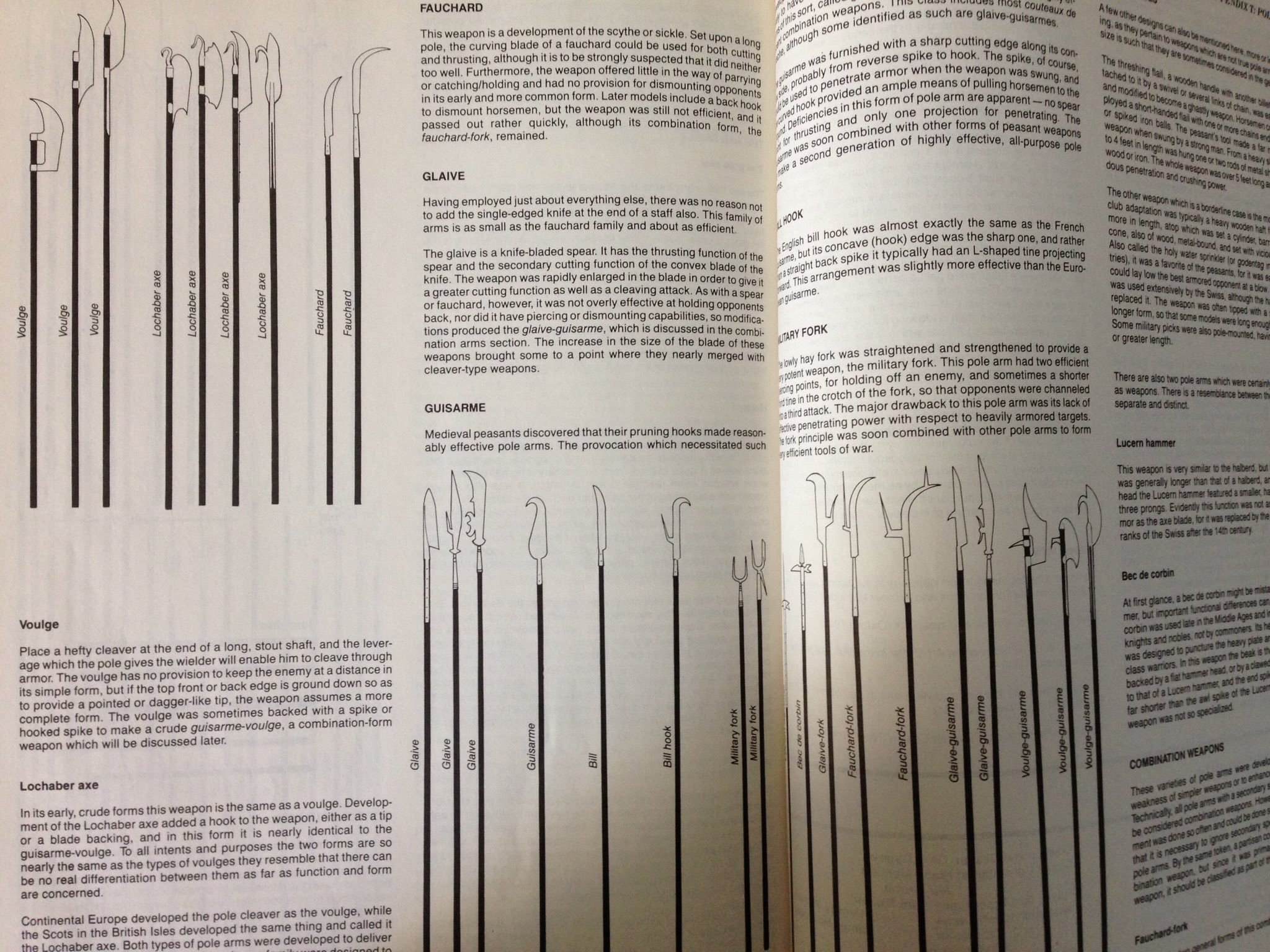
… but more because of other game systems, especially modern/SF games. I’m thinking especially of games I never actually played, like Twilight: 2000, where part of the attraction for some players was very realistic lists of guns and heavier weapons, military vehicles, communications gear, and more.
Typically, gear manuals are about bells and whistles: weapons and ammo and special pieces of kit that most player characters badly want (and thus, which most players will drool over). In Paranoia, though, new gear is almost always experimental or illicit, and usually is only the source of new and terrible problems, with all those bells and whistles existing mostly to fail and break and explode and hurt the characters attempting to make use of the gear.
Speaking of which, Paranoia as a game has a long tradition of gear-manuals-as-more-bad-news, too: all the way back in 2nd edition, Paranoia had a “dangerous gear” manual. I don’t have a copy of it, but it was titled The R&D Catalog, and it was written by Ed Bolme, author of one of the Paranoia tie-in novels, and C. J. Tramontana. My impression is that The R&D Catalog set the broad trend that was followed in the two books I’m reviewing today.

1. The Way These Books Were Written
Like several other books in this edition of the Paranoia line, these two books were produced by the Traitor Recycling Studio. This was apparently an outgrowth “The Great Toothpaste Disaster”—which, as it turns out, was a game of Lexicon 1 hosted by Allen Varney and set inside Alpha Complex. Apparently the game functioned (or at least ended up serving) as a sort of recruitment process for game designers with a love for Paranoia, who went on to contribute portions of books, and eventually whole supplements, to the Paranoia XP line.
Those who’ve been involved in the OSR movement take pride in their participation of “Gygaxian Democracy”—a term I’ve seen used for group projects where people contributed individual hexes for large hexmaps that were then shared online for free, public use of any interested GM. It’s a cool, DIY sort of way to get a project going, but it’s something that Paranoia elevated to a whole different level, way back in the early oughts: see, Allen Varney actually tasked members of the Traitor Recycling Studio with creating the content of actually-published Paranoia books.
That’s an interesting idea, but from my readings in the game line so far, I have to wonder what it was like wrangling those projects into shape. The TRS-powered books I’ve read felt as if they needed some pretty intensive editing, and they also tended to be much bigger and more sprawling—and, yes, sometimes more haphazard—than I imagine an equivalent book would have ended up being if it’d been penned by a smaller group of experienced game authors. I particularly found this to be the case with Extreme Paranoia, a book that has a lot of content that I suspect could have been boiled down a little more, if there’d been time and authors who were skilled at doing that sort of thing.
But, well, I come not to bash or praise, but only to observe and discuss. I’m curious what motivated the experiment, what reasons lay behind doing things this way, and what the editing process was like. However, since I can only speculate, I’ll leave off there, and just say it’s something that certainly shaped the books that resulted from the process… sometimes in interesting ways, if not always necessarily for the better.

2. The C-Bay/Gray Subnets Schtick
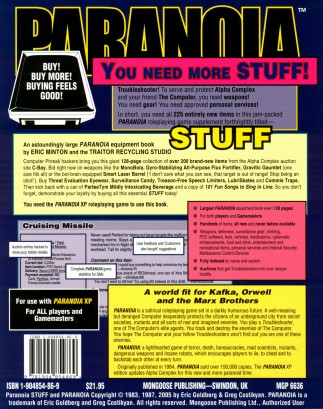
I can’t remember if the concept of C-Bay (an Alpha Complex equivalent of eBay) or The Gray Subnets (the Alpha Complex equivalent of the darknet) got mentioned previously in the core rulebook or some other supplement—I don’t think so, but I’m not sure. Regardless, it was in the pages of Stuff and Stuff 2: The Gray Subnets that these concepts were hammered into place.
Honestly, the authors did a good job given that they were working within the paradigm of a pen-and-paper RPG, but this is one of those things I feel illustrates the limitations of tabletop RPGs, but which will probably be gone in a decade if we have the right kind of creative energies applied to them. Can you imagine a working C-Bay online—or, at least, on a handful of interacting tablets or computers—which players could visit either between or even during sessions? By “working,” I mean both that it has an interactive component—counter-bids and delivery notices and stuff issued automatically by the site, perhaps with some preliminary input (like how much something will cost) as well as a large number of possible errors and malfunctions built it, but also something that, when characters do use it, it seamlessly interfaces with their digital character sheets in Roll20 or Discord or whatever, adding gear to their sheet (and adding some note to the GM’s data about how that gear can go wrong)? I think that’d be pretty amazing, especially if GMs could set parameters like whether PCs should be able to buy a given item, how often a given item comes into circulation, whether and how often NPCs bid on things, and so on.
I mean, this is good old Paranoia, so fast-and-loose improvisation of things going wrong is an expected GM skill, but I’ve also never heard a GM complain about having access to integrated support material… whether for a face-to-face context, or online. My point is more about how the concept of C-Bay opened up for me some pretty cool possibilities in terms of online frontends to various in-game systems, as well as how automation could allow that frontend to give players fun stuff to do during brief snippets of time between games, something that isn’t for every group, but which would certainly be appreciated by some groups.
(I haven’t had the time to check out the digital support materials for newer games like the software issued supporting Monte Cook’s Invisible Sun, so I’m not sure how far toward that anyone’s gone yet, but I feel like sometime in the next decade, someone is going to pioneer some kind of system like this for a game, and take tabletop RPGs beyond what they’ve been since their inception: a hobby with a single primary medium for rules and supplement materials being books of text.
3. Information Layout and the GM/Player Barrier
One thing that I’m not happy about in Stuff and Stuff 2 is the way information is managed. In Stuff, the wacky ways that gear can fail is right there in the writeup… so GMs probably won’t let players read the book because even relatively well-meaning players will notice stuff. whether they want to or not. Stuff 2 fixes this problem by moving that stuff to a GM-only section at the back of the book… but this means a GM who hasn’t prepared for a given item coming into play will have to spend time flipping to the back to get an idea, or else come up with one on the spot. (Which is fine, but reduces the usefulness of the failure modes content, which is actually pretty well-done.) Of course, I’m not terribly worried players will peek: players rarely shell out for gamebooks, and indeed it’s often a bit of a struggle to get adult gamers to read supplementary materials at all, but even so, I can see GMs being hesitant to loan out these particular books, given that the wacky failure modes for all the gear are contained within them—and I can imagine those who don’t mind this could still find themselves having to make up failure results for gadgets in-game anyway.

Again, I think a functional, partly-automated-but-also-customizable fake auction site that could be used by different game groups simultaneously (say, by groups signing in with a group code, and GMs signing in with a GM-only password attached to that group code) would be a wonderful option. I think it’d get used. But it also sounds like a lot of work. Absent that kind of solution, then the best option would be a pair of books, formatted so that the page references match, but in the GM’s version, instead of art, there are text boxes containing the GM-only stuff.
However, I will say that in the realm of printed books, the layouts chosen in Stuff and Stuff 2 alike are disappointing because they breaks a cardinal rule of good game book layout: that one should not let information from one entry spill over into the next page unnecessarily. (That is, if you’re writing a fake catalogue, lay it out like a fake catalog: items should appear in blocks, and the blocks should never be split between two pages. This is purely aesthetic, but I think it’d help make the illusion of C-Bay a little more compelling, even though it was limited to the printed page.
(And, again, I wonder to what degree the real issue was that this the work was crowdsourced and the editing required to get things to fit would have just been a way bigger job than there was money and time for, though I’m just speculating.)
4. The Art
Essentially, there isn’t any for the gear in Stuff 1, and there’s very little in Stuff 2. I really liked the cheesy, horrible sidebar ads in Stuff 2, but I think gear illustrations are one of the big attractions for gear supplements. (Again, hearkening all the way back to the simple illustrations of the various pole arm types detailed in Unearthed Arcana.) I’m sure this would have bored the hell out of Jim Holloway, of course, but then again I also think that cartoony drawings of gear wouldn’t have been the way to go: far more effective would have been terrible photographs taken on sellers’ PDCs, along with the occasional terrible crayon drawing or blurry, baffling image.
5. Supplemental Rules
There are some supplemental rules (or better to say, guidelines) contained in STUFF that GMs might find useful: there’s a short section on Cybernetics in Alpha Complex (spoiler: it suggests that the simple stuff stays simple-but-buggy, but the more spectacularly science-fictional stuff be horribly prone to commensurately spectacular malfunctions) and some rules on payment systems and delivery services within Alpha Complex.
Depending on the tone and flavor of your particular game, this might be the sort of stuff you’d gloss over, or it might be very useful to you, something that a note from Paul Baldowski in the section on payment and delivery methods actually comes right out and says… but Baldowski observes that a profusion of both systems can lead to more fear, distrust, and paranoia among players, which is (in the latter case, literally) the name of the game. Besides that, it’s also more realistic for a range of systems to exist, if you’re doing a “Straight” mode game and wanting to instill some sense of verisimilitude, in which case these short rules snippets do a lot of the heavy lifting when it comes to the worldbuilding necessary to create that sense.
I don’t have a lot to say about the actual products featured in these books, in part because I wouldn’t want to spoil any surprises for anyone, but also because it’s hard to pick favorites. There’s a lot of funny stuff here, and a lot that helps fill out the setting of Alpha Complex. I can honestly say that while reading both volumes, I laughed aloud many times, not only at the little gags that are scattered throughout, but, more often, at the sheer perversity of how messed-up so much of the gear is when it does go massively, horribly wrong. I think if you’re running a comedic SF game of any kind, there’s plenty to steal here. It’d be wonderful if some kind of app were to surface for game groups—maybe free for player access, but a paid upgrade for the GM—but it’s not like I’m regularly playing Paranoia these days, and I certainly don’t have the coding skills to create such a thing at the moment, even if there were a market for it. But it’d be fun, and I do hope this kind of digital supplement concept does get implemented for RPGs more in the future, because it definitely offers a lot of potential fun and craziness.
A game created by Neel Krishnaswami; the original post is gone but I’ve linked to the page preserved by the Wayback Machine.↩