



- Series: Paranoia XP Reviews, Book-by-Book
- Reading Paranoia XP: Paranoia [XP], Service Pack 1 (Core Rulebook)
- Reading Paranoia XP: The GM Screen, Mission Blender, and Mandatory Mission Pack
- Reading Paranoia XP: Citizen’s Guide to Surviving Alpha Complex and The Little Red Book
- Reading Paranoia XP: Service, Service!
- Reading Paranoia XP: The Traitor’s Manual
- Reading Paranoia XP: STUFF and STUFF 2: The Gray Subnets
- Reading Paranoia XP: The Mutant Experience
- Reading Paranoia XP: Extreme Paranoia
- Reading Paranoia XP: Criminal Histories
- Reading Paranoia XP: Big Book of Bots
- Reading Paranoia XP: The Thin Green Line
- Reading Paranoia XP: The Underplex
- Reading Paranoia XP: Flashbacks
- Reading Paranoia XP: Flashbacks II
- Reading Paranoia XP: Alpha Complex Nights
- Reading Paranoia XP: Alpha Complex Nights 2
- Reading Paranoia XP: Crash Priority
- Reading Paranoia XP: Sector Zero
- Reading Paranoia XP: War On [Insert Noun Here]
- Reading Paranoia XP: WMD
This is a review of the core rulebook for Paranoia XP, a pretty old game line that I have some interest in, shared for those who are interested. If you’re not, well… skip it!
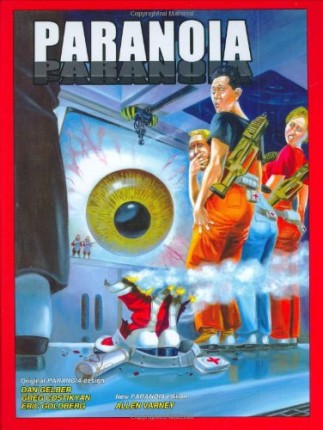

Which Varney duly did. Apparently parts of the game line, which I plan to review here as I read the books one by one, were crowdsourced, meaning contributed by random Paranoia fans on the internet who signed up to contribute.
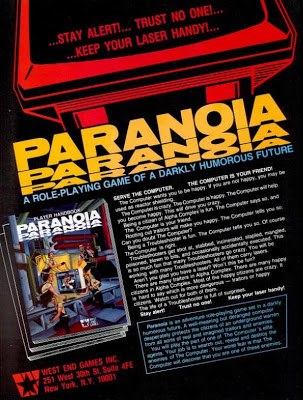
My own experience with Paranoia is limited. I’ve never gotten a chance to play the game, and in fact until last year, all I knew about it were enticing ads for the first and second edition that I’d seen in issues of Dragon ages ago, like this one:

Last year, I bought up a significant amount of the 1st and 2nd edition Paranoia lines (avoiding the later West End Games books and of course not going near the apparently lousy “5th” edition), and then finally took the plunge and picked up (piecemeal) the XP line as well. My timing was good, it seems: I managed to pick up a lot of the last available, reasonably-priced copies of specific books at a somewhat sane price. (I’d probably have bought the PDFs instead at Drivethru RPG, except Mongoose had withdrawn them in preparation for releasing the new edition of Paranoia. A lot of—or maybe all of—the PDFs are now available, including some as Print On Demand. I’d have gotten them already via the Humble Bundle, if I hadn’t missed it: by the time it did come around again, I’d already bought print editions of everything anyway.)
So anyway, this is a review of the XP-edition era core rulebook.
It’s a pretty good core rulebook, though it took me an age—months on end of picking it up, reading a bit, and putting it down again—to read it all the way through. This is both funny and odd, since it only took me a few days to tear through my copy of the 2nd edition’s version of the core rulebook.
Why’d it take so long? Not because it’s bad, per se: I pretty consistently found it funny, actually. I think the real answer is because there was so much detail, even for someone who’s already familiar with the setting and the concept of the game. Certain parts felt suprisingly detailed for a game in which players are famously “not allowed to know the rules.” At each turn, I kept asking myself, “When I get around to running Paranoia, will I be using this subsystem?” The XP edition actually includes some cool innovations over 2nd edition, too, though overall it feels pretty faithful to 2E’s tone and mechanics, with a shot of 1st edition.
That brings me quite naturally to how that faithfulness to 1st edition manifest in the XP book: Allen Varney’s introduction of defined “modes” of play in Paranoia XP. This seems innovative to me, though I don’t know if it’s the first RPG ruleset that actually included explicit “play modes” of this kind. Certainly to me it seems like an innovation borrowed from computer games, and I’ve seen later games—most notably, various Gumshoe-powered ones—use the concept, but this is the earliest instance I’ve seen of it in a tabletop game.
The modes introduced here are Straight, Classic, and Zap. “Straight” is the most surprising: it’s basically when you treat Paranoia as something vaguely like a “serious” RPG setting: there’s still the absurdity and insanity of Alpha Complex and of The Computer, but the characters are more bound by rules and laws and system—they can’t just shoot one another with impunity on the flimsiest of grounds—and there’s a certain degree of seriousness to proceedings, with a little more ability to get a longer-term “campaign” of sorts going. (I hear this is something more in line with the 1st edition rules, but I’ve not yet had the chance to closely read that edition, despite having the 1st edition hardcover rules—so I can’t say.) The “Classic” mode, on the other hand, is the familiar tone of 2nd edition Paranoia core rules: it’s zanier and goofier, full of institutional craziness, but not quite the death-propelled, ridiculous free-for-all that “Zap” (shoot-em-up free-for-all) games are.
(Though he stops short of telling people how to have fun or how not to, Varney makes no pains to hide that he thinks “Zap” is the least interesting of play modes for Paranoia, despite also being what a lot of people who’ve never played it imagine to be the default mode. This, Varney seems to suggest, traces back to those off-the-rails, badly-done late-2nd edition adventure and supplement books, and the mess that was the (fan-canonically) “nonexistent” third er, 5th Edition. I suspect it also traces back to what geeky teenagers do when given sixpacks of clones and laser pistols, but whatever. Either way, “Zap” is enough of a part of the Paranoia tradition that he doesn’t dispense with it. You can have mindless clone-shootups if you really, really want to.)
Speaking of faithfulness to that tradition, I found the tone and humor throughout the XP edition’s core rulebook pretty wonderfully matched that of 2nd edition Paranoia. It’s fun to read, even just as closet-drama in terms of imagining what kind of a game I’d run if I got the chance. From the kooky ECLA (End Citizen License Agreement) that precedes the title page, to the way the rules and flavor text bitlets are written, it’s a masterful presentation of the setting, with as much as possible presented in a wonderfully awkward meta-level that hover between being an RPG rulebook and being an in-world document. By sort of glancing at the fourth wall, but pretending it’s still there, the book creates a bizarre effect that I really enjoy.
So what’s over-detailed? Well, for some Paranoia GMs, I suppose nothing is, but on a personal level, I think the text is ever so slightly verbose throughout. Of course, that’s not surprising for a game published in 2004: rule-lite existed, but it wasn’t as popular an aesthetic as now: people were still paying a lot of money for big fat White Wolf tomes and massive D&D books filled with stats tacked onto stats on top of stats. Having just worked my way through the full line of Wraith: The Oblivion books (a line that ended just a few years before Paranoia XP appeared), I have been feeling “verbosity fatigue,” and maybe some of that’s carrying over; I’m probably also sensitive to it since I’ve been battling my own natural verbosity in a couple of RPG writing projects. (If the OSR has given gamerdom just one important gift in the past decade, it’s the reminder than a ruleset, setting writeup, or adventure text needn’t be verbose, and is easier to use if it’s terse or even downright gnomic… unlike this review.)
With that in mind, certain chunks of the worldbuilding in the Paranoia XP core rulebook are perhaps more detailed than I feel I’d necessarily use in a game: I might change my mind if I were to run a bunch of sessions, and start using things like the Service Firms more extensively, of course: as players became better acquainted with the setting, more oddities and secrets and setting material could boil up to the surface. But at the moment, I feel a bit bewildered by all of the many, many examples of types of Service Firms mentioned in the rulebook. I also think the Mutations section tends to explain things at greater length than I necessarily need (though that was also true of 2nd edition). Again, in the context of games from the time, Paranoia XP‘s core rulebook doesn’t seem that overdetailed… and, well, I feel like the system is flexible enough that one could drop some things, and make up or reintroduce other things at will. (Like, say, Treason Points, which were a feature in 2nd edition and brought back in the 25th Anniversary Edition, or so I hear.)
Likewise, I personally feel like the economy of Alpha Complex didn’t need to be detailed as much as it is: I kind of prefer Alpha Complex being the closest thing to a functional socialist state (albeit a dystopian one) while being deeply paranoid about Communists. I supposed it can, if you want it to, but I always thought it was much funnier when everything was free and shared and a machine ran the means of production and everyone was eating vat-grown food but Troubleshooters were crusading against communism because it was the worst thing in the world.
The ruleset seems solid to me, to whatever degree a solid ruleset matters when players aren’t allowed to know the rules and GMs are urged to change and break the rules at will: the Skills seem appropriately coarse-grained, combat (physical and social) seems reasonably fun, and character tics are a fun addition to the Mutations and Secret Society affiliations (familiar from 2nd edition) that help make roleplaying dispensable clones who’re doomed anyway just a little more fun and compelling.
The adventure included in the core rulebook, “Mr. Bubbles,” feels a little railroady to me, but then maybe that’s because life in Alpha Complex is inherently railroady on some level? I mean, all missions in Paranoia have a set structure, and “Mr. Bubbles,” when it deviates from this structure, seems to do so in the hope of providing a fun riff on the familiar, while also serving as an exemplary adventure that GMs can use to design new and crazier ones: it’s a railroad where the train is supposed to go off the rails multiple times, I guess you could say?
Since it’s in the rulebook, it’s one probably the scenario that gets run most often in Actual Play sessions recording available online (like this one here), and most of the players seem to be so busy grappling with the insanity of their malfunctioning ill-gotten gear, their insane secret society missions, their crazy Mandatory Bonus Duties, and the madness of the mission itself that they’re mostly grateful for a little GM direction.
Anyway, reading the rulebook has just reinforced my desire to run Paranoia. Not just once, but a bunch of times. I think if I had a regular group, it’d be our go-to between-major-arcs game, though I think it’d also be fun to run a straight “campaign” in the style of one of those omnibus films, with some kind of homegrown metaplot action in the background to stitch together the misadventures of each week’s doomed group of Troubleshooters (or, indeed, characters from other echelons in Alpha Complex). Like with Orpheus (a game for which I have a review queued up and will post sooner or later), Paranoia is one of those I think might work better as a series once your players have gotten used to, and familiar with, the weird setting. Of course, if they’re already used to it, there’s no need… but I haven’t met that many, especially players who’re willing to consider it a game for an ongoing series in the “Straight” mode.