For this last bimonthly installment of my recent reading for 2025, I’m including RPG stuff here on this page, since there isn’t a lot of it. It’s at the end, so that those interested can find it easily, while those who aren’t interested can leave the page once they hit that bit.
Ooops, I never finished the RPG book I was reading, so… I’ve moved that to my first post for next year. Anyway, here’s the last of my reading for 2025.
Fiction
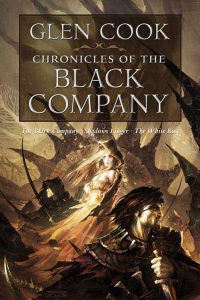
Chronicles of the Black Company by Glen Cook is something I got interested in mostly after reading through a game inspired by the books, Band of Blades. After reading just a few pages of the first novel in this omnibus, the original novel titled The Black Company, I got a strong sense I’d want to read the whole series, and so I ordered (mostly second-hand) copies of most of the other main omnibus books in the series.
Cook is credited as one of the seminal authors of grimdark fantasy, and, well, yeah, there’s that. But what does that mean? I’m late to the party, having first encountered grimdark in RPGs, where it took on edgelordy connotations. I mostly don’t find Cook is consciously edgelording, at least not in the first few Black Company novels. There’s some weird sexual violence, including sexual violence against children that comes up in passing in a few spots, which is clearly referred to as a bad, horrible thing. There’s also some homophobia sprinkled throughout—passing moments, but recurring ones—though considering that the first novel was published in 1984, I’m inclined to consider it a product of its time more than anything else. So, yeah, some of the stuff in this first book aged poorly.
Despite those things, what’s compelling about it is the voice of the narrator, the particularization of all the characters in the Company, the brutal and even downright alien weirdness of their patron the Lady and her servitors, the otherworldly Taken, as well as the terse prose. All of the characters spring to life, and they all felt distinct in my mind despite some of them only getting a few, or no, lines of dialogue whatsoever. Cook also managed to write something that felt true to the experience of soldiers: the endless waiting, with groups of soldiers playing cards in their downtime, and military wizards trying to one-up one another in spell contests, killing time between brutal battles and ridiculously dangerous missions. Somehow it took me a full couple of weeks to read this, but it was a good couple of weeks.
Shadows Linger, the second novel in this omnibus, was immediately different though the terse, spare writing style was recognizable. Most noticeable was the shift to more than one viewpoint, and a simultaneous shift to much shorter chapters… well, sort of. The Black Company had only seven chapters, whereas Shadows Linger hit seven chapters before I was a quarter of the way through. On the other hand, the former novel was still broken down into short sections, they just weren’t labeled “chapters.” Presumably this change is mostly there to make the shifting points of view less confusing, but it also gives the impression that the book is a quicker read.
It’s a quieter novel than the first one, with a lot of the early action focused in a distant city where a couple of characters are hiding out and scrambling to make some money, and where the Black Company isn’t around. The book is still written as a “chronicle” penned by Croaker, but he recounts events from the point of view of a different character for the sections of the book when the Black Company isn’t in town. When they arrive, things connect up and crescendo into a much bigger conflict in a way that somehow managed to surprise and impress me.
It’s another novel I think could offend a lot of modern sensibilities—one major character is at times incredibly misogynistic, for one thing—but I found the misogyny was more the character’s than it was the novel’s, and for my part I enjoyed the book partly because I found it somewhat less bleak than the first, both in some of its details and in the general direction of its plot arc. It’s also got a really big set-piece battle scene that erupts out of quiet in a way that felt pretty satisfying, you just have to be patient in order to reach it.
I found this. quicker read than the first novel, for what it’s worth, and I also found it less grim, with fewer offputting moments. Don’t get me wrong, there’s still dark stuff, but it’s less gratuitous and more tied to the plot in this volume.
The White Rose is the third and final novel in the first Black Company trilogy, and closes out this omnibus. This finds the Company—what’s left of it—taking a stand against their onetime employer, the Lady, and rallying behind the reincarnation of a major historical figure who once defeated her, the eponymous White Rose. It’s got the weirdest setting yet—a vast desert populated with talking menhirs and walking trees and bizarre flying creatures, and I really liked that setting for all of its weirdness. But it also unpacks a lot of ancient history from the world, while still carrying familiar characters forward. One thing I really liked is how, while some characters stay familiar, others change and develop a lot in this book. Most especially, we get a much closer look at The Lady and at the White Rose alike, and they go from being complete ciphers to being quite rounded, filled-out characters, each with their own flaws and strengths and attractions. The book also gives us glimpses of the deep past, which suggest that some conflicts we’ve witness in the trilogy are only the most recent iteration of a long-ongoing, cyclical clash in the world of this story… and yet, at the same time, the book insists that the characters we see at the heart of that clash are not just eternal, externally-driven figures, but individuals with personalities, fears, passions, and sorrows of their own.
I’ll be honest, I ended this omnibus curious about how Cook would go about continuing the story, for a couple of reasons. (It’s surprising that there is a Black Company series after the end of this novel, for one, since they almost disband at the end of the book… almost, but not quite.) As with earlier volumes, we lose a few characters I’d have liked to see more of, and a few others depart for mysterious reasons all their own. I was impressed at how, when the most prominent of those who departs leaves, I actually felt disappointed: he hadn’t been given much stage time, but he’d somehow grown on me all the same. This is a strength of Cook’s writing: to make even minor characters charming in their own way, and their individual deaths or departures somehow more affecting than you’d expect. The novel also has a lot more human moments in it—moments of pity, sympathy, and need that I didn’t expect in the book. It’s a great conclusion to the trilogy, one that ties up enough loose ends while leaving others for future exploration. I liked it best of the three novels collected in this omnibus.
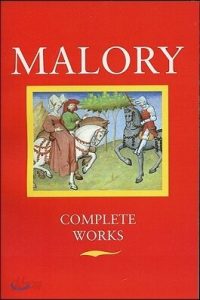 Next, I turned to the Complete Works of Sir Thomas Malory (edited by Eugène Vinaver), a book I picked up as part of my preparations for running Mythic Bastionland. This volume is based on the Winchester manuscript, which means it’s pretty much what Malory himself wrote originally. (Until somewhat recently, the only early version of the text available was the Caxton version, named after the book’s first publisher, and apparently there are noteworthy omissions from the Caxton which are included in the Winchester version of the text.)
In fact, I borrowed the two-volume Penguin edition—which is based on the Caxton—mostly out of concern that Vinaver’s Winchester is not modernized, and I thought it might be a challenging read. However, I was pleasantly surprised by how readable the Middle English is compared to other medieval English texts I’ve read before. Now, there is some vocabulary that requires use of the handy glossary at the back of the text, but overall it’s far less impenetrable than I was preparing myself for—for example, it’s much easier to read than Chaucer, let alone the Pearl Poet, and if you have a decent English vocabulary then most of what you need to adapt to is the non-standardized spelling of familiar words, and a bit of guesswork at words that we still have, but in a form slightly mutated from the one used in Malory’s time. If you’ve read Russel Hoban’s post-apocalyptic novel Riddley Walker, I’d class it as about as challenging a read as that: it reads like mostly modern English with whacked out spelling, plus a few weird variations on the language thrown in. Like the Hoban novel, I found Malory’s original text—as edited by Vinaver—to be not so hard at all, once I got used to it.
I’m not quite finished with this book—it’s long, 726 pages long to be specific (not counting glossary and reference materials in the back), and slower going than an equivalently-long modern English text, thanks to the archaic English and stochastic spelling—but I found it fascinating and very worth digging into. As anyone who’s read the Pearl Poet (specifically Sir Gawain and the Green Knight) or any of Chrétien de Troyes’ Arthurian romances can tell you, medieval Arthurian stories are pretty weird. (Hell, anyone who’s seen the film The Green Knight can tell you that: the film captures that weirdness wonderfully.) There’s a strong fairy-tale strain to the stories, with lots of figures being, well, mysterious and magical and that just kind of being how it is. I also suspect that the structure of these stories is influenced by some of the conventions of stage drama performance from the time, something I started to suspect when reading “The Knight With Two Swords,” the second story in the book. There’s a lot of characters just coincidentally showing up at a spot just in time to deliver exposition needed for the story, and then disappearing (either literally, as Merlin does, or figuratively, as other characters do).
I am kind of taking my time with this book, and likely won’t finish it until sometime during winter holidays in 2026, but I wanted to mention it now because it’s a big chunk of what I read in December this year.
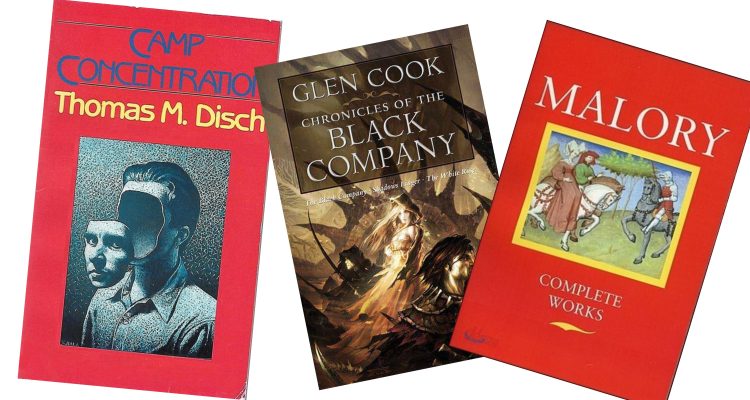
 I remember seeing Thomas M. Disch’s Camp Concentration when it was reprinted back in the late 90s, back when I lived in Montreal and often dropped by Chapters, but I never picked it up. (Instead, I read the simultaneously reprinted Disch novel 334, as well as Disch’s book on poetry criticism, The Castle of Idolence. Both were interesting, but money was tight and I never got around to Camp Concentration. I did pick up a copy at some point, probably when Disch passed away, but it languished and it’s gone now. However, it was mentioned in something else I read recently—maybe Delany brought it up in The Jewel-Hinged Jaw?—and decided to check if the library at work happened to have a copy. Whaddaya know, they have a a 1982 mass market paperback edition from Carroll & Graf. And so now I have been reading it.
What can I say? It’s Disch, so it’s pretty dark. It’s a bit reminiscent of Flowers for Algernon—a guy takes part in a weird science experiment that messes with human consciousness—except the guy taking part is a political prisoner (specifically, a conscientious objector), and the experiments involve things like hyper-lucidity drugs and other weapons to use in the war he refused to sign up for: one against the Third World guerrillas tearing apart the shaky democracies of the West. (I guess Americans have had that nightmare floating around in their backbrain for some time now. Probably as long as America’s been tearing apart the shaky democracies of the developing world, I guess?) Anyway, it’s a much darker work than “Flowers for Algernon”—the novella, at least, which is the version I’ve read—and a fairly strange book. I’m less impressed with it that with some of the other Disch books I’ve read, but it was interesting and strange and a relatively short read. (Though, in fact, I finished the book on January 1st, I’d read most of it by the end of 2025, so I’m counting it as a 2025 book.)