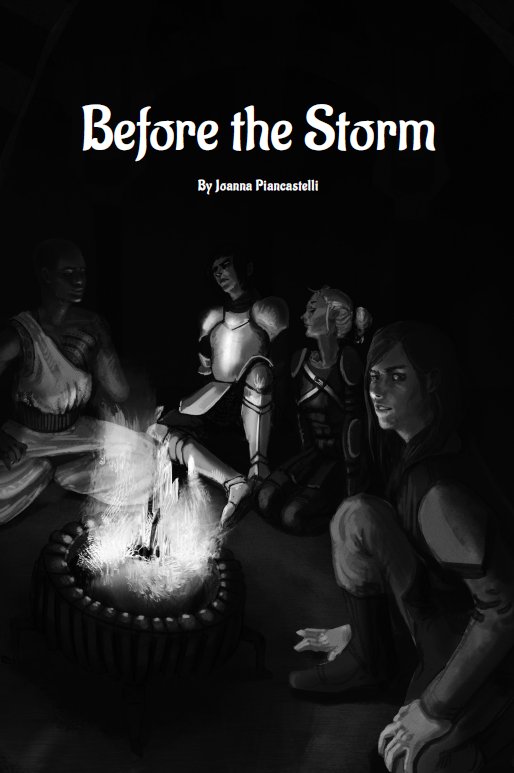
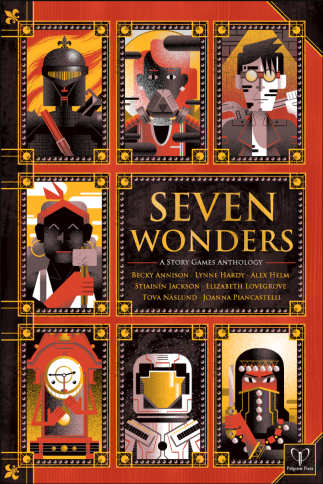
 A few weeks ago, I was fortunate enough to participate in a playthrough session of Joanna Piancastelli’s Before the Storm, which is the final final game in Pelgrane Press’s storygame collection Seven Wonders. I should have written up the session at the time, because now some of the details of the session have slipped away from my memory, but I’ll focus on my impressions of the game as a system and an experience, rather than the plotline that unfolded during our particular session.
First off, the game really captures the mood it’s going for, or it did for us. The idea is that your characters are gathered somewhere the night before the great battle that will decide the fate of the last holdout in the world against an a massive empire. The game isn’t about that tumultuous battle, though it does come up in the denouement: it’s actually about the characters’ conversation as they wait for the dawn of their D-Day, and all the memories and flashbacks that cross their minds during that time. The characters have in their possession something called The Sword of the World, but it’s so open-ended that in our game that wasn’t even literally a sword; it was a spiritual force we had allowed into ourselves to facilitate the coming battle.
What our group found was that a lot of the gameplay was about characters’ differing values and beliefs, and how characters might challenge one another on their blind spots, delusions, and blind faith in this or that. My character was a teenaged mystic who’d been raised to believe his order was a benevolent force for good in the kingdom and that it would save the world. Boy did others do their best to poke holes in that belief! Similarly, one character was essentially a fantasy Thatcherite who believed money was the key and solution to all problems, and we had fun skewering that belief as much as we could. Another was a guardsman with some heroic ideals that he failed to live up to, as we reminded him, and the other character was a friend to animals whose claim to believe that animals and people were all equal, and all necessary for the battle, was something we challenged as well.
The mechanics honestly reminded me a lot of Fiasco, with a little bit of The Quiet Year mixed in. That’s not a dig: I love Fiasco and I think these mechanics, despite reminding me of that system, were thoughtfully and intelligently put together. Essentially, the game runs off pulls of cards from a deck, which prompt a little discussion and then a flashback, one per round for each character. As the flashbacks unfold, players might play their own characters, or they might play other characters briefly. For example, in one of my characters’ flashbacks to childhood, two players took on the role of fellow mystic students, while the other player took the role of their instructor.
There’s some giving away of cards, some keeping of cards, and the cards essentially determine your character’s fate in the final battle, as well as (through the selection of a card from those you have accumulated) the chances that the final battle goes your way. In our game, one player purposefully gave away his black cards and collected red cards, to ensure that his character would have a chance to die heroically. I was trying to have my character die in a blaze of glory, but he ended up surviving due to this. 1
We had a great, dramatic, and satisfying experience with Before the Storm, and I definitely would like to revisit Seven Wonders and try some of the other games it contains. (I’ve had it on my shelf but haven’t read all the way through, since a I had a feeling a lot of the games would work better face to face and I haven’t had much opportunity for that in recent years.) Becky Anniston’s When the Dark is Gone especially has me curious!
This mechanic, too, reminded me of the Aftermath stage in Fiasco. In fact, I think this is how I made the connection.↩