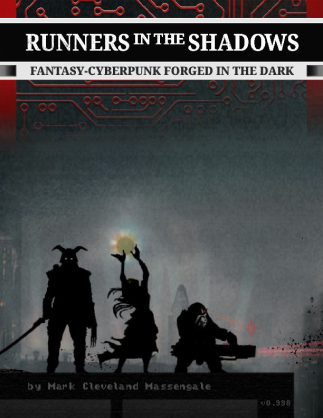
So, I’ve been playing a game of Mark Cleveland Massengale’s Runners in the Shadows with a group GMed by Jeremy Tolbert for almost a year now. It’s a Forged in the Dark hack for playing Shadowrun style fantasy-cyberpunk games. Despite Shadowrun having been pretty big 90s game—something that most of the other players in our group seem to have had experience with—I knew the setting/game by reputation only. To be honest, in the 90s I wouldn’t have wanted to play Shadowrun anyway: I was very much in the “I don’t want my genres mixed up” camp, like a kid who doesn’t want different foods touching on their plate.
Hell, I was even a little dubious about Shadowrun even when we started with Runners in the Shadows: Cyberpunk plus fantasy races? Really? Can it work?
 Well, to my surprise, it does work, at least in RPG form. I think partly this is because the setting doesn’t take itself too seriously, specifically not in the game we’re playing. That’s not to say we don’t face dire consequences or dilemmas from time to time, but I mean: an elf with cybernetic legs who’s a super-sniper? A troll who occasionally shows up to wreak mayhem? A street punk with cyberarms and a penchant for explosives, cheek and jowl with a wizard who conjures spirits and a single dad who is adept at cutting deals and talking his way past people? Or, my character, a drone pilot with a mysterious corp-military background and a ridiculous cold streak an an addiction to normcore BTL chips, whose closest collaborator in the group is a dwarven hacker with a penchant for slapping stickers onto every system he hacks? All that is mashed in among our characters, who style themselves after the Knights of the Round Table—yeah, they’re Arthurian nuts as low-rent runners whose “Arthur” is a souped-up, biohacked canine with a virtual crown on its head and with better hacking skills than most of the group.
The system is about as streamlined as you can get for a cyberpunk game. Blades in the Dark is really loose and light on gear, preferring handwaves to detailed writeups. Runners in the Shadows is a little bit less loose—there’s detailed writeups for the kinds of implants characters can have, and how they work, for example, and also detailed descriptions of the various modules that can be swapped in and out on drones. But I think that’s somewhat inevitable in a science-fiction game: part of the attraction is the tech, and handwaving with tech leads to the differences between technologies being less distinct and less meaningful.
Where Runners in the Shadows shines is in the same place Blades in the Dark does: the action system. When you’re used to the rules, it’s easy to reconcile different actions going on at the same time. There isn’t a separate, complicated, janky subsystem for hacking, or for drone piloting, or combat. Basically, everything is resolved in the same way, whether you’re shooting at an enemy from 500 yards, trying to bust past the network security into a corporate server, trying to talk (or fight) your way past a group of gangers, piloting a drone through dangerous airspace, or even attempting to bash your way through a wall inside a refurbished warehouse. You figure out the position and effect available for a given appraoch, adjust to preference, roll the related ability dice, and figure out whether the result is a full success, success with complications, or a failure; then you maybe resist any negative consequences, or deal with them. That’s pretty much it, and it’s the same pathway for any action you’re attempting in the game.
As with Blades, you can expand or contract how significant the rolls are for a given action: maybe one success means you wiped out a single enemy, or sent a mob fleeing. Maybe you need to fill a clock (with three, four, or more successes) in order to finish building a superweapon or hacking a particularly secure system or navigating your way through an unfamiliar complex. The mechanics don’t change, and that’s a real strength of the system.
I should note, we’re playing with some of the rules modifications published by John Harper in the recent Deep Cuts book. These rules mods streamline the downtime phase and make it more fun and interesting to play out, make certain (mostly minor) injuries slightly less horrifically punishing, and so on. I’m a fan of a fair number of the rules mods in Deep Cuts (enough to have picked up a hardback copy in the recent Backerkit campaign for the book), and would definitely be using some of them for any Blades in the Dark-based game if I were to run it.
Would I run it? I don’t know. I’ve played Blades itself quite a lot—maybe for almost two years straight, between two different groups, and for four years if you count Runners in the Shadows and a a pretty long campaign of Scum and Villainy . There are a lot of other games out there that I’d like to try out, after all. But then again, I really, really like the game system, and find it elegant and fun… and there are some really cool Blades-based games out there, like Band of Blades and Court of Blades, which I’d love to get a chance to play or run sometime.
But no, I probably wouldn’t run Runners in the Shadows myself, though that’s mainly because Shadowrun isn’t a big thing for me. That said, I might use a truncated version of it to run a straight cyberpunk game. I did, in fact, recommend it to a friend who was casting about for a cyberpunk RPG ruleset, because I think it does the genre pretty well, and because I think it’d be trivial to omit the fantasy trappings and just use the cyberpunk stuff from this game with little or no loss.
Anyway, I’ve been having fun with Runners in the Shadows, and I think it’s mostly a well-designed hack of Blades that offers a streamlined, sensible, modern ruleset for playing Shadowrun, or any cyberpunk game using Forged in the Dark mechanics.