- Readings, January/February 2026
- Readings, March/April 2026
- Readings, May/June 2026
- Readings, July/August 2026
May and June of 2026 were pretty good for reading! I we finished up some of those translations projects I mentioned last month, and though more have come in, with a lot more free time available I was able to finally do some serious reading!
I remain stalled out on reading Sir Thomas Malory’s Complete Works (edited by Eugène Vinaver), which is funny since the RPG I was reading it for inspiration for has played out and ended. Even so, I’m trying to get back into it, one chunk at a time. In the meantime, below the cut I’ve only posted properly about things I’ve finished. There’s a lot!
Fiction
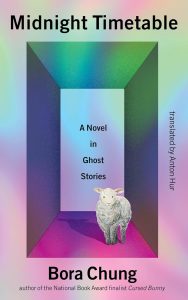
Midnight Timetable by Bora Chung (translated by Anton Hur) is a book of ghost stories set in a research complex where cursed/haunted objects are held and studied and, the ending suggests, protected from the dangers of the world of the living. It’s a very light book, for a collection of ghost stories, which is not to suggest that the stories don’t contain darkness, so much as to say that there’s constantly a weird sense of humour to them. Several of the stories are accounts of events in the lives of people working at the facility, retold by coworkers, so that there develops over the length of the book a kind of “lore” tied to the research facility. That facility itself is less a feature of the stories than a kind of backdrop or connective tissue between them, for the most part, but it’s present enough as a trope that it kind of brought to mind things like SCP or, if you’re old enough to remember it from late nights on TV in the late 80s, the old Friday the Thirteenth TV series.
As for the ghosts, some of them feel very much like the kind of thing one might encounter in modern Korean urban legends, whereas others felt more surreal and bizarre, like the ghost sheep that appears briefly—in a particularly surreal scene—in one story, and then later shows up again much more prominently in the next story. One gets the feeling—and I guess it’s kind of confirmed by the author’s remarks in the epilogue—that these ghost stories are intended as fun reading, rather than as particularly frightening. At least, the stakes never felt to me like they got too high, and the sting of each tale always felt somehow appropriate to the situation in which the haunting occurred, which in a weird way felt like it moderated the chilling effect of the hauntings. I haven’t thought through that idea too deeply, but I think I find ghosts scarier when their hauntings are somewhat unfair, inexplicable, and cruel. In these stories, as the book itself acknowledges, some living people are way scarier than any ghost.
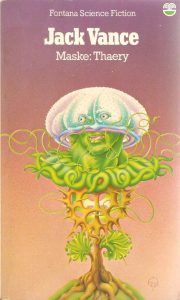 The library at work had a copy of Jack Vance‘s Maske: Thaery, and I’ve eyed it off and on for years, but I figured I might as well read it. The copy I read was the Fontana Science Fiction imprint edition—the same publisher as a number of other old SF novels in the stacks—pictured to the right. I have to admit to having picked up early on an uncomfortable vibe similar to the one I felt when reading Vance‘s The Gray Prince, which Vance wrote after a trip to what was then Rhodesia, and which sadly reads like a defense of European colonialism in Africa, not to mention a SFnalization of Rhodesia in the 1970s sympathetic to the British perspective. I don’t think Maske: Thaery represents anything like as direct an analogue to any real-world society, but on some level, looking at the mutually hostile and weirdly “opposite” societies of this setting, it does feel a little bit like how Europeans would have described and thought about different ethnic groups in one of their colonies, as well as how different ethnic groups who’ve suffered colonial rule sometimes look at one another: simplifying, exaggerating, and antipathetic.
Along these lines, what’s interesting about Vance’s worldbuilding is that he—maybe accidentally?—recapitulates something David Graeber and David Wengrow described in The Dawn of Everything (a book I briefly discussed in this post from last summer) as a real-world phenomenon: schismogenesis. This is the (contested) idea that societies define themselves in opposition to one another: if one group farms grains and vegetables, the other group will lean into hunting or fishing, say. Wengrow and Graeber write:
Each society performs a mirror image of the other. In doing so, it becomes an indispensable alter ago, the necessary and ever-present example of what should never wish to be. (p. 180)
Whether or not this is actually a real phenomenon in our world, I don’t know: as the essay I linked above suggests, there could be other reasons why we see societies side by side so often inverse-mirroring one another in this way. But this is a fundamental worldbuilding tool in Jack Vance’s writing, one I’ve seen in other of his novels as well, and one that is immediately noticeable on page 1 of this novel. I don’t know if Vance was aware of this concept (which dates back to the 1930s) or if he was just drawing on his own observation of human behaviour, but it’s an interesting facet of his writing, and one that seems to run through a lot of it. To what degree Vance’s affinity for schismogenesis relates to his experiences of travel in a recently-postcolonial world, I’m not sure—but I can’t escape the feeling that there is indeed a link. It gives this worldbuilding trick a kind of, well, colonial vibe, if I’m honest, and I was a uncomfortable with it.
I don’t think Maske: Thaery is supposed to be a direct analogue to anything in the way The Gray Prince is, but it still has a funny, vaguely colonial feel to the seemingly schismogenetic cultures. The novel itself, though, is more concerned with interworld shenanigans of a kind one might expect from a book set within Vance’s “Gaean Reach” milieu. The tale itself, as it turns out after a long setup, is… well, it’s kind of hard to categorize. There’s some class critique, some bildungsroman, some espionage, some travel-adventure… but really, the book is kind of a muddle, and, well, I’ve noticed that a lot of the characters fall into stereotypes that one sees in a lot of Vance books. Between that and the sexism inherent in his work, it’s one of those things that can be a little distracting. Meanwhile, this book is not Vance’s strongest work, nor does it live up to the other Gaean Reach books I’ve read so far. It was alright, and entertaining enough, but not something I’d ever revisit.
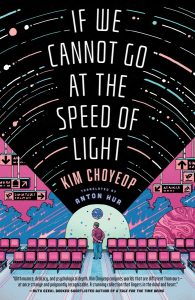 My wife mentioned Kim Choyeop to me long before her work was ever translated to English, telling me that she was sure I’d love her stories. She was right. If We Cannot Go at the Speed of Light (translation again by Anton Hur) is a recent publication (in English translation) and one that’s solidly worth checking out. The stories in this collection display incredible range and a stunningly vivid imagination. The tales collected here run the gamut: there’s one about first contact, a couple about oddball forms of space travel, one about posthumous mind-uploading and family, a utopia/dystopia, a tale of emotions sold as consumer goods, and even a strangely haunting tale of (transient) human-alien symbiosis.
Kim’s work also manages to feel very “Korean” while also feeling like it’s in dialog with a lot of SF—and global issues—outside Korea, which I think is notable and interesting. She has a really light touch, and her instinct for where to start and end a story is sharp. I enjoyed these tales and found myself thinking them over… as well as thinking that she’s a writer who could do really interesting things if she were working with longer wordcounts. (Most everything in this collection is a short story, but I’d love to see what she’d do with her themes and ideas at novel or even novella-length.)
The two stories that stuck with me most were the really haunting “Symbiosis Theory,” the tale aforementioned about alien-human symbiosis, and “Pilgrims,” which felt almost—not quite, but almost—like a response to Ursula K. Le Guin’s “The Ones Who Walk Away From Omelas.” In the latter tale, people from a village of people bioengineered to be free of hate and violence go on pilgrimage to a place called “The Origin” where people are engineered in a very different way… but what does it cost to live free of hate and violence, and would we be human without these capacities? Both of these stories stuck around in my head for days after I finished reading them. I also thought “The Materiality of Emotions” was really thought-provoking, in its exploration of our strange and fraught modern relationship to our own emotions.
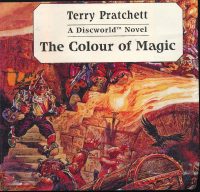 I’m new to Terry Pratchett‘s Discworld—and sometimes feel like I’m the last person my age to start reading them—so I figured I’d start with The Colour of Magic. I gather it’s not so as Discworldy as the books become later in the series—that it starts our more as a send-up of pulp sword and sorcery fiction—but, well, since it’s my first Pratchett novel, I have nothing to compare it to, and it feels pretty Discworldy to me.
The audiobook, read by Nigel Planer, has some extended sound effects that were funny at first, but ultimately I felt were a bit rough. (Then again, I’m sure the audiobook was recorded a long time ago, so maybe it’s the best the audio engineers available could do with the tech available at the time.) The reading, though, is superb, with Robinson rendering the text clearly, characterfully, and inventively. I would point to this audiobook if someone asked what a human audiobook reader can do that an AI can’t.
Either way, I found it quite an enjoyable novel, full of cleverness and wit and critical but undeniable love for the genre of fantasy, especially swords and sorcery. (This was my listening for drives to and from work in May, and for my too-infrequent trips to the apartment complex gym.) At one point, I found myself googling for information to confirm my suspicion that Pratchett had played D&D at some point in his life, because, well, it’s kind of obvious from his work. From the absurd character names to the crazy adventures the characters undergo, I’m surprised and kicking myself for waiting so long to try a Discworld novel. Given the chance, I’ll definitely be visiting Discworld again soon.
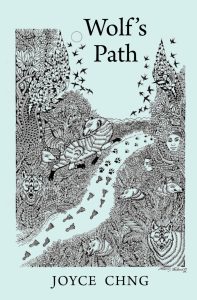
Joyce Chng’s Wolf’s Path is a retrospective of Chng’s short fiction, apparently going right back to the early days of their career. It was published by Atthis Arts and was released to mark the author’s 50th year on the planet.
I’ve included this book under “Fiction” but it’s worth noting that toward the end it also contains other things, like poems and even a recipe that is also a comment on life during the pandemic. That said, it’s mostly fiction, so that’s why I’ve placed it in this category. There are a few threads that run through the whole: war is a preoccupation, for one thing, and many of the main characters are queer, though often they’re living in a world that is ambivalent about their queerness. Chng’s stories are also very evocative of place: the smells, the weather, the foods, the sounds of what are often, if not always, Southeast and East Asian settings. (The setting is ambiguous a lot of the time, and some stories are set elsewhere—on other worlds, in New York City—but even in these, there’s an attentive inclusion of Asian themes, imagery, details, and more.
Standouts for me included “Dear Son” (a last will and testament with a twist), “A Basketful of Figs” (a story about identity, love (?), war, and family), “Silver Wings” (about a superhero’s daughter grappling with her mother’s legacy), “Lotus” (the story of a couple who stumble onto fabulous plenty in a climate-changed world, and the dilemma it poses for them), and “Yao Jin” (a story I can’t even really summarize but which has stuck with me). You’ll notice I’m being evasive about what the stories are “about” and in part it’s because I think these stories work best when you go in blind, and in part because the stories are actually about a lot of different things at the same time, like all good fiction is. “Dear Son” especially stuck with me, the dilemma it poses very much like the dumplings in the story—fascinating, strange, serious and intense, philosophical and at the same time laugh out loud funny and audacious.
I read this as an ebook, which I apparently bought on the jungle site at some point, though if you’re interested, for a day or two more it’ll be available in the Pride bundle over at Storybundle.
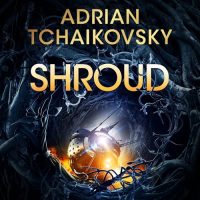 Shroud by Adrian Tchaikovsky is the first work by this author that I’ve read. I checked it out as an audiobook, while pedaling like a maniac at the gym and, mostly, driving to work and back home.
“Shroud” is a moon orbiting a gas giant, where life is discovered. It has a complex atmosphere, and one that blocks out direct light from the system’s sun. The narrator is a scientist aboard an exploratory ship run by a corporation—and, if you’re thinking of horrid space corps like the ones in Alien or the game Mothership, you’re on the right track. But when things go wrong and some characters find themselves marooned on Shroud, they make an astonishing discovery, one that will be overshadowed by the rapacious nature of the corporation that owns them.
I was pleasantly surprised at how much I enjoyed this dark story, and how much it made me feel like I should read more modern SF set in space. (I hesitate to call this “space opera” as that feels like the wrong subgenre designation for it, but maybe that’s just me.) Anyway, I guess maybe I should check out some more of the author’s work, though I’ve no idea where to begin. Suggestions, anyone?
Nonfiction
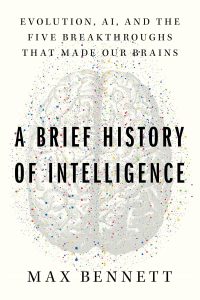 A Brief History of Intelligence by Max Bennett. The book does what it says on the cover: it explores the history of intelligence on our planet, from its most rudimentary stages of development up to the present and beyond.
Bennett does touch on AI, but mostly in terms of talking about the mechanisms underlying how AIs are trained, and how those mechanisms sometimes match and and sometimes differ from the apparent mechanisms of intelligence in living creatures, from the earliest bilaterans, through the vertebrates, mammals, primates, and human beings specifically. (He breaks it down to five basic breakthroughs that made human-type intelligence possible, reserving a sixth speculative breakthrough for what might come next.)
It’s a somewhat dry read, but you will walk away from it with a better understanding of some of the underlying processes in your own consciousness and mind and where they probably came from in the process of evolution. Not that this is necessarily helpful in managing one’s mind, of course, but the aim of the book is more about telling us the history of our brains, and that genuinely is interesting to know more about.
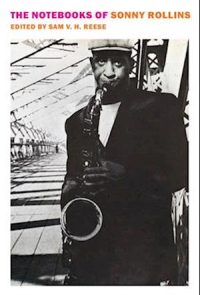 The Notebooks of Sonny Rollins (edited by Sam V.N. Reese) were, coincidentally, the book I started about an hour before hearing the sad news of Sonny Rollins’ passing. Rollins was the last man standing from his generation of jazz musicians, and it’s a loss to the world.
His notebooks proved somewhat challenging to parse. I especially struggled with the part that interested me the most: his notes on saxophone playing. I just couldn’t make heads or tails of most of the stuff he wrote about saxophone technique, which feels a little frustrating since I’m sure whatever he was discussing in those notes was really invaluable.
Outside of the musical notes, the stuff about his personal life and philosophy were interesting to see. I didn’t know Rollins was so much into Eastern philosophy and religion, yoga (long before yoga became trendy in the West) and spirituality. I also appreciated his political reflections toward the end of the book, and Rollins was clearly quite preoccupied with the problems that American capitalism pose to the planet back around the time of the Bush administration, or even before. It was also illuminating to see two things about how Rollins addressed himself in his writing: for one thing, he was merciless at points in terms of the amount of discipline he expected of himself. (The bit where he describes himself in the mirror as “too much fat ass” and the constant reflections on diet, smoking, and health come to mind.) The other thing, though, was that he made an effort to politely address himself, often imploring himself to do this or that thing on saxophone, often preceding the request with the word “please.”
One thing I found myself wondering was what other information was contained in his papers. Apparently there were six boxes of his notes from over the years donated to the university library that now houses them—Duke University, I think it was?—and I can’t help but wonder what else got left out. There were, I suspect, a lot more sketches, and a lot more insights. That said, this selection is enough to give a partial view of the man from the inside, especially of his evolution over time. There were so many potential book titles scribbled in his notebooks, and I wonder if he ever made any progress in writing one of them? (I wish he had, though maybe I would have found it just as incomprehensible as most of the saxophone tips included in this book.) In any case, I guess for more of Sonny Rollins, I’ll have to go track down Aiden Levy’s biography. I hear it’s a heavy tome, but maybe if I see a copy in Canada this summer I might pick it up. (Or maybe I’ll just get an ebook?)
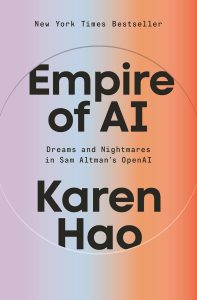 I also read Empire of AI: Dreams and Nightmares in Sam Altman’s OpenAI by Karen Hao. It’s quite the book! Hao’s central thesis is that the best metaphor for the way AI companies are operating today is “imperialism”: that they’re fundamentally extractive and emploitative, that they concentrate power and wealth, and that they are worst for the vulnerable and disadvantaged. She mostly brings the receipts for this, too.
This is a book that I found was torn between two different projects. The first is to give a history of OpenAI up to the present (circa 2025, when it was published); the second, to unpack Hao’s thesis that the generative AI industry we’ve ended up with is one in which AI corporations act like empires in most of the worst ways possible. To some degree, I think doing the latter would be impossible without doing the former to some degree… but there were times when I felt like Hao was struggling as the two threads diverged. All of that said, if you’re like me in having the impression that most of the gen AI industry is dominated with pathetic clowns and horrible assholes, Hao’s writing certainly supports that view. She doesn’t engage in character assassination, by any means, but she does paint a picture of the techbros of AI—and especially of Sam Altman—as people no sane individual would ever trust to take care of a mission as highfalutin as the one that OpenAI constantly claims it is diligently carrying out. Altman particularly comes out looking like a manipulative liar and a bit of a psychopath, at least if he’s already rubbed you the wrong way as he has me. Why should we trust someone who insists that safety is the raison d’être for OpenAI, yet advocates cutting corners when it comes to safety? Why, indeed, should we trust his prattling on about Universal Basic Income when the man let his own disabled sister languish in poverty for years? Why should we trust anything he says, when practically nobody who worked with him seems to trust him after a few years?
To me, though, Hao’s thesis about how AI corporations behave like empires—fundamentally extractivist, exploitative, consolidatory with wealth and power, and so on—is more interesting than the details of Sam Altman’s (so-called) life, and I also found more that I didn’t already know about in the sections where she explored the use of data annotators abroad and the construction of data centers abroad. The story of OpenAI is important to her thesis, but she tells it in such a detailed way that sometimes I found myself wondering when she’d get back to exploring her very compelling analogy. She does get back to it from time to time, sometimes quite forcefully, but honestly most of the book is focused on recounting, in detail that is incredible given the corporation refused to cooperate with her for most of the research—the story of OpenAI. That said, I have to give her props for also being one of the few people I’ve seen to present a compelling alternate vision for what we could be doing with AI, in a more human-centric and non-imperialistic way, with real-world examples!
If you’re interested in this topic, and not willing to read a long book about it, I’d suggest this long interview of Karen Hao, where she covers a lot of the same points about AI imperialism itself. (I think it also works really well as a kind of behind the scenes glimpse of Hao’s take on issues about which she makes an effort to remain as neutral as possible in the book.) I really enjoyed Empire of AI, and I think Hao’s one of the few speaking truth to power when it comes to the whole AI business and what it’s doing to our world. As she argues: it doesn’t need to be this way, and it could be so much better, and the reason it isn’t is not because of the nature of the tech, but because of specific business decisions made by specific people who could decide otherwise.
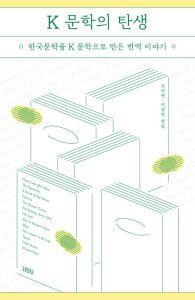
K문학의 탄생 (edited by 조의연 and 이상빈—I’m reluctant to Romanize their names incorrectly) is a book focused on Korean translation and translation’s role in the so-called K-culture industry. It’s a collection of essays focused mostly on translation and issues related to it, which my wife had out from the library and which she recommended to me. It’s not a completely bilingual volume, but most of the essays included appear both in Korean and in English.
The book contains essays by a number of translators, mostly grappling with issues related to the translation of Korean literature to English. I especially enjoyed Lauren Albin and Sue Hyon Bae’s essay “Our Own Kim Hyesoon” (about the process of translating a collection of Korean poems, performed by a group of English-speaking poets), Bruce Fulton’s “Every Translation Matters” (about the different ways that translations can “matter” across genres, contexts, and more), Lizzie Buehler’s “Translation as an Act of Recycling” (about how perceptions of translation have shifted over time, and how perhaps another shift is overdue, to recognize without shame that translation is a derivative act of creation, one that can be framed as “recycling” with all the anti-capitalist freight that could carry), and Jake Levine’s “K-Translator as K-Contents Worker” (about Levine’s experience and feelings about being a literary translator and a “K-content worker” translating pop song lyrics). There are a couple more essays in the book (and a few that appear only in Korean, which I didn’t bother to try read), but these are the ones that really stuck out to me, especially that last one. I can relate, as a (co-)translator of SF, since genre fiction has always straddled the line separating literature from pop cultural content.
Probably this book is not easy to track down, but if you’re interested in Korean literature in translation, and especially the behind the scenes work side of it, the book is worth getting your hands on.
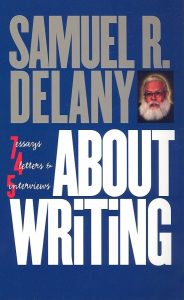 Finally, I read Samuel Delany’s About Writing: Seven Essays, Four Letters, and Five Interviews. Delany is thoughtful and interesting—if sometimes daunting1—and I was curious what he had to say about the art and craft of fiction writing.
The introduction is incredibly long and incredibly detailed… at least, in comparison to the first few essays. In it, Delany explores things like what drives writers to write, some of the mechanics of good fiction writing, what each of the last few centuries has contributed to the art of the novel, and his own tastes and preferences as a reader. To say he’s widely read would be an understatement—and to be clear, it doesn’t surprise me a bit, having read other nonfiction books by him—but one ends up feeling like, “Geez, I’ve never read half of these books…” and feeling sure Delany would raise an eyebrow and say, “Well, you know what to do…”
The essays are short and deal with a range of topics, mostly about career concerns and the teaching of writing. They’re followed by a handful of letters—all from Delany, but to different people—kicking around some of the ideas that come up in other parts of the book. I found this the most pleasant part of the book, as the letters were fun to read and Delany’s personality shone through them very clearly, more than anywhere else in the book.
Next come the interviews, which are very long and very in depth. They’re less like interviews and more like essays with occasional external prompts. They paint a picture of Delany as a very smart and slightly daunting figure. He sometimes goes on tangents—tangents prompted at times by the built-in assumptions in some of the questions, of course—and even those tangents have an incredibly methodical rigour to them. The man is utterly learned, though I cannot help but wonder what being his student is like. (Like, most Creative Writing classes I’ve been in would have been gobsmacked and silent if faced with lectures on anything like the level of discussion going on in these interviews.)
Finally, there’s an appendix where Delany kind of lays out some basic advice for writers, which I found fine for what it was, a bit more demanding (in a good way) than I’ve seen in other writing books, but also quite brief.
The book does live up to its title—it is indeed about writing—but it’s more an extended discussion of Delany’s perceptions about writing as a brilliant reader and as an accomplished writer, than it is a manual for people who are hoping to become writers themselves. Or maybe I should say, it is a book about writing, but it’s advanced topics that I don’t necessarily think I’d give someone just starting out. (Except maybe the part where Delany emphasizes that most would-be writers give up along the way, that is.) More than anything, I feel like what I learned about in this book is Delany’s experience and attitude toward writing (and reading, because the two are inextricably linked).
Graphic Novels
Once again, I was able to read a few graphic novels via Hoopla and Libby, using my library card with the Queens Public Library. It was an investment that turned out to be well worth it. Probably I’ve read more comics in the past few months than I have over the last decade, and it’s all down to having a tablet and access to Hoopla and Libby, especially Hoopla.
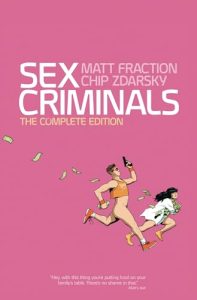 First, I read the complete six-volume run of Matt Fraction and Chip Zdarsky‘s Sex Criminals. This is a weird series. Basically, imagine that there’s an underworld of people, mostly all disconnected from one another, who all have supernatural powers (yeah, superpowers, kind of) that manifest when they orgasm. A couple of them happen to meet and sleep together—and discover they’re not they only one in the world like this… so they team up and start robbing banks. (For a good cause, but still, they’re bank robbers.)
However, things spiral beyond their control when they realize there are others like them, too, including some who are in the business of tracking down, tracing, and controlling people like them. The whole “have sex, rob banks” thing is abandoned pretty quickly once this revelation is made, and the story goes in another direction, one I think is actually more interesting and makes for a better story.
The comic is unabashedly pervy, but I think the freedom of going there also allows them creators to really go wild with their ideas. The art is full of jokes in the background, and the writing is pretty meta at points: at one point, the story even cuts to a cartoon depiction of the two creators discussing one of their creative dilemmas that came up during the making of the book. Anyway, it’s compulsively readable and fun, and I think it sticks the landing with an emotionally compelling ending. It was a weird series, and you need to be in the right mood, I think, but I enjoyed it.
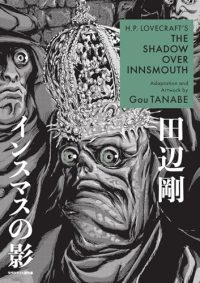
I also read Gou Tanabe‘s Lovecraftian manga adaptations The Shadow Over Innsmouth. It’s surprisingly long, but full of wonderfully creepy illustrations that kept me riveted despite my already knowing the story very well. Gou has a way of really capturing something about Lovecraft’s stories, which is interesting because, in the past, I have argued that one thing that makes Lovecraft work is how he rarely directly describes the horrors in his tales. Yet somehow the way that Gou depicts them doesn’t diminish the horrors; I think it has something to do with the way he draws—often just showing fragments of horrors seen very up-close, interspersed with two-page spreads of the same horrors seen at a distance. In any case, this is a very effective retelling of Lovecraft’s story, and I enjoyed it till the end.
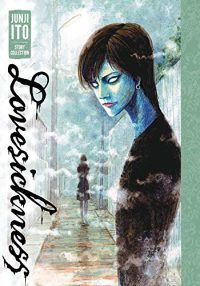 I also checked out Ito Junji‘s collection Lovesickness, which collects the stories from two series—”Lovesickness” and “The Strange Hikizuri Siblings”—plus a few unconnected stories.
“Lovesickness” is, well, very Junji Ito, with all the strange, emotionally-wrought compulsive horribleness you would expect in a town where people stand on streetcorners and ask passing strangers to tell them their fortunes… and where a mysterious stranger walks through the fog, handing out fortunes that drive their recipients to suicide. I liked it, because it really captures something about the emotional extremes that love, limerence, and infatuation bring out in people.
This is followed by “The Strange Hikizuri Siblings,” a pair of stories about a family of siblings who are… well, strange in awful ways. They’re definitely strange, but these tales are definitely the book’s weakest, as they go for a kind of black comedy vibe but come off being just… well, weird and mean, but weirdness and meanness without any real stakes or point.
Finally, the book ends with three unconnected stories: “The Mansion of Phantom Pain” is a creepy tale that asks what would happen if someone experienced phantom pains beyond the scope of a human body. It’s short but effective. “The Rib Woman” deals with crazy beauty standards and a supernatural song, and I thought it worked well. And then there’s “Memories of Real Poop”, which I have to assume was included because it’s short and it made it possible for the last few pages of the print edition to be filled, because it doesn’t fit well with the rest, and is honestly kind of pointless.
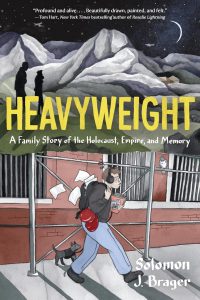 After hearing it mentioned on a podcast, I sought out Solomon J. Brager‘s Heavyweight: A Family Story of the Holocaust, Empire, and Memory, which is a sort of autobiographical comic about the author’s family history, tracing back to their great-grandfather, a boxer from the colonial era of Germany’s history. Brager explores all kinds of questions tied to German imperialism—and German-Jewish support for it—as well as the uses and misuses of Holocaust memorializing, Holocaust forgetting, and silence, all within a framework of working through one’s one family history and family issues. It reminded me a bit of Alison Bechdel‘s Fun Home in that the author and their issues are inextricably linked to the story told in the comic, a facet of the tale that resonates all the more in the light of the author’s (amateur) interest in boxing, and the author’s great-grandfather’s career as a boxer in pre-World War II Germany.
There’s also historical stuff I didn’t know about, like the German panic over a small number of African soldiers sent by the French to Germany after World War I—to the point where German soldiers abroad carried out atrocities against African natives in German colonies as “vengeance” for imagined crimes by Black soldiers in Germany. Brager does a really good job of unpacking this history and working through it in a way that contextualizes their family’s history, both the elements that were remembered and the elements that were forgotten or quietly left behind—as well as seriously wrestling with the question of how to think and feel about the brutalities of history within a context of all of the brutalities of history and of the present, including the fact that their ancestors sought refuge in a settler-colonial society, where their whiteness afforded them some safety that was perpetually denied others in the same country.
It’s not a light read, but it is an interesting and thoughtful one.
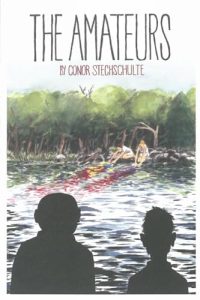 I also read Conor Stechschulte‘s The Amateurs via Hoopla. I… don’t think I really got it. It felt like it was aiming at some kind of critique of capitalism and modern life, but I guess somewhere along the way it lost me.
Deleted: I finished it, but I feel like I missed the point of it. There’s a brief opening section where a cop and a medical expert discover a severed human head that’s somehow still alive and talking, but then the story quickly cuts to what it’s mostly about: these two guys who show up for work at a butcher shop, believing they are butchers, but they have no idea what they’re doing and make a (self-mutilating) hash of the job while some customers come in (and then repeatedly return) hoping to buy some meat. I can see how someone would be drawn into some kind of reading of the text as a critique of something, but the text didn’t really draw me into such a reading. It felt more… well, a bit absurdist and horrific, except the art style didn’t really evoke much of that mood. There’s also this recurrent flash… -back? -sideways? It didn’t stick around in my memory, but all I know is that it involves someone else. At least, I think it did.
Deleted: Maybe this one was just not for me? It was short, anyway.
Deleted:
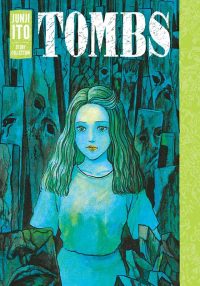 Next, thanks to Libby, I was also able to borrow the Ito Junji collection Tombs. This is a collection filled with a number of short stories, some of them exploring themes that are familiar if you’ve read Ito’s longer works. For instance, “Slug Girl”—a tale about a girl whose tongue transforms into a slug—reminded me a lot of Uzumaki (which I discussed here), as did “Clubhouse,” though in a different way. Meanwhile, “Bronze Statue” has some thematic connections with aspects of Tomie (which I discussed here).
A couple of the stories were weaker than others, especially “Clubhouse” and “The Bloody Story of Shirosuna,” but even those stories are worth a look. I will say I’m more accustomed to Ito’s longer work, which, though often episodic, stretches story arcs over a much longer number of pages, so it was a bit weird to be reading shorter, more compressed stories by him. But it was a quick, fun read.
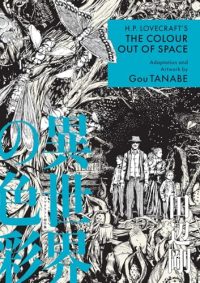 Having read lots of Gou Tanabe‘s adaptations of Lovecraft stories—almost all of the ones available to me via Libby—I figured I might as well read the only one available that I haven’t gotten around to, The Colour Out of Space. It’s a great adaptation, capturing all of the highlights of the story and visually representing them in a way that is expressive, striking, and yet also often vague and suggestive. This is a story that I teach each semester in my SF course, and I have to admit that if I had a way of assigning the comic book to students as a supplement to the original story text (or the Korean translation I make available to students), I would definitely do so. Gou Tanabe’s love for Lovecraft’s work is evident in the book, and it’s worth checking out if you enjoy cosmic horror or HPL’s work.
Emanon (Vols 1-4), cowritten by Shinji Kajio and the series’ illustrator Kenji Tsuruta, was another Hoopla read. There are four volumes in this series at present. The comic is based on fiction by Shinji Kaijo, including one piece I’ve apparently read before in Speculative Japan 2 (which I reviewed in Kyoto Journal 78). The manga is beautifully drawn and written. Besides all that stuff, it’s also a love story to science fiction, to memory, and to life on earth.
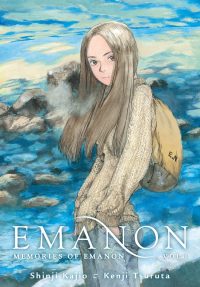 The main concept introduced in the first volume, Emanon Vol. 1: Memories of Emanon, is that there’s a girl out there who inherits memories from her mother on the day of her birth, and can remember living on earth in one form or another all the way back to the beginning of life on our planet. It’s a wild concept, and the author’s love for the SF of his youth is obvious in the text, but just as core to the story is the charm of the way it’s drawn: you can feel the unnamed narrator’s deep attraction to Emanon from every image, and is longing for her later in life—his longing for the magic of youth, for his days as a hopeful young man—is palpable and bittersweet later on in the story, too. Certainly, it brought me back to my misspent youth falling in love exclusively with unavailable girls.
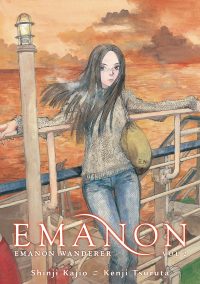 Volumes 2-4 are subtitled differently as “Emanon Wanderer,” Parts 1-3, which go back in time to Emanon’s youth. Volume 2 is the most male-gazey of the series, with a lot of images of Emanon in the nude, bathing in rivers and at the onsen, though I think in some ways it’s trying to evoke a sense of Emanon as a primal living being, as something wild and part of nature. (But it’s also an excuse to draw a pretty girl naked, I suspect.) Finally, the story coalesces into a journey to meet her brother, whom she abandoned at an orphanage back in the 1950s. We learn more about how her memories transfer—and what happens to her previous form—when the next Emanon is born, and we see a tense encounter between her and her brother when they finally do meet. The encounter is ultimately frustrating for both, but I think it drives home what I was saying about Emanon being a wild creature, a primal being: her memories are mostly of not being human, and as a result she doesn’t completely think of feel about things the way we humans do. This is an interesting turn for the story to take, especially after the way Volume 1 kind of gives the impression of Emanon as a kind of perfect “hipster chick” (as the author and narrator refer to her): no, she’s something far different and more difficult to grapple with than that.
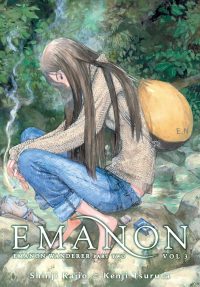 Volume 3, in turn, follows Emanon back into the present of the 1970s, somehow having lost her memories. She’s found in the woods by a man, with whom she begins to live. This story intersects with Volume 1—we see one scene from that volume, but from Emanon’s point of view—and we (and Emanon too) learn more about what is possible for the previous Emanon when the next one is born. It’s a bittersweet love story, especially given how the child Emanon has just experienced a long love-story of her own (as her previous self, her mother), when she re-encounters the nameless narrator of Volume 1, who, it seems, spent a decade pining for her—or rather, her mother—and wondering what would happen if they ever met again.
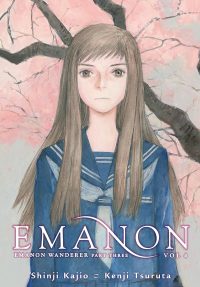
After Volume 3, I ran out of Hoopla credits for May, so I had to wait until June to borrow Volume 4, which carries the story of Emanon into the 1980s. The story is a little more disjointed in that section: Emanon is now in a new child’s body, and trying to hide how intelligent she is while in school; then she meets a boy with superpowers who is convinced she will someday be his “bride”—something she seems not to want; and finally she meets up with a friend of hers that is new to the series, a time-jumping woman from the near future named Hikari, who is born not long after Emanon nurses the elderly version of Hikari on her deathbed. It’s a weird set of twists that hint at how the world of Emanon is even weirder and more puzzling than originally suggested, but I found it quite interesting. Sadly, it seems like this is the last volume the series will get, at least for now. There is a novel, though I think only one excerpt has been translated. (The previously mentioned one in Speculative Japan 2.)
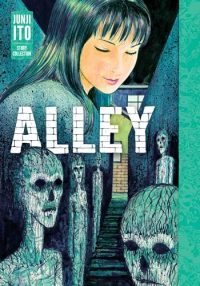 I also read Ito Junji’s Alley, which (predictably) is a collection of short horror narratives in manga form. Most of them are short and nasty, true to form in Ito’s oeuvre, but a couple really stuck out in my mind. “Mold” is one of them—a story about a guy who returns from abroad to a home he’d just built before leaving, and which he left in the care of one of his childhood schoolteachers (though against his better judgment). He returns to find his house overgrew by some new, horrible kind of mold, and… well, I bet you can imagine where it goes from there. This one and Ice Cream Bus share a kind of horror of foreign substances and of human bodies being transformed by them.
Then there’s the longer and weirder “Town of No Roads,” which I’m tempted to read as some kind of critique of how Japanese society handles personal boundaries and privacy. The story starts with a lack of privacy a girl experiences when her weirdo family’s members keep peeping on her, but the private story gets mirrored by an external situation: when she tries to get to her aunt’s house, she finds a whole neighborhood—actually, bigger than a neighborhood—where privacy is a thing of the past, and sees some really weird reactions to it. I swear, I think this comic is saying something about the way Japanese people experience constant scrutiny in the eyes of others, and about how it impacts different people differently—some people putting on masks to hide in plain sight, and others giving up on privacy altogether. And the way it starts in the family… well, I’m thinking of Korea now, and the way personal boundaries are really, really often seen as completely permeable within families… and how hiding away of things this leads to in the lives of young adults. I’m sure the argument has been made before—surely, it must have been—that this is Ito’s critique of traditional familial boundaries and the intrusiveness attributed to others’ eyes in public life. There’s also a whole “serial killer” thread in there, but I’m not really sure how it fits intpo my reading, though, again, I could make some arguments about the way resistance to prying eyes can lead people into some really twisted places.
The rest of the stories feel a little short, and sometimes end in what feels like a hurry. Or, rather, they felt like they ended suddenly; sometimes that made sense for the story. (Like in “Mold” and “Inn.”) Sometimes, maybe not so much. But I think the book is worth checking out even just for “Town of No Roads” alone.
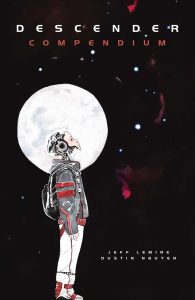 I checked out the compendium (i.e. complete) edition of Descender, a comic series written by Jake Lemire with art by Dustin Nguyen, dealing (at first) with a robotic child in a world where robots went amok, and where some other robots invaded known space, and then most robots were destroyed, and people have sort of recovered in the ruins of that? I found this challenging to read on my iPad, as the lettering is sometimes quite small. (There is a frame-zoom function for reading comics, but I like to see the whole page. Sometimes, though, I had no choice but to use it.)
This one was okay. The writing didn’t really do much for me—I think there were too many unnecessary flashbacks, and some things were kind of dragged out longer than they needed to be in my opinion (it’s a 718 page omnibus, and… yeah, for me it felt that long)—but the art, which was all watercolor, was really eye-catching and unusual. The characters aren’t particularly deep, and they don’t go through much development, but maybe for a younger reader, the constant action would more than make up for that. I don’t think I’ll be reading the follow-up, Ascender, personally, but maybe it’s just not for me? It’s an Eisner winner (for the art), which makes sense. Some people loved it, but it kind of wasn’t my thing, though I did finish it.
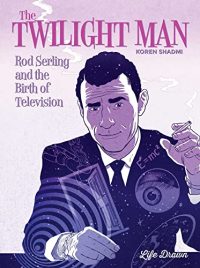 I also read (via Hoopla) Koren Shadmi’s The Twilight Man: Rod Serling and the Birth of Television, which is precisely what you imagine it would be: a sort of biography of Rod Serling, the creator of The Twilight Zone. This was much shorter, and quite a quick, interesting read. I knew a little about Serling’s biography, but didn’t know much, and this dug into some of that, as well as the process by which Serling established himself as a TV writer, and then (in a roundabout way) eventually sold CBS on the concept of The Twilight Zone. It was his one big hit, catapulting him to celebrity, but he never really did much else of major interest with the medium of TV, which is interesting. He died back the 1970s, arguably in part taken down by some of the stuff he did to keep himself going during the heyday of The Twilight Zone.
The show only ran for three seasons, though of course those are the longer American-styled seasons of yesteryear. Still, it goes to show you that a show back then could have immense cultural impact even just after a few seasons. It’s maddening that the show was essentially sabotaged by an exec who cut its budget relentlessly, because he didn’t like or understand the appeal of the kinds of stories explored in The Twilight Zone. (I guess it’s true in TV that the more things change, the more they stay the same.)
Anyway, as someone who grew up watching The Twilight Zone episodes in rerun—that was what aired on Saturday mornings when I was a kid in northern Saskatchewan, along with the original series of Star Trek and what I think was the ’80s Spider-Man cartoon, along with long blocks of the tiresome The Mighty Hercules cartoon—it was really nice to see a little more behind the scenes of Serling’s show, and it was interesting to learn more about Serling. Now I’m tempted to add an episode of The Twilight Zone to the syllabus for the Science Fiction class I teach at the university. (I was close to including “The Monsters are Due on Maple Street,” when I launched the class, but decided on including something else instead.) Having a little Serling in the mix couldn’t hurt, though, and it would be justification for me to have the library order a copy of the Parisi biography of Serling, too.
Poetry
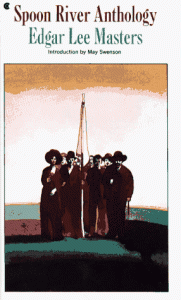 I finally dug into some of the poetry I’ve had languishing on my shelves. First, I read Edgar Lee Masters‘ Spoon River Anthology, which I’ve had for years but never really looked into. It’s essentially a portrait of a small community through the voices of its dead, rendered as free-verse poems. The characters call out injustices, abuses, and cruelties, gossip about their neighbours (living and dead), and drop hints about their lives, dalliances, mistakes, grudges, and triumphs over one another. Many of the stories are interconnected, and I imagine one of the pleasures of the book can be to get into those interconnections and trace them.
That said, it’s a long text—over 300 pages, in my copy—and Masters was very much the kind of writer to bang you over the head with his point, and then turn around and bang on his point a little more, because dead horses can be beaten ad infinitum. And then write a couple of epilogues too. (Though, honestly, I liked the Spooniad—his retelling of events in the town in the style of a Homeric epic—and even the epilogue had its high points, though they were fewer. There’s something almost Stapledonian about the way the book ends, really—it reminded me of Star Maker specifically.)
I think the book works best in fast gulps, rather than reading it all the way through in one go or going by dribs and drabs, but I also can really understand why some people never get to the end, even though I enjoyed it for what it is.
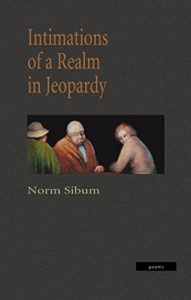 I also checked out Canadian poet Norm Sibum’s 2004 collection Intimations of a Realm in Jeopardy. I really enjoyed his earlier (1998) collection, The November Propertius, which I read on David Solway’s recommendation back when I was taking a poetry workshop from him. (Solway, that is.) During some trip back to Montréal I picked up more of Sibum’s poetry collections, including this volume, but then I deposited most of them—with the exception of The Pangborn Defence, which I posted about here—on the shelf and read other things. So, I’m 22 years late on this collection, but that’s fine: good poetry ages as well as wine, at least on the timescale of a single human lifespan. (Sometimes on other timescales as well, but not always.)
Knowing the year these poems were published helps a bit with understanding what they’re driving at. They’re dark and at times apocalyptic; George Bush Jr. is referenced multiple times as the president of the United States, and there’s a sense of pervading doom to the poems. But it’s not just the doom of war: the poems in this collection number only a few, and each of them tells the narrative (from different men’s points of view) of doomed relationships: romance dying, relationships long dead, anxieties about long-ago attraction and sex lying in the dust of yesterday. They’re dark and somewhat hopeless, elegiac without being sentimental, and studded with occluded references to things that we readers can only guess at—and as a reader, you need to accept and be fine with those kinds of references that you yourself cannot quite follow. It’s this fusion of personal loss and doom, and the broader doom that hung over us in the early oughts, that gives these poems their energy and drive, which is to say that it’s quite a serious and downbeat collection, less thoughtful than prone to unhealthy rumination and worrying at the past and present—and future—the way a dog worries a bone. It hasn’t unseated The November Propertius as my favorite of Sibum’s books, but it’s an incredibly crafted statement of where a lot of our heads were at around the time it was published, and well worth a read, as long as you go in expecting not to understand everything that’s going on in these pages.
I have yet to try read Dhalgren: I’ve had a copy for years but am still working up to it.↩
You had me at ‘Omelas’!
The Ones Who Walk Away from Omelas is one of my favourite short stories, alongside your own Prodigal of course (I may have mentioned this before…).
I will definitely be giving If We Cannot Go at the Speed of Light a read after your review.
I’m a bit of an Adrian Tchaikovsky fan. His Children of Light trilogy is wonderful, a very original sci-fi which goes in a direction you will not expect. I also loved his City of Last Chances book and am currently reading the sequel. In this he manages to juggle a very large diverse cast very well and again, it’s highly original but in the Fantasy genre.
His writing is clever, sharp and humorous I think. He is also the co-host of a mostly book-based podcast:
https://podcasts.apple.com/gb/podcast/starship-alexandria/id1806388787
He and his co-host recently reviewed Piranesi on there.
Hi Russ!
If We Cannot Go At the Speed of Light is definitely worth checking out.
Children of Light sounds good, I guess I’ll check that out, along with that podcast! Thanks for the recommendation!
Ooops, I’m assuming it’s the Children of Time that you’re referring to? (I can’t find a Children of Light, and Children of Time seems to be one of his more famous series.)