- Readings, January/February 2026
- Readings, March/April 2026
- Readings, May/June 2026
- Readings, July/August 2026
- Readings, September/October 2026
Fiction
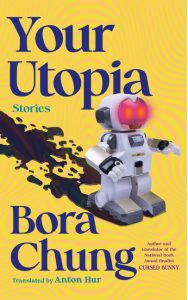 Bora Chung’s Your Utopia (translated by Anton Hur) was the first book I finished this in September. Before leaving for Canada this summer, I’d been partway into it—having gotten in signed by the author after sitting on a discussion panel with her—so after returning, I dug in again as soon as I got the chance.
I think the story that stuck with me most after finishing the book was “Seed,” though “The End of the Voyage” also hung around in my mind quite a long time afterward. They’re rather opposite stories, in some ways: “Seed” is hopeful and radical, imagining a posthuman world where genetic engineering and mutation have led to the Earth—or, rather, plants—fighting back against the depredations of humans in a characteristically plant-like way that isn’t violent but is hopefully transformative. On the other end of the spectrum, “The End of the Voyage” is deeply pessimistic about humanity and the world it lives in. It’s a zombie story, kind of, mostly set in space onboard the last ship of (supposedly) infection-free humans in the world.
“A Song for Sleep” was also quite haunting. Both it and “Your Utopia” center the perspective of human-programmed machine intelligences and their brushes with other machines and with humans… or what seem human at first, at least. There’s something disarming about the way Chung handles these nonhuman (machine) points of view: my normal response to such stories is to be cynical about machines ever caring about humans as much as humans wish machines eventually would, but the way she writes the minds of these machines somehow disarmed me.
A few of the stories are really, really sad, including “A Song for Sleep,” “Maria, Gratia Plena,” and “To Meet Her.” They’re not sad for the sake of evoking sadness, though: they’re the kind of sad that stories are when the author is saying something honest about the world, the sort of thing we’re expected not to look at or draw attention to. That’s how I felt reading those stories, and the afterword only reinforces that sense.
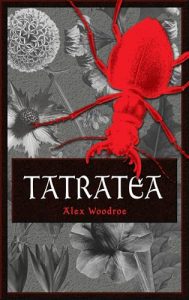 Tatratea is a really grim novel by Alex Woodroe. But the time I publish this post, it’ll be out in stores, but I read it as an eARC. It was a very quick and slippery read: I almost never get through books in one sitting, but this one I did. The story’s set at the end of the world, and as the story proceeds, one learns a little about how that came to be—not a lot, but enough to be carried deeper and deeper into the world Woodroe’s invented. Although I was curious and longed to know more about everything in this wildly inventive novel, the pacing was relentless enough to mostly keep the story going past that curiosity—or, rather, the suspense was enough that my curiosity about what would happen next outweighed my curiosity regarding the world and worldbuilding.
The narrator is one of the most untrustworthy narrators you’ll ever encounter, not because she’s a liar, but because she’s at risk of losing her mind and hallucinating everything at any moment. In fact, she periodically does tests to check if it’s already happened. Those tests are something she was taught by some kind of seemingly semi-religious, mysterious organization organization that’s sent her to the place she’s investigating, and more than one weird lifeform she interacts with.
The inevitable comparison that will be made is with Jeff Vandermeer’s Annihilation (and presumably the other books in the Area X series). However, I haven’t read the those books yet (I know, I know…), so I cannot say much about that beyond the fact that both involve a cosmic horror, seemingly from outer space, that does bizarre things to the people and plants of the Earth. Also, that Woodroe’s novel is perhaps even more pessimistic—at least, based on my impression of Annihilation from the movie adaptation? It is, after all, explicitly set at a time when the extinction of humanity seems to be inevitable, and the text is self-consciously engaged with ideas from nihilist thought. If I had one criticism of the book, it’s that it ends a lot like how life often ends: a little abruptly, and before one is really ready for it.
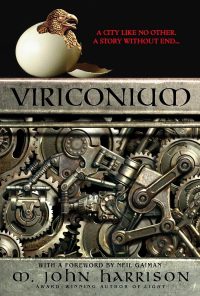 Next, I read “A Storm of Wings” from M. John Harrison‘s collection Viriconium—the second of the Viriconium novellas (or short novels?). It’s a dense, rich text, one that demands really attentive reading, and it covers a lot more ground in just a hundred and forty-some pages than some books cover in twice that length. It’s haunting, lyrical, and dark.
It’s also really, really challenging reading, and sometimes maddening, though I think it’s supposed to be, given that it’s about an invasion of… insectoid aliens…? who drive the world mad…? through telepathy…? … by inflicting their world-perception system upon humans, as humans inflict theirs on the insectoids…? The novella is really elusive and deeply weird, and it took me a few times to go into it hard enough to develop the momentum to carry me through past the first few chapters. Especially in the beginning, the sentence structures and diction feel like they’re designed on purpose to discomfit and elude too much clarity. I actually admired the effect, but it made it harder for me to dive in.
Harrison’s an immense stylist and writes gorgeous prose, though sometimes it’s so convoluted that one must read a sentence a few times just to get over the structure, and the beauty, and the incredible diction, in order to get at what is actually going on in the story. Something is almost always going on, but you also need to be ready to not fully understand it, or to only be shown hints of things he refers to. Harrison seems to be against forcing the reader’s interpretation of things, and he’s famously anti-worldbuilding, or rather, against worldbuilding that offers you things on a silver platter. You get hints and suggestions, references to things, and they don’t matter except in what they suggest. You’re pretty much never going to get the backstory, only the wistful sigh and the chunk of rusted metal laying amid the sands of the waste.
And rusted metal laying amid the sands of the waste, big time. Major characters die, others disappear inexplicably, and there’s an elegiac feel to the whole thing. But it feels like Harrison kissing goodbye not just to this world—despite the fact he would return to it later—but to the possibility of a coherent, unified, objective world existing at all. In that sense, it’s almost a kind of postmodernist fantasy-horror, something that surpasses its cosmic horror and body horror to ultimately arrive beyhond all that at something more fundamental, which I guess we could maybe call epistemological horror. (Epistemology comes up in lots of horror, of course, but I’m not sure I’ve seen horror so fundamentally rooted in epistemological skepticism before.)
As a side note, seeing N*** G*****’s name on the cover is just… well, I’ll say it’s unfortunate. The asshole wrote a lot of forewords and introductions to other people’s books, and now we’re stuck with seeing his name on countless volumes that aren’t even his, and remembering all we have since learned about him every time we see it. I suppose it’s not the first case of this: the bright spot of light, I guess, is that the world will move on, and that as books are reissued, they will come out without the man’s forewords and introductions. But for those of us who already have these volumes, I suppose we’ll just have to live with them. If you don’t have it already, though, I’d go for the fantasy masterworks series, which is just as complete but lacking the offending foreword.
Comics
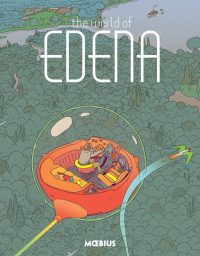 The World of Edena by Mœbius. It’s much less different from The Incal than I expected: I thought that Mœbius might write a rather different story from what Jodorowsky had done, but it turns out the men worked together for a reason—at the very least, due to an affinity for comparable themes.
That said, I found The World of Edena much more engaging, even despite the occasional thematic overlap with The Incal. The story involves a couple of artificially asexual, adrogynous humans who end up being transported to another world via a mysterious shining pyramid. When their artificial treatments wear off, so does their androgyny and asexuality: they become a man and a woman, and, well, this being Mœbius, you can guess what happens next. But then, you cannot guess what happens after that. They end up on a weird world where they individually have adventures among the bizarre society of humans there, before eventually being reunited.
Which is to say, the plot is a little seat-of-your-pants, but it works well enough as a skeleton for the kind of narrative and imagery Mœbius wanted to build here. I had fun reading it, though I’m not in a huge hurry to read more of the man’s work.
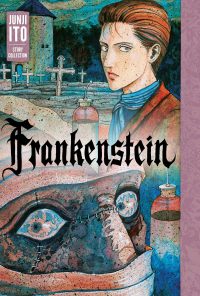 Next, I read another Ito Junji story collection: Frankenstein. It was… fine. Not the best Ito I’ve read, but not bad. I preferred the latter half of the collection, which was mostly weird short stories about some kids who discover that one of their houses is a portal between multiple parallel worlds… and who discover that one of their alternates from another world is a horrible person doing horrible things. It’s more like what you’d expect from Ito, where the Frankenstein adaptation is more just a straight retelling of Mary Wollstonecraft-Shelley’s novel.
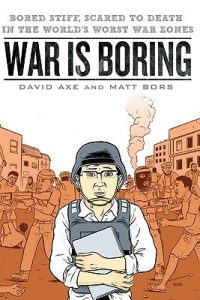 I also read War is Boring: Bored Stiff, Scared to Death in the World’s Worst War Zones by David Axe. It was interesting to see the author’s reflection on his experiences in a number of war zones. It emerges that Axe seems to be addicted to danger and risk, and he seems to be quite aware of it. That said, the story doesn’t really end, so much as it just sort of reaches the present without any kind of conclusion. Well, there is an afterword, but it’s less of a conclusion than a nihilistic footnote to the horrors Axe has described in the comic. I felt the afterword took away from the story, but it also underlined something about the protagonist: he doesn’t seem to learn anything from his experiences, or what he learns is all just bad news. I guess that mirrors humanity’s “learning” experiences with war, though, and Axe is pretty conscious that nothing good really comes from war. His disgust with those who enjoy the fruits of its effects without suffering any of the costs or risks is interesting, but even so, the afterword kind of deflates it all into a sense of meaningless hopelessness.
I guess this poses an interesting contrast with Bora Chung’s Your Utopia, discussed above: both because Chung’s work seems to discuss sometimes-hopeless situations and the sadness that they engender in those who witness or experience them, but Chung’s work seems to insist on things nonetheless mattering—even if evil or cruelty triumphs, the effort to stand witness, to speak out against it, to resist it matters. Axe’s afterword feels quite opposite to that, suggesting that, in the end, nothing really matters. I don’t know that Axe actually believes that, but it’s the vibe I got reading the afterword, especially as a conclusion to the story preceding it, and it left me kind of frustrated. Maybe that’s the point, though.
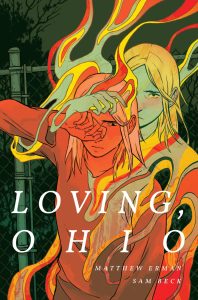 Via Libby (like all the other comics above), I also borrowed and read Matthew Erman and Sam Beck’s Loving, Ohio. It’s a weird, dark comic about some people in a small town (the eponymous Loving, Ohio) who are involved with a cult called The Chorus. It’s an alright story, though I felt like I didn’t quite get the point of it, or something.
There are a lot of unanswered questions that remain at the end, and I wondered a lot about how we’re supposed to interpret this story in terms of what it’s saying about the real world. Maybe I’m pushing the story into places it’s not really meant to go when I look for something like that, though, and I feel like I’m at a disadvantage since I don’t really know enough about Ohio to know whether this story is specifically about that state, or if it could have been set somewhere else, and just happens to be set in Ohio.
Anyway, it’s certainly not a bad book, but it was a little perplexing to me.
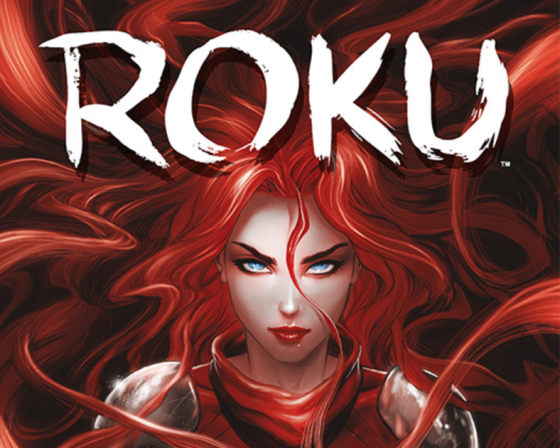
I read Cullen Bunn‘s 2019 comic series Roku—all four installments—but it did not really make much of an impact on me. I was looking for something involving spies, and ended up with something more like an espionage superhero murderer narrative. It was fine, but maybe I’ve been spoiled by graphic novels, because a story that was four comic books long just felt way too short for me to dig into. I was surprised, since I enjoyed Bunn’s Harrow County books quite a lot, but I think the story just needed more room to stretch out.
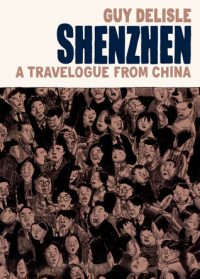 Next, I read Guy Delisle’s Shenzhen: A Travelogue from China. I’d read his volume Pyongyang years ago and enjoyed it, so when I saw this was available via Libby, I went for it immediately. It was an interesting look at what Shenzhen was like in the 90s, and reminded me a lot of what Korea was like in the early oughts. Delisle manages to show just how disorienting (and frustrating) life can be as an expat in Asia, without crossing the line into mockery or disrespect on the one hand, or petulant complaining on the other. He threads that needle and manages to be entertaining even with stuff that feels quite familiar in my own personal experience, and that’s a commendable feat.
I rather enjoyed Shenzhen and I’ve put a few more of Delisle’s books on hold via Libby, so I expect to read more of him in the near future.
Meanwhile, I’m still working my way through the Tintin series with our son. In September and October, we read several volumes.
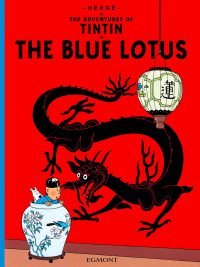
I mentioined last time The Blue Lotus, which I reread alone to see what I think of it. While there are some deeply racist, anti-Asian sentiments expressed in the book, they’re all expressed by villainous characters, and indeed Tintin makes an enemy of one of them by specifically condemning him for being a big fat racist toward a Chinese character. The book is set during 1931, in a period when the Japanese occupied parts of China, and interestingly, the depiction of the Japanese Imperial officials is much more critical of the Japanese empire than I expected. I have to give Hergé points for his sympathizing with the colonized and his jabs at the colonizers. His depiction of China contained some stereotypes, but one can see he’s making an effort toward human decency. That doesn’t excuse everything, but to me it counts for a lot.
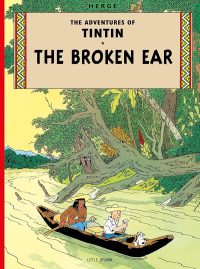
The Broken Ear reads like a satire of tinpot dictatorships and specifically of the dictatorships in South and Central America contemporaneous to its writing (1945). It doesn’t connect to The Blue Lotus—it’s a stand-alone adventure, one in which Tintin attempts to track down the a statuette stolen by a pair of Latin American rogues, identifiable because of its broken ear. However, Tintin ends up in prison, then in front of a firing squad, then as the aide to a dictator, and then back in hot water, all while oil companies and weapons manufacturers maneuver and scheme to set off a war over oil on the land bordering two South American countries. So far, so satiical, and none of that bothered me. I was, however, a bit more uncomfortable with the “savages in the jungle” stereotypes that kicked in when we finally see the Arumbaya, the aboriginal tribe who made the statue in the first place. Hergé clearly means well, and I’d argue that in this volume at least he doesn’t engage in outright racism, but there’s a sort of comfort with the stereotypes that emerged from European anthropology that just made me uneasy.
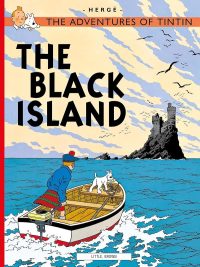
The Black Island concerns a mystery in which Tintin is dealing with a couple of ne’er-do-wells, chasing them from Belgium to England and thence to Scotland. I was surprised by the nastiness of the bad guys, and even now that we’re five books into the series I’m still also surprised by the gun violence—often played for laughs—and the general criminality of the storyline. I’d imagined Tintin’s adventures would involve traveling the world and reporting on news events unfolding at the time when the books were written (with maybe some espionage on the side), but it turns out those historical events more often end up being the backdrop to tussles with criminals and investigations into crimes. That’s not a complaint, just an observation. I must have read one or two Tintin books before, but somehow I’d picked up very little of what the stories are actually like, I guess. As for the story, it was fun! It’s obvious to me why these comics have remained popular for almost a century now, all over the world, with translations into so many languages. (We were lucky to get them cheaply and second-hand in English, considering they’re all available in Korean translation.)
Interestingly, the deeper we go into this series, the more I see the line between stereotype and caricature blur. The old, kilted Scotsman speaking in a thick brogue (about halfway through this book) is an example. He’s over the top stereotype, but he also captures something of Scotland for Hergé’s original audience, which I assume were Belgian and French-speaking kids and teenagers. (I do wonder how the Scottish brogue was rendered in French, though.) There’s a fine line between racism and stereotyped caricature, and part of the equation is the power dynamics of the then-still-colonial world. I suppose that’s why the depiction of a stereotyped old Scotsman is less unsettling than the banana-republic stereotypes in The Broken Ear, which in turn doesn’t feel quite as questionable as the depiction of the Arumbaya people in that same volume.
It’s funny, since I actually grew up a fan of the other major French-language comic series that was beloved globally: Asterix & Obelix. In that book, the same kinds of caricatures and stereotypes are deployed, with two big differences. The first is that it’s set in the ancient world, which means there’s a distance from modern colonial concerns (even while the books are also self-consciously anti-colonial). The second is that all the characters are stereotypes, including the Gauls, in a way that one never seems to see in Tintin when he’s dealing with Belgians.
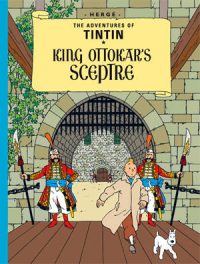 Next was King Ottokar’s Sceptre, in which Tintin visits an imaginary country in the Balkans to investigate what is going on with a mysterious and baffling professor whom he suspects is actually a crook posing as the professor in a bid to steal from that country’s royal family. The picture that emerges is of a government littered with conspirators, ultimately found to be insurrectionists from the country next door. Again, it’s caricature, though in this case it’s regional caricature since the state depicted in the story was an invented one, and so is the state aggressing against it.
In this one, Tintin kind of drops the ball near the finish line, but luckily Snowy steps up and saves the day. It was fun, or at least I enjoyed it, but after we finished it, we decided to take a short break from Tintin and read something else. (Never fear, though, we will come back to the series eventually.)
That’s it for now, though I’m partway through another couple of books that I expect to finish in November. More on those, plus whatever else I read after them, at the end of the year.
Bluesky Discussion
View on BlueskyNo replies yet. Be the first to comment on Bluesky!