- Ezra Poundings – The Reboot
- Blogging Pound’s The Cantos: Canto I
- The Traneumentary, Shooting for Trane, and Pound/Trane in Comparison
- Blogging Pound’s The Cantos: Canto II
- Blogging Pound’s The Cantos: Canto III
- Blogging Pound’s The Cantos: The Ur-Cantos
- Blogging Pound’s The Cantos: Canto IV
- Blogging Pound’s The Cantos: Canto V
- Blogging Pound’s The Cantos: Cantos VI and VII
- Blogging Pound’s The Cantos: Cantos VIII-IX (The Malatesta Cantos, Part 1)
- Blogging Pound’s The Cantos: Cantos X-XI (The Malatesta Cantos, Part 2)
- Blogging Pound’s The Cantos: Cantos XII-XIII (Baldy Bacon and Kung)
- “Ezra Poundings”
- Pound and the Occult: Leon Surette’s The Birth of Modernism: Ezra Pound, T.S. Eliot, W.B. Yeats, and the Occult
- Blogging Pound’s The Cantos: Cantos XIV-XV (“The Hell-Cantos”)
- Blogging Pound’s The Cantos: Canto XVI — Ending “A Draft of XVI Cantos”
- Blogging Pound’s The Cantos: Canto XVII — Toward “A Draft of Cantos 17-27”
- Blogging Pound’s The Cantos: Canto XVIII & XIX
- Poundmania: On Process and Plans
- Blogging Pound’s The Cantos: Canto XX – XXII
- Blogging Pound’s The Cantos: Cantos XXIII – XXIV
- Blogging Pound’s The Cantos: Cantos XXV-XXVI
- A Study From Ontario: Leon Surette’s A Light From Eleusis: A Study of Ezra Pound’s Cantos
- Blogging Pound’s The Cantos: Canto XXVII
- Blogging Pound’s The Cantos: Canto XXVIII-XXX
- Ezra Pound Posts Delayed
- The Mays of Ventadorn by W.S. Merwin
- Blogging Pound’s The Cantos: Canto XXXI-XXXIII
- Blogging Pound’s The Cantos: Cantos XXXIV-XXXVI
- Blogging Pound’s The Cantos: Cantos XXXVII-XXXIX
- Blogging Pound’s The Cantos: Cantos XL-XLI
- Blogging Pound’s The Cantos: Cantos XLII-XLV
- Blogging Pound’s The Cantos: Cantos XLVI-XLVII
- Blogging Pound’s The Cantos: Cantos XLVIII
- Reading the Cantos: A Study of Meaning in Ezra Pound by Noel Stock
- Blogging Pound’s The Cantos: Canto XLIX
- Blogging Pound’s The Cantos: Canto L
- Blogging Pound’s The Cantos: Canto LI
- Blogging Pound’s The Cantos: Canto LII
- Blogging Pound’s The Cantos: Canto LIII
- Blogging Pound’s The Cantos: Canto LIV
- Blogging Pound’s The Cantos: Canto LV (Plus, What Do Ezra Pound, Robert Howard, J.R.R. Tolkien, H.P. Lovecraft, and Sun Ra Have In Common?)
- Blogging Pound’s The Cantos: Canto LVI & LVII
- Blogging Pound’s The Cantos: Canto LIX
- Blogging Pound’s The Cantos: Canto LX
- Blogging Pound’s The Cantos: Canto LXI
- Blogging Pound’s The Cantos: More on Canto LVII, and Canto LVIII
- Blogging Pound’s The Cantos: Canto LXII
- Blogging Pound’s The Cantos: Canto LXIII
- Blogging Pound’s The Cantos: Canto LXV
- Blogging Pound’s The Cantos: Canto LXIV
- Blogging Pound’s The Cantos: Canto LXVI
- Blogging Pound’s The Cantos: Canto LXVII
- Blogging Pound’s The Cantos: Canto LXVIII
- Blogging Pound’s The Cantos: Cantos LXIX and LXX
- Blogging Pound’s The Cantos: Canto LXXI
- Blogging Pound’s The Cantos: Canto LXXVI
- Blogging Pound’s The Cantos: Canto LXXV
- Blogging Pound’s The Cantos: Cantos LXXII and LXXIII (“The Fascist Cantos”)
- Blogging Pound’s The Cantos: Canto LXXIV
 This is a series where I post what I think are slightly atypical readings of the Cantos of Ezra Pound.
There’s also an (updated) index of all the Cantos (and related sources) I’ve discussed so far.
Today’s selection is one of the celebrated “Pisan Cantos,” Canto LXXV, plus some discussion of Pound’s relationship with music.
Canto LXXV
This Canto might give us not much to discuss, but I’ll do my best. There’s only a few lines of verse, which refer to hell—”Out of Phlegethon!” being the opening line. (“Phlegethon” is a flaming river in Hades, the Aeneid apparently tells us (per Terrell). Apparently the Canto is specifically an invocation of this scene in the Aeneid, since in it Aeneas sees the river Phlegethon and then is guided to Orpheus, who plays music upon his lyre.
What music? Well, what Pound provides us is an arrangement of some very old music by one “Gerhart” (Münch). Münch was a German musician who played a fair number of concerts with Olga Rudge in Rapallo, and—never missing a chance to drop names—Pound mentions him having Klages and Buxtehude in his satchel. Buxtehude was a Baroque composer and organist—Dietrich Buxtehude—and Klages was an anthropologist who apparently influenced Münch. (Buxtehude and Klages, along with Hans Sachs, are sort of in the “musical postbag” of Münch, so to speak.)
The little snippet of verse at the start of Canto LXXV ends with a final invocation and hint at the identity of the sheet music below it: “—not of one bird but of many”.
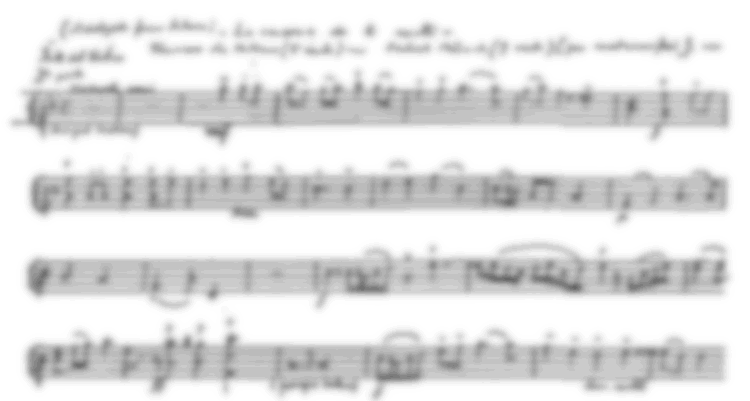
Then follows a painfully microscopic print of two pages of sheet music. The music is Münch’s arrangement of Francesco da Milano “La canzone da li ucelli” (“the song of the birds”) for solo violin. Well, but Francesco da Milano’s piece is actually an arrangement of Clement Janequin’s “Song of the Birds.”
Say what?
Well, okay, let’s start with the easy and obvious thing: this is bird music, and given the appearance of birdsong in the previous Canto, Pound is playing off that. Birds can be used to speak of freedom, of love (as per Bernart da Ventadorn), of divinity (as the “eagle with bright eyes” referenced in Greek in Canto LXXIV). Bird can be symbols and reminders of all of these things at once, and of course, during his time at the DTC, Pound would have had more exposure to birdsong—and less exposure to music—than he’d had in years. It makes sense that he’d want to invoke that, and of course this piece came to his mind.
However, on a deeper level I think what’s going on here is, in some way, pretty evident. I take it for granted that one of Pound’s metaphors for translation in The Cantos is the nekuia: the summoning of a spirit by the translator. In music, there are not translators but rather arrangers who do a similar kind of work, “translating” works from one form to another. Janequin’s original piece was a choral work, and a devilishly clever one, with a lot of bird-like sounds when it’s sung due to the way the text is set to melody:
Francesco da Milano, on the other hand, was a lutenist, and his setting was for lute. I couldn’t find a lute performance, but here is one of several guitar performances I have found:
According to Pound in his ABC of Reading, da Milano’s arrangement removed the lyrics but left the birds in the work, again as Terrell tells us. Something essential and powerful survives despite the transmutation of the music from one form to another, just as in a translation of poetry something essential and powerful survives—and one could also argue that the poet or the composer’s presence in the work survives the translation, when it’s done well.
Of course, what we’re given is not Francesco da Milano’s arrangement we have either, but rather Münch’s subsequent re-arrangement of it for violin. You can hear a rendition of Münch’s arrangement here, along with the short text at the beginning of the poem:
What we have here, then, is a kind of musical nekyia: Pound is evoking Münch, who in turn evokes Francesco da Milano, who in turn evokes Janequin, who himself is evoking singing birds. The musical equivalent of what we see in Canto I, but extended through even more permutations.
At the end of the arrangement comes a small inscription that Terrell tells us is probably a “bone inscription” (i.e. very early Chinese writing—I think it’s actually seal script, though), which he claims is equivalent to 新which supposedly can be translated as “make it new.” (My own searches suggest it is more simply translated as “new,” though.)
Besides the nekuia, though, there is also Pound’s treatment of a person he knew: Münch was part of the musical scene in Rapallo, as were Pound and Rudge, and the piece above was actually performed in Rapallo. Pound recalls Münch and recalls his music in the same way: ineffable, impossible to capture, and yet important to set down on the page. Like poetry—especially Pound’s poetry—music is difficult to set down on the page, and is similarly difficult to read and make sense of without training. Music can in some way capture something ineffable—like it captures the birdsong that Pound insists was “still there” despite all the adaptations the piece had gone through—but only through skill and specialized knowledge, just as poetry can capture something of the essence of a time or a person but only through the skill of a poet and of a good reader. To most people, the Cantos in general would be as opaque as is the sheet music in this Canto to someone who cannot read music… and at the same time, Pound seems to be suggesting that those who cannot read music ought to learn it, if they wish to be “literate.”
This seems as opportune a moment as any to dive into the issue of Pound and music, about which I’m far from an expert but I can comment on a few points of interest.
In 1921, Pound wrote an “opera” titled Le Testament de Villon. At this point Pound not only had no musical training, but he also disdained it—being convinced that books of theory and orchestration would likely be completely “wrong” and also convinced by a performance of Debussy’s Pelleas et Melisandre, that knowing too much theory might be bad for a person. (He really hated Pelleas et Melisandre. It’s especially ironic that he held up Debussy as an example of what you get when you are corrupted by theory, given how Debussy revolted against all the theory and rules he’d been taught as a conservatory student, choosing instead to be guided by a more pressing concern: pleasure. Not that Pound would necessarily have approved of that, either.)
Pound’s comments about theory are amusing to me, a trained musician, because while on one level I recognize the brash arrogance of a creative mind lacking in training, on the other hand I see an amazing lack of humility. In letters to musicians at the time, he asks the most rudimentary questions—questions that would have made a trained musician blush when coming from someone purporting to write an opera—but Pound didn’t seem to believe musical theory was important for a would-be composer. One is driven to wonder just how much “help” Pound got in turning his original sketches into playable music.
For all that, Le Testament is actually kind of interesting. Some bits sound like someone got the Webern drunk and convinced him to orchestrate some imaginary medieval drinking songs for people who have no more than a year’s experience on their instruments; other parts sound almost convincingly like the soundtrack of an early horror movie. It’s by turns goofy and vicious, at least the recording I’ve heard (from the Pound CD, Ego Scriptor Cantilenae. You can listen to that CD on Youtube, here.) I am not sure to what degree the work is really Pound’s, and to what degree composer George Antheil’s “corrections” are what made it sound passable.
Pound had also written other pieces: a suite of fiddle music, an opera titled Cavalcanti, and other assorted pieces. They’re… interesting. You can certainly tell that Pound wasn’t a trained musician, but you can also sometimes hear what could be an anticipation of how some trained musicians later in the 20th century would revolt against their training. A lot of his music was vocal, for obvious reasons—he was interested in lyrics and how the lyrics meshed with the music, being the main on. But there’s also an oddness to it, in part because it sort of sounds neo-Medieval or neo-Early Music in its way. That, too, makes sense, and not just because of Pound’s interests in renaissance and medieval poetry and history, but also because the middle ages and especially the renaissance were periods when the rules of music had not yet been established firmly, and composers were figuring out what sounded good to them using fairly fundamental tools like modal scales and ostinato rhythms, the same kind of thing an untrained musician would gravitate toward using for their experiments.
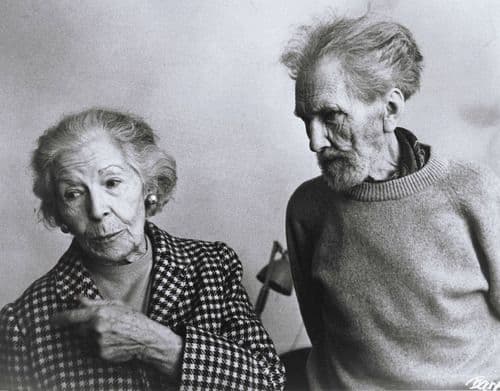
Pound’s involvement with music wasn’t limited to experiments in composing, however. In the 20s he tried his hand at organizing concerts, and by the 1930s, he had become the self-appointed musical director of classical concerts at the civic hall in Rapallo. In this position he was involved in a number of concerts with Olga Rudge—including the Vivaldi concerts of 1936, and he and Rudge can be considered pretty much jointly responsible for the “rediscovery” or at least the resuscitation of Vivaldi. In this work, Pound and Rudge were supported by Winnaretta Singer, the princesse de Polignac, who resided in Venice. (More about that here.) Pound’s interest in Vivaldi broadly fit within fascist Italian nationalism, of course: there was always a political edge to that effort—and that much is clear from the fact that Pound used Vivaldi for the introductory music to his own fascist radio broadcasts. (As Guy Davenport apparently loved to mention—and noted in one piece in Harper’s, apparently?—the first people in modern America to hear Vivaldi’s work were FBI analysts listening to recordings of Pound’s fascist radio broadcasts.) That said, Pound also was interested in artistic resurrections and revivals, and loved to swim against the current. I’ve read that, in fact, in his time the classical musical mainstream wasn’t so much unaware of Vivaldi as it was uninterested in his work, finding it somewhat insipid and, well, what the kids today would call “basic.”
That Pound would be interested in music is not a surprise: it aligns very well with his interest in poetry, and Pound was well aware that for large chunks of history, poetry was song and song was poetry. His adulation of the troubadours as artists, and as keepers of an ancient sacred flame (as he hints in The Spirit of Romance) suggests it was inevitable he would take an interest in song as well as verse.
What is surprising, to me at least, is how much of a role music played in his life in Rapallo. Pound was a very busy man, not only having a mistress and a wife, and doing political broadcasts, but also organizing concerts. Not all of his efforts led to much: he apparently purchased a bassoon only to give up on the thing. (And if you’ve tried the bassoon, it’s not hard to imagine why.) Still, it’s very odd for him to include the score for an instrumental work in the Cantos, even as much of a hodgepodge as the book is. I think this “poem” more than any other so far demonstrates the demands that Pound made of his readers. I can imagine his contemporaries looking at Canto LXXV and just rolling their eyes, and I can understand why, especially in a world without Terrell’s A Companion to the The Cantos of Ezra Pound, or some equivalent reference work. Like, how in the hell is someone meant to decipher whatever meaning is intended by this music’s inclusion?
I can imagine at least some readers skipping Canto LXXV entirely… and I can imagine Pound viewing those readers as failing his test. I can imagine others who sat down at the piano, or grabbed a guitar or saxophone (as I did when I first saw it) and played through it, but weren’t sure where to go after that. I suspect Pound would see that as, well, something, but not a successful reading of the poem either. One gets the sense that for Pound, the ideal reader is the student with endless amounts of time to devote to polymathic study, and that a successful reader goes, “Oh, I clearly don’t know enough about music history!” and then goes off to study it comprehensively, eventually stumbling upon the Janequin, Milano, and Münch. Like, reading the Cantos is supposed to be a springboard into your “education” in all the things Pound felt were important, and that an incredibly tall order.
Little wonder if people don’t have much to say about Canto LXXV, I guess. There are lessons that writers can take from this—widely divergent ones—but one that’s undeniable is that the more you demand of your readers, the fewer readers will be willing or able to come along for the ride.