With all my posts about brewing here, you might think I’ve stopped writing… but I haven’t. Indeed, I have a short story or two on the go, and I’m hoping to have them go somewhere soon. One is called The Clockworks of Hanyang, which is developing nicely now (I posted about it close to a month ago, and it’s still developing, albeit slowly). The other story is “The Brewsters,” a tale of post-apocalyptic brewing. The idea had occurred to me a few times, but finally when it came up during a discussion on the homebrewing board I frequent, I decided …
Tag: BEER & HOMEBREWING
‘Tis the Saison
So the last couple of days were busy: I was given only a few days to submit some “necessary paperwork” to some committee, I’m not sure which one or whether it’s of any use to them. I also formulated my final exam for my Film course, which I’ll be giving today at noon. And of course I was grading student work. But along with all that, I finally got in a mazing session–that is, I made some mead, which I discussed here–and I made a beer too. Le Premier Fois Saison Saison is, as the name suggests, a seasonal beer. …
No Boil Bokbunja Melomel
UPDATE (17 Dec. 2010): I wrote this up on Tuesday but forgot to post it. Therefore, it refers to a future act which actually happened on Wednesday. Just so you know. The melomel, incidentally, is in a bucket right by my desk, bubbling away happily. Must remember to do a DAP addition this evening. And by the way, I haven’t racked the Golden Strong to clear, but I should be doing that soon. (As soon as I can rack my Persimmoned Wheat off the fruit and put it in a closet on my balcony to clear.) ORIGINAL POST (written 14 …
Brew Plan: All-Wheat Berliner Weisse
Making a beer with only wheat in your grist isn’t supposed to be easy, but I heard someone refer to it on a podcast, and ever since then I’ve wondered how to do it. The problem, of course, is the mash tun. When you brew with grains, you have to mash them, and wheat is not like barley. Now, when I say “mash your grains”, I don’t actually mean mashing them up. It means, basically, soaking the crushed grains in warm water to get some nice chemical reactions, like loosening up proteins, getting enzymes to convert starches to sugars, and so …
Pseudo-Sahti Boiled
I’m not sure how soured it went in the 36 hours or so that it sat there–I could taste a touch of tartness, but not a lot–but I figured 36 hours was long enough to let the wort sit, so I boiled up the Pseudo-Sahti on Wednesday morning, with the following “hop schedule”: First Wort: 10 grams Amarillo 5 grams Cascade (because I didn’t have enough Amarillo) 40 grams crushed Juniper berries 15 grams uncrushed Juniper berries 2 grams Laurel Leaves 3 Minutes before Flameout: Irish Moss (oops, should have been earlier… been forgetting the Irish moss a lot lately!) …
Rye Sourdough Starter, and Brett Bread
So, yet another of things I’m experimenting with was inspired by The Mad Fermentationist, namely, Brettanomyces yeast in bread making. I’ve only found two cases online, one by TMF who used it to make some baguettes and the other by a guy who used Brett to make pizza dough. So a cxouple of days ago, I decided to make a sourdough starter using rye (the most easily fermented type of flour, apparently–all you really need to do is mix it with water and leave it warm, the lactobacillus and the wild yeasts do their thing quite happily, they say) but …
Parti Gyle, Attempt #1
Back in the old days, when industrial brewers had less technology and worse malt to work with, they used a method called Parti-Gyle to extract as much of the sugar from their grains as possible. One technique that was used, is the Parti-Gyle. Essentially, brewers would mash their grains, and run off a certain amount of high-gravity wort, for use in something like a barley wine or a strong ale. Now, if you take a full batch-sparge session (where you rinse the grains a few times successively), the first third of of the wort you run off contains about half of …
Unexpected Fermentation
I was checking on the wheat beer that I split and racked onto persimmons and black raspberries, and I noticed that there was some foam on top of a third fermentation vessel in the same closet. In that vessel, I had left a little wheat beer and slurry, onto which I poured a diluted black raspberry juice syrup. The first dilution was probably not thin enough, because the yeast did practically nothing, but when I diluted it further, the yeast still refused to act. So I did what the lazy man does: I left the quart jar of twice-diluted syrup …
Less Than A Mazing
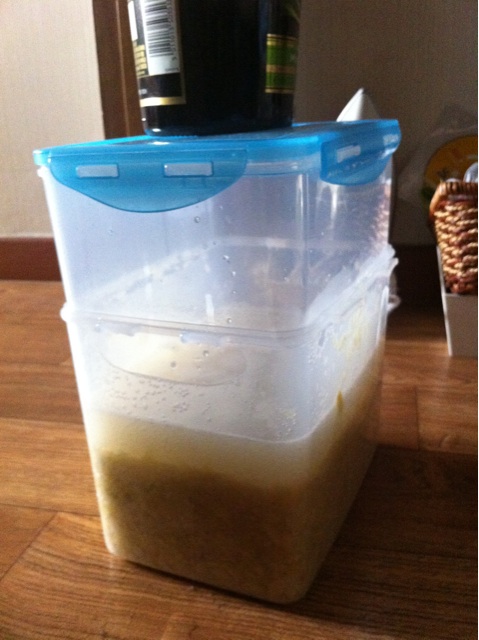
What a day. I had planned to get so many things done: brewing, mazing (meadmaking), shifting the sauerkrat to its new container, cleaning up, grading. Well, the power went out about 10:00am, and I called the office to see whether it was campus-wide. The girls in the office noted the Net wasn’t working, but they had power… and then realized that the new building (where most of my classes are, along with the office) has its own generator. They called the Facilities office around 11:30am… but didn’t call me back. I called after lunch, and was told they’d been told …
Mazing, Brewing, Renaming a Beer
Wednesday, I’ll be brewing a semi-familiar beer, my On a Jag Abbey Dubbel… except, I’m gonna get the volume right this time, damn it, and it will be a Dubbel, ie. maybe 6-7% alcohol. And, well, I’m going to use the Belgian Abbey I yeast (a little more estery), instead of Belgian Abbey II (not so estery). At least, that’s the plan, though I’ll be honest: I’ve mixed up my yeasts and I’m just going by what condition they’re in, now. (The smaller sample in rougher condition in my fridge is Belgian Abbey II, and the bigger sample in the …