- Coming Soon: Mythic Bastionland!
- Our Mythic Bastionland, Session 1
- Our Mythic Bastionland, Session 2
- Our Mythic Bastionland, Session 3
- Our Mythic Bastionland, Session 4
- Our Mythic Bastionland, Session 5
- Our Mythic Bastionland, Session 6
- Our Mythic Bastionland, Session 7
- Our Mythic Bastionland, Session 8
- Our Mythic Bastionland, Session 9
- Our Mythic Bastionland, Session 10
- Our Mythic Bastionland, Session 11
- Our Mythic Bastionland, Session 12
- Our Mythic Bastionland, Session 13
- Our Mythic Bastionland, Session 14
- Our Mythic Bastionland, Session 15
- Our Mythic Bastionland, Session 16
- Our Mythic Bastionland, Session 17
- Our Mythic Bastionland, Session 18
- Our Mythic Bastionland, Session 19
- Our Mythic Bastionland, Session 20
- Our Mythic Bastionland, Session 21
- Our Mythic Bastionland, Between Sessions 21 and 22: The Feast
- Our Mythic Bastionland, Session 22 and Epilogue
- Our Mythic Bastionland Wrap-Up: Behind the Scenes
This post is a little different from the rest of this series. For one thing, it details some stuff that happens between sessions of our game.
Our next session is the last possible one for this season of Mythic Bastionland, so I’m kind of trying to get to the climax, but we didn’t have enough time in the last session for proper setup of that. Queen Borran Gladsmere met the Knights, and promised them a feast that evening, but we didn’t get to play through it, which is perhaps for the best. Still, the feast does happen, and the Knights surely learn some important information while they’re at it. I wanted to disburse that information without spending half a session on it, and one player suggested I just write it up as a post, which was a great idea. So that’s what this is, starting a few hours before the feast:
Before the Feast:
(Note: Esther, Sir Leif’s player, suggested I could share this with everyone, so I’m posting it here.)
Sir Leif spent much of the day the library at Blackwort’s House of Learning, studying historical records, and managed to answer the following questions to some degree:
How did the queen get to the throne, and were there any interesting things at play that led to her ascent to the throne?
The official accounts are all clear: the former King, Mellen Cogswaine, died of a heart attack, and left no direct heirs to the throne. He had some distant cousins, but the custom of the realm is that direct descendants, even illegitimate ones, hold priority over more distant relations. Therefore when the girl’s mother Quiralorn and the mysterious figure Sparenot (see below) brought Borran Gladsmere to court and insisted the girl was a direct heir of Mellen Cogswaine, the late king’s advisors permitted the girl the opportunity to demonstrate her fitness for the throne, which she successfully did, “calling the axe” and “singing her grandfather’s songs,” which her mother claimed the girl had never heard before. It didn’t hurt that there was an ancient prophecy about a crippled queen, either.
Nonetheless, there was some speculation about the role of Sparenot in the girl’s ascension. The truth about him was unknown but some writers suggested he was a mysterious figure, possibly a seer or a warlock of some sort. Some used this suspicion to lend Sparenot authority—if he were a Seer, then he saw the realm’s destiny and served the realm well by presenting Borran for ordination; others hinted at how some present had grumbled that perhaps he had taught Borran her grandfather’s songs, and perhaps even had used magic to fake the “calling of the axe.”
Is there any word about Lady Ygraine, the scorned mistress of King Aeldrin, and her actions? How is she remembered?
All accounts agree that she was struck by horrible grief when King Aeldrin died, and that her heart broke on that day, never to properly heal. She never returned to her castle in the Fields of St. Hellane, but instead went directly to Blackwort Castle to seek revenge. She slew the killer of King Aeldrin, seized Hegravayne, and then, in disguise, traveled to the southern end of the realm to bring the evil blade—a blade she herself made when spurned by King Aeldrin—to the knights faithful to the late King, so that the sword could be buried with his corpse.
After that point, the accounts diverge: some had her set up residence in a tower on the edge of the realm and spend the rest of her life in mourning, dying after a century and a half. Other stories claimed she had ventured to a distant realm and was never heard from again. In another account, she became the consort of the Wild Prince—whose fortress lay southeast of Caerwyn Bridge, in the Elder Forest—and eventually became his queen, not out of love, but out of a desire to someday strike down the new rulers of the realm. Another account claimed that she was secretly a Seer, and went into hiding to escape being hunted down by the knights of Blackwort Castle.
Whatever her fate, Borran Gladsmere’s family has gone out of and back into power several times over the past millennium, and often their misfortunes and falls from power were blamed on Lady Ygraine, even long after she must have been dead. Even today, there remains a saying at Blackwort Castle that one “best not tempt Lady Ygraine”—a warning against taking unnecessary risks.
Is there any local beast of note in the area?
There are two. One is a talking fox, known as The Fox of the Road, who sometimes appears to travellers and challenges them to a game of riddles; if beaten, he vows to come to the victor’s aid at the moment when they need it most.
The other is an enormous (but not giant) cave lion that lives in a cave north of Blackwort Castle. It’s famously ferocious, and has in the past attacked people who trespassed into its territory. Anyone who vanquished this beast would be celebrated in Castle Blackwort and the fortified town of Blackwort that surrounds the castle, and a hero to the peasant farmers of the region.
The Feast
The sun set late at Castle Blackwort, a sure sign of spring being well on the way to becoming summer. The Knights attended the feast in the Castle held in their honor, arriving on time and being cheered by the other Knights as they arrived. The feast hall was curiously devoid of courtiers, those in attendance being mainly fellow knights, as well as Borran Gladsmere:

… and her advisors.
The identities of these advisors, the Knights learned during the course of the evening. The matronly female advisor was Quiralorn:

… who was Borran Gladsmere’s mother. It was suggested that she was her daughter’s closest and most-trusted confidant, and a powerful force in Queen Borran’s court, and she was the individual who, other than Borran, seemed most interested in hearing more about the Knights through the stories of their adventures. The Knights got the feeling she was trying to feel them out, to get a sense of whether they could be trusted to serve her daughter the Queen well and faithfully.
Next, the older man in the nobleman’s clothing was an ambitious older man, apparently a former mercenary, possessed of very formal mannerisms and speech, named Roosen:

He was notably very interested in music, and led the singing of several drinking songs at the feast. The knights in the court seemed to respect Roosen’s judgment in general, though there were occasional jokes about his age, hinting either at incipient dementia or a failing of his courage. The Knights got the impression that nobody was willing to say much about it, but that Roosen had just emerged from a period of courtly disfavor, before reestablishing himself in Borran’s (and Quiralorn’s) good graces.
Finally, the advisor in the monastic clothing was named Sparenot:
 … about whom fellow knights were unusually reluctant to speak: it was implied more than once that he would inevitably learn (or hear?) all that was said about him, and that those who crossed Sparenot eventually paid in terrible ways. It was also occasionally hinted that he was in possession of magical powers, possibly a Seer in hiding, and that he was the true foundation of Queen Borran’s power. Nobody said a bad word about him, but neither did they speak in praise of him, nor seemingly did they dare to tease or joke with him, as they did with Roosen.
Early on in the feast, Sir Yorick:

… also recognized one more person at the feast: a minstrel:

who was playing a tune that fawningly praised the exploits of Sir Gowere, one of the knights at the feast (see below). Yorick manage to spot him before he managed to recognize Sir Yorick. (See Questions for the Players, below.)
At the feast, Queen Borran revealed how she had proven her right to rule the realm. Apparently both actions were party tricks that she performed for every feast: some of the knights’ attention drifted when she performed these acts, though all were polite enough to bang their fists on the tables in applause. The first trick was not particularly convincing, though it was impressive: she sang a series of three songs, all of which supposedly were composed by her paternal grandfather (King Yeltin), and which she had not learned prior to the day of her coronation. Indeed, it was said that she had never actually learned these songs, but had known all three somehow through some preternatural cause, one that verified her as King Yeltin’s descendant. The second trick she performed was much more impressive: she stood in the middle of the room as one by one the knights and advisors present each intoned the following phrase: “Come to me, Glynfallar.” When the knights said it—including Sirs Yorick, Tyack, and Leif:


… absolutely nothing happened. However, when Queen Borran said it, a great war axe leaped down from the wall, crashing to the floor, and then dragged itself across the stone cobbles to her feet, before leaping up into her hands. As this happened, Leif was sure to pay close attention to Sparenot, who was smiling but not doing anything visibly—no ritual chanting, no special concentration. young Borran Gladsmere struggled with the weight of the great axe, nearly falling over, but steadied herself and raised the axe high, and the knights cried in unison, “Long live Queen Borran!”
As the feast continued, the knights present began telling tales of their adventures to Sirs Leif, Tyack, and Yorick. The adventures were all quite astonishing stories, some ending in triumph, others ending in confusion or defeat. Most of the knights good-naturedly ribbed one another, but through the course of the feast, the Knights observed enough to get a sense of some of their relationships, as well as of the character of the various knights present. The most notable of the knights in the room were the following:
Sir Brayne, the Mock Knight:

… constantly kept one watchful eye on Borran Gladsmere. Given to speaking in a blustery voice, he was clearly very close with Sir Ezterre, the Questing Knight:

… who speaks with a foreign accent, and who was given to reminiscing about Borran Gladsmere’s father, the late King of the realm.
Sir Myghal, the Rat Knight:
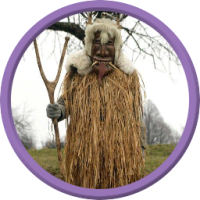
… sometimes straddled the line between good-natured ribbing and mockery in his rejoinders to the stories of Sir Brayne. He seemed to be much closer a tall slender knight with a lilting voice and fashionable attire, named Sir Burgoyne (the Willow Knight):

Sir Burgoyne seemed to have many inside jokes shared with Myghal, and thought himself quite a wit… perhaps more of a wit than he really was. From the tales he told, it was clear that he is a better fighter than his slender, willowy figure suggests. He sometimes referred to Borran Gladsmere as his “sweet cousin.”
If the knights had not recently met a real giant, they might have mistaken Sir Gowere, the Whip Knight, for one:

He was intelligent, handsome, and enormous, and it was clear from his interactions and the tales he told that he has the heart of a bully, though for the most part he was restrained during the feast by the rules of courtly manners. Sir Tyack saw him outside at one point, snorting some herbs from the palm of one of his enormous hands, after which he seemed slightly more languid and quiet. He made a respectful speech about the fallen knights of the realm, naming them one by one and mentioning their exploits in passing as he did so—and the list was long enough to give the impression that a number of knights had fallen in the realm of late. If there was one knight of whom Gowere took note more often than the others during the feast, it was Ser Reyka, the Fanged Knight:

… who was indeed fanged, and whose adventurous tales often involved unarmed combat. At the point of each victory, Reyka licked the tips of her fangs as if luxuriating in the memory of a glorious killing bite. She was perhaps the most friendly of the knights with Borran Gladsmere. She spoke with a slight speech impediment—presumably on account of her fangs—but nobody teased (or dared to tease?) her about this.
Ser Ogan, the Gallows Knight:
… was mostly quiet and morose, though she cheered a little louder than others when Gowere toasted Burgoyne’s exploits. She spoke with a lowborn accent, sounding much more like the peasants in Belfin Village than like the nobles and knights of Blackwort Castle. Notably, she did approach each of the Knights and complain about some minor inconvenience or annoyance at the feast—the boar meat being cold, the ale being smokier than usual, the hearth being poorly tended—and she seemed to find some measure of joy in her complaining.
Finally, there was Sir Wodwale, the Ghoul Knight:

… who, though elderly, did not appear ghoul-like at all. His stories mostly focused on life in Port Mullen, and his “years at sea,” but other knights jokes directed at him seemed to hint that he had died on the battlefield only to arise more than once during his adventures. He fidgeted constantly with some sort of small wooden figurine in his hand as he spoke, and the other knights present all were unusually courteous to him, as befitting his seniority at the court.
Of current events, some talk at the feast circulated around the following:
- Speculations regarding the fate of Sir Valamonte, the Halo Knight, who rode out of Blackwort Castle in search of the Tree a few weeks earlier, after its branches spread across the sky, and never returned.
- A prophecy made by the Brazen Seer, who was recently visited by a few of the knights at the feast, and who warned the knights to oil their weapons and steel their souls for a terrible battle to come.
- Word of sightings of The Claw, a gigantic black lobster, near Port Mullen, as foretold in prophecies by the Painted Seer.
- Stories recounted by peasant refugees of fires raging across the southeastern corner of the kingdom for unknown reasons.
- Speculations and jocular boasting about the upcoming tournament that will be held at Blackwort Castle a few weeks hence.
Upon hearing about Sir Valamonte being missing, Sir Yorick announced that the group had happened upon a dead knight on horseback while investigating the Tree, and given him a proper and honourable burial. The other knights at the feast were very pleased by this, and praised him for his courtesy.
Questions for the Players:
Sir Yorick: You got a chance to speak with the minstrel, Yerkin, who authored “The Three Foul Knights”. What did you say to him, or do to him?
Sir Leif: Sir Burgoyne made a point of sitting with you and asking you about King Aeldrin, Lady Ygraine, and Hegravayne. You got the sense he was feeling you out, but you’re not sure why or what for. What kind of impression did you try to make on him?
Sir Tyack: Toward the end of the feast, you spotted a servant with an oddly familiar look about him:

How did you respond to this surprise?
We’ll answer these questions in a few sentences each at the start of the next session, and then jump forward to the tournament.