The Beggar’s Opera by John Gay

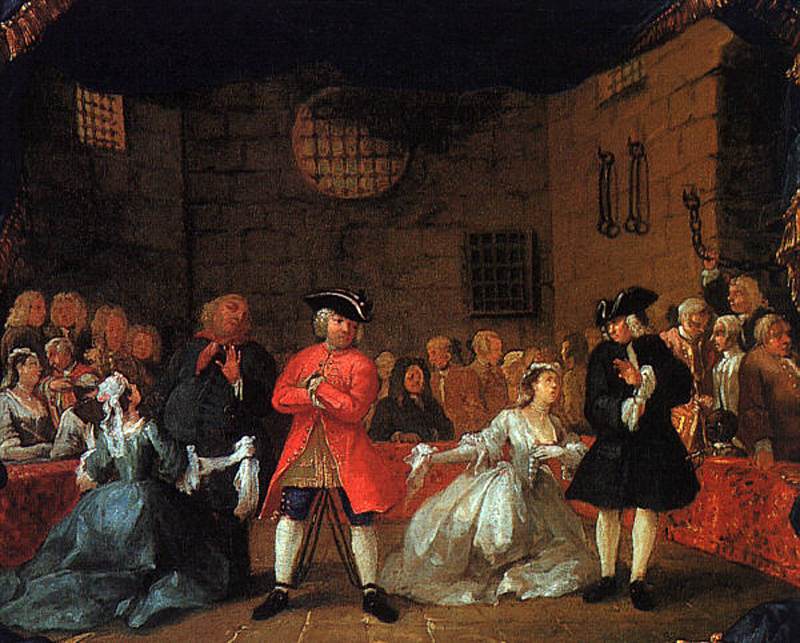
(Note: This is a longish post. I apologize that I could not shorten it further, but I haven’t the time.) Those in the know will note that I specified only John Gay, and not the composer Pepusch: I’m working on getting hold of a copy of the opera–the 1983 staging, supposedly with the original music, aired by the BBC–but for the moment I just have the public domain etext from Project Gutenberg. It’d be an understatement to say that The Beggar’s Opera was kind of a big deal during and after its first staging in Haymarket back in 1728. Better to …

Continue Reading

The Harlot’s Progress (BBC4) and The Georgian Underworld: A Study of Criminal Subcultures in Eighteenth-Century England by Rictor Norton

Historical fiction–speculative or otherwise–is a challenge for a number of reasons, but probably the biggest challenge is the problem of texture: how to get the texture of that alien historical world right? This is what impressed me about China Miéville’s depiction of Bas-Lag in Perdido Street Station (a book I discussed here a decade ago): sure, as one friend commented, it reads like someone’s AD&D adventure… but the world is so utterly textured, so rife with details. It feels like a real city at some grungy, nasty moment in its history, like the festering horror-show that was London in an …

Continue Reading

Swords Against Death by Fritz Leiber

Swords Against Death is the second of Fritz Leiber’s Lankhmar books, featuring the archetypal characters of Fafhrd  the barbarian and The Grey Mouser the rogue. The book includes stories spanning from 1940 to 1970… which I imagine, if you’re reading the book attentively and know this, would leave you watching for signs of change and development in the author’s writing style. As for me, it wasn’t really apparent to me, as I read the stories, that they were written across such a long span of years. That isn’t to say there weren’t shifts in tone and style, or that there …

Continue Reading

Mission Child by Maureen McHugh, and Thoughts About Stretching the Limits of the Genre

I’ve loved Maureen McHugh’s writing since first contact. That was, like for many people, her debut novel China Mountain Zhang, a book I stumbled upon in the Chapters in downtown Montréal, I think sometime in 1999 or so… a couple of years before I left for Korea, where (back in the old days) I had to make do with reading whatever I happened to find. It was because Maureen was teaching a week at Clarion West in 2006 that I decided to take the plunge and go; it was because of China Mountain Zhang that I realized the kinds of stories that …

Continue Reading

Three Questions About Western Historiography and Korea

Another excerpt from Donald Clark’s Living Dangerously in Korea, and two three questions: Given the speed of change in modern Korea, it takes some mental effort to recall the conditions of diet, health, housing, education, and living standards that prevailed in Korea at the time of liberation. In the 1930s, for example, life expectancy was thirty-six years for men and thirty-eight years for women. Women were treated like chattel by their own relatives. They had little autonomy or even identity of their own. They were known as so-and-so’s mother or daughter or wife and their given names were so seldom …

Continue Reading

Paul Auster on Writing in Oracle Night

I usually find it kind of boring or annoying when writers write about writers (and about writers writing, especially, or even worse, about writers struggling to write), but Paul Auster has managed to do it well, both in his autobiographical Hand to Mouth (a review of which I wrote in 2006, though it was lost to the aether at the time and I never rewrote it), and in the book I’m reading now, Oracle Night.

Continue Reading

Heathern and Terraplane, by Jack Womack

I’ve just read Jack Womack’s second and third novels (both of books set in his “Dryco” series) back-to-back. Longtime readers will note that I lauded the first novel in the series (in terms of series timeline) with lavish praise back in 2012. I also read the Womack’s first novel, Ambient, and it made a strong impression on me at the time, but that was years and years ago, and I’m due for a reread since I’m apparently trying to read all the Dryco books this year. (Actually, when I read Ambient, I wanted nothing more than to read everything else …

Continue Reading

The Genocides by Thomas M. Disch

When I read Thomas M. Disch’s 334 back in grad school, I found it didn’t make much of an impression on me, beyond its unremitting and overwhelming grimness. Perhaps the bleak grimness of graduate school distracted me from its finer points? I’m not sure, but I can say that the cruelty and bleakness of The Genocides has definitely made an impression on me: I have essentially devoured it over the last day-and-a-half.  

Continue Reading

Donald Clark’s Living Dangerously in Korea

I’ve mentioned Donald Clark’s book Living Dangerously in Korea: The Western Experience 1900-1950 a few times lately (and it will certainly come up again), but I haven’t really summed up my thoughts on the book, something I’m trying to do a little more since falling out of the habit last year. Here are my thoughts… 

Continue Reading

The Poet by Yi Mun-Yol

When I ran across a very positive review for Yi Mun-yol’s novel The Poet over at Korean Literature in Translation, I was really excited to check the book out. It’s a novel about a poet who went by the handle Kim Sakkat–“Rain-Hat” Kim, the grandson of a rebel-leader who suffered social censure (and, almost, the execution of his whole family, in retribution for the granddad’s “crime”). The grandson becomes a poet, and then a wanderer, and arguably the first proto-rapper or beat poet in Korea… and the novel purports to explore his life story. Sound great, right? Unfortunately, I found …

Continue Reading