Mary Ambree and Female Warriors
Over the years, I’ve seen a lot of writers of fantasy talk about historical female warriors—the historicity of women marching into battle alongside men—and there’s obviously value in looking at history, because there are plenty of dumbasses out there who will be quick to say something stupid like, “But women didn’t march into battle! That’s dumb!” There will be nitwits who will say it’s feminist claptrap, or unbelievable, or implausible, or whatever. (I mean, I suppose we should spend time correcting such ignorance and stupidity when we encounter it, at least occasionally, right? So: yes, it is plausible. There definitely were societies where women …

Continue Reading

July/August Books

My last stretch of comments on books was really, really long. 5,400-odd words long, if I recall right. So I’m going to try for shorter and pithier this time. Should be easier, since I read less than I’d hoped I would, but even so… shorter. Pithier. Also: I have been feeling like I have been reading too few books by women, so I did something about it. At least on the fiction side I achieved parity—three female authors and three male ones—but I’m not so concerned about the nonfiction/research books, since you don’t get to choose who writes research books pertinent …

Continue Reading

Recent Books

I’ve been reading a fair bit this year, as far as my standards go. More than usual, anyway. This is everything so far, though, of course, a few of those I gave up on and didn’t finish: I’ve been feeling a little disappointed lately in how so much of the SFF world online is so busy talking about scandals and outrages that we never seem to talk about the books anymore. Short stories, too, but, well, that’s for another post. So I figured: do my bit. Post about what I’ve read lately. Part of why I stopped was because–on some very bad …

Continue Reading

The Georgian Postal System(s), and Cross-Writing

As I’ve been harping for a while now, modernity didn’t just spring out of nowhere… it got built out of chaos, and it got built, primarily, in the form of systems, since people realized that systematization was an effective way of converting chaos into order. Modernity thrives on order, for better or worse, but as is clear to anyone living in a big city where modernity is a recent import (and not yet completely metabolized), you cannot have a modern metropolis without highly functional, highly integrated systems. As I’ve mentioned lately, it seems to me that it was in the Georgian era that a lot of …

Continue Reading

The Brewing Industry in England, 1700-1830 by Peter Mathias

Well, I’ve finally finished studying Peter Mathias’ masterpiece of brewing history, The Brewing Industry in England, 1700-1830. It is regrettable in the extreme that this book is both out of print, and as difficult to obtain as it seems to be. (I was lucky, as I’ve mentioned in the past, to get help from a friend in Germany who aided me in dealing with online bookseller there; apparently the demand of Mathias’ book in Deutschland is less than in the English-speaking world, and I got it for a relative song.) I’ve mentioned the book in many a recent post, so I’m just going …

Continue Reading

Tristram Shandy: A Cock and Bull Story

Well, I’m still at about page fifty of Sterne’s Tristram Shandy, which is an entertaining book so far, but which is nonetheless a bit slow going: the sentence structures take some getting used to, to say the least. I’ve temporarily abandoned ship to reread Gulliver’s Travels (for the first time since childhood), another popular Georgian novel and one with much less tangled prose. Still, I do intend to continue with Tristram Shandy–and for that matter Moll Flanders–once Gulliver’s finished his travels. I only made an effort to see Michael Winterbottom’s film adaptation of the former, titled A Cock and Bull …

Continue Reading

Georgian England, The Developing World, Crime Prevention, and Internet Trolls

Life in Georgian London was an alien sort of existence: it’s hard to wrap your head around it, though there is one analogy I’ve discovered for it that neatly says a lot about the things we take for granted… and also suggests something of our future, too. I suspect the unexpected key is this figure: Yes, our old friend… the internet troll.  I’d argue that, among other things, the Internet is pretty invaluable in keeping humanity acquainted with what it’s like to live in a lawless, unpoliced world. Which is the kind of world that people in the 1730s lived …

Continue Reading

And Called It… Macaroni?

Yes, even in Canada we know the Yankee Doodle song. But like everyone else, as kids we giggle and find that last line in the first verse: Yankee Doodle went to town Riding on a pony; He stuck a feather in his hat, And called it macaroni… Who the hell sticks a feather in his hat and then calls it “macaroni”? What in the hell is that about? Maybe everyone else knows, but I sure didn’t. Not till the other day, anyway. The answer, as for so much around here lately, lies in Georgian England.

Continue Reading

The Beggar’s Opera by John Gay

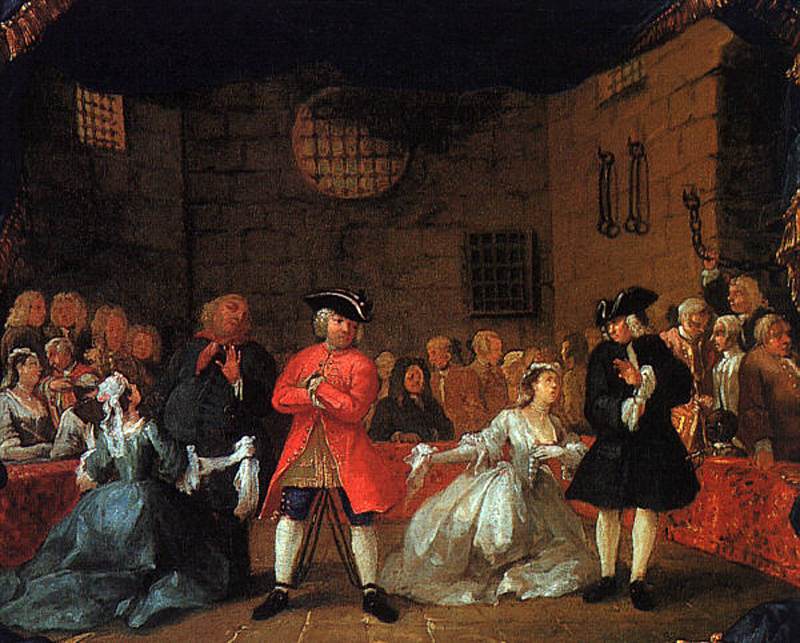
(Note: This is a longish post. I apologize that I could not shorten it further, but I haven’t the time.) Those in the know will note that I specified only John Gay, and not the composer Pepusch: I’m working on getting hold of a copy of the opera–the 1983 staging, supposedly with the original music, aired by the BBC–but for the moment I just have the public domain etext from Project Gutenberg. It’d be an understatement to say that The Beggar’s Opera was kind of a big deal during and after its first staging in Haymarket back in 1728. Better to …

Continue Reading

The Harlot’s Progress (BBC4) and The Georgian Underworld: A Study of Criminal Subcultures in Eighteenth-Century England by Rictor Norton

Historical fiction–speculative or otherwise–is a challenge for a number of reasons, but probably the biggest challenge is the problem of texture: how to get the texture of that alien historical world right? This is what impressed me about China Miéville’s depiction of Bas-Lag in Perdido Street Station (a book I discussed here a decade ago): sure, as one friend commented, it reads like someone’s AD&D adventure… but the world is so utterly textured, so rife with details. It feels like a real city at some grungy, nasty moment in its history, like the festering horror-show that was London in an …

Continue Reading