Hop-Pickers and Pagan Ritual, from the 1750s to the 1930s

I’m still working on a series of posts on the South Sea Bubble. It’s kind of fractal: the more you look, the more you see, and it all links so complexly that it’s hard to fit into a single series of posts. So anyway, in the meantime, here’s another subject I’ve been reading up on: the tradition of hop-pickers. It seems like there’s been a surge of nostalgic memory for the tradition of Londoners from the East End making their yearly pilgrimage–a pilgrimage involving 250,000 people at its height, at the beginning of the 20th century–out to East Kent, where a large proportion …

Continue Reading

Books For Malt-Worms

Today, a light post, but still relevant to beer and brewing in the early 1700s, following my recent post on “Books of Secrets.” Like all industries, beer and brewing are connected to both the industries that produce their raw materials, and spawn other industries as well. One of the more interesting industries that has been spawned by the beer business is the “beer book” business. Most homebrewers think of “beer books” as books on homebrewing–either style guides and recipes or technical manuals. Some beer history buffs will also think of books on beer history, of which a few great ones exist out there. The former has been …

Continue Reading

Geneva: a Poem. (1729)

Today, another post with some fun stuff (more fun than fungemia, at least) from my ongoing novel research… Back in the early Georgian era, pamphlets were used to do the kind of advocacy and political consciousness-raising we see going on today on Youtube and other social networking sites. One of the more famous ones–and certainly, a poem of interest to anyone concerned with the conflict between gin distillers (who were linked to free-marketeers) versus brewers (who were linked to religious and social reformers) was Elias Blunt’s “Geneva: a Poem” (1729). The full title text is: Geneva: a Poem. Addreſs’d to the Right Honourable Sir R— W—. By Alexander Blunt, Distiller. In …

Continue Reading

Got Hops?: Southwark Borough High Street

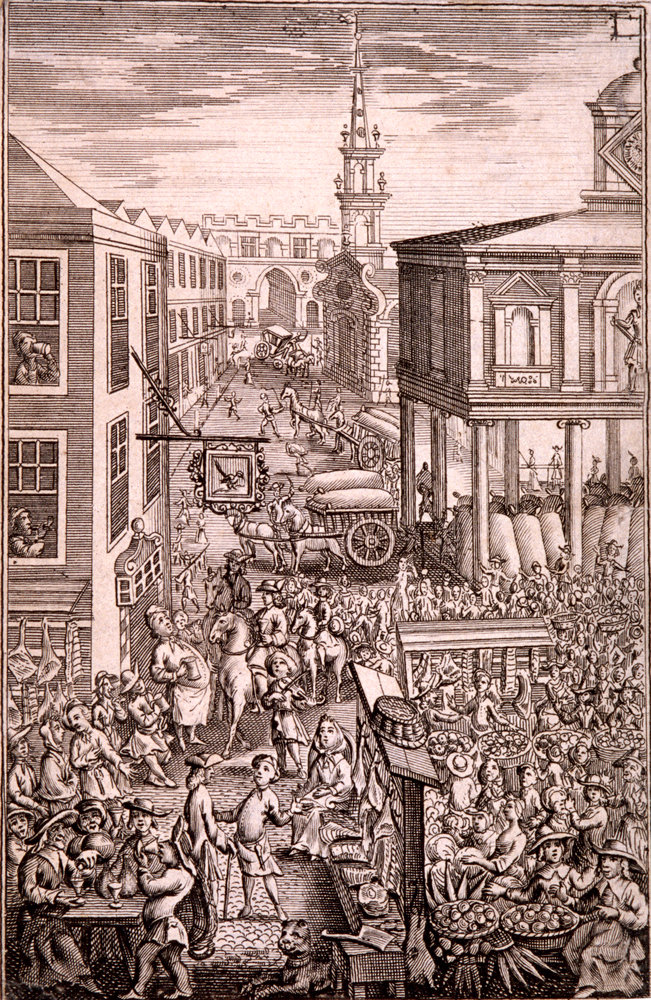
This is a post on the geography of the hop trade in London in the 1730s, but it’s really more than that. It’s actually the product of research I had to do to figure out where exactly my protagonist was walking in one scene of the novel I’m writing, and what it probably looked like. As such, it veers between all of this: the main hop market in London, urban geography, the architecture of London bridge at the time, how Londoners internalized the systematic cognitive infrastructure of being urban people, the state of capital punishment in London, hop packaging and transport in the early 1700s, a …

Continue Reading

Cats in the Brewhouse

A short post, because I’m busy…  While searching (fruitlessly) for a picture of the brewer John Perkins at Shut Up At Barclay Perkins, I found a great post about another sort of animal laborer in the old London brewhouse: cats. Probably anyone who’s lived on a farm isn’t surprised, but this was news to me, even if it immediately made sense.   I’ve mentioned before how work-animals–specifically horses–were an important part of the brewhouse. But I hadn’t realized that cats, too were used by brewers. It makes sense, of course: rats like to eat grain, and cats like to hunt …

Continue Reading

How John Perkins Saved Thrale’s Anchor Brewery From the Gordon Riots

Long story short? Free (as in “free beer”) beer. And food. And a horse-drawn cart. But you want the long version, right? In a very recent post, I speculated on parallels between Georgian England and other societies that are in a comparable stage of internalizing modernity, industrialization, urbanization, and so on. I specifically suggested that what had sounded so odd to me about the handling of the Bin Duong rioters here in Vietnam–trying to appease them, and even give them a refreshing drink–might have a parallel in Georgian England. Well, whaddaya know. While reading a paper on the hop trade …

Continue Reading

Steam-Powered Brewing and Gibson & Sterling’s The Difference Engine, or, Research vs. That Other Thing

I mentioned a while back that I’m listening to an audiobook of The Difference Engine. Well, I’m pretty close to the end now, and enjoying the hell out of it. One phrase that comes to mind is how Edward Said described the novel as a form (in the process of explaining why understanding novels were useful to understanding imperialism), in Culture and Imperialism: Note the highlight: “an incorporative, quasi-encyclopedic cultural form.” That is not only something I aspire to in my own fiction writing, but it most definitely is true of The Difference Engine, except it’s sort of a weirdcyclopedia, …

Continue Reading

Isinglass

There’s some wonderful information in Peter Mathias’ The Brewing Industry in England 1700-1830, especially if you’re looking for funny details about the world of London brewers in the 1730s that could be hacked into alchemical-industrial conspiracy. For example, isinglass: It’s basically made out of fish bladder, and it’s used as a “finings”–that is, you dump some of it into your finished beer (in powder form, I think, though I’ve never used it myself), and it pulls the yeast to the bottom. In other words, it clears up your beer, and it was the main way of doing so prior to mode recent …

Continue Reading

He’s No Isambard Kingdom Brunel, but…

I know, I’m late to the party, but lately I’ve been reading Sydney Padua’s the webcomic The Thrilling Adventures of Lovelace and Babbage (coming soon as a book, apparently?), and, well: Everyone loves Isambard Kingdom Brunel, and for good reason: though he was more like the Tony Stark of his age–“accomplished” barely touches how important an engineer he was during his short but influential career in early Victorian London–the Wolverine-like look he gets in Padua’s comic (and, well, in the photos, really) is, er… I’ll put it this way: as Padua has noted, he’s an extremely popular character. He even got …

Continue Reading

Yeast, as Understood in 1736

  I’m really glad I was able to get a second opinion on one little detail that has become of great importance to my ongoing novel project. That is: how well did brewers understand the function of yeast in brewing back in 1736? It might sound strange, but that detail is incredibly important in terms of a lot of things going on in the book! During my visit to Korea, I got a chance to read a fair bit of Jamil Zainasheff and Chris White’s book Yeast: The Practical Guide to Beer Fermentation. I wasn’t particularly blown away by the book: …

Continue Reading