The Compleat Meadmaker by Ken Schramm

Those who know me personally know that my passions tend to kind of take over. When I am interested in something, it begins to occupy a big part of my mind. I think about it a lot. I talk about it a lot. Those who know me are used to it, I suspect. Hanging out with a homebrewer can be something like hanging out with a writer of the talky kind. I have friends who are writers of the non-talky kind, the sort who seem to feel that talking about their current projects is a way of abandoning the project …

Continue Reading

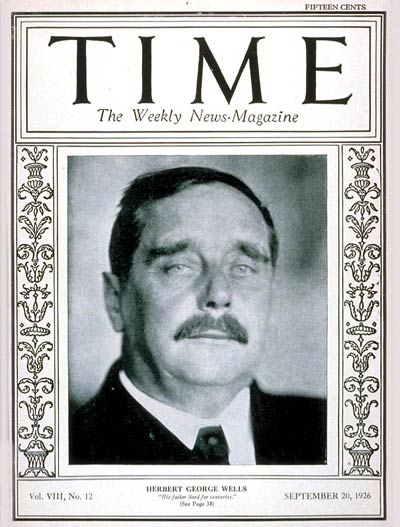
The Last Books of H.G. Wells — The Happy Turning: A Dream of Life & Mind at the End of its Tether by H.G. Wells, Forewords by Rudy Rucker and Colin Wilson

Much as I enjoyed it myself (primarily as a curio of sorts), this slim little book is one that most SF fans, I think, need not hurry to read. Unless one is truly interested in Wells as a man, in seeing how old age and the knowledge of his approaching death (by liver cancer) affected his thinking and writing, I don’t think someone is likely to get much out of it. But if you are interested in Wells, this book can help you get a handle on his last few years. These works, especially Mind at the End of its …

Continue Reading

Shadow Lovers: The Last Affairs of H.G. Wells, by Andrea Lynn

Not so very long ago, in a post where I requested some help regarding some articles, and discussed some of my ongoing readings, I bashed Terry Eagleton’s self-righteous and dismissal of H.G. Wells, in the course of his review of the book I am now reviewing myself, University6 of Illinois scholar Andrea Lynn’s Shadow Lovers: The Last Affairs of H.G. Wells. Leaving aside Eagleton’s ignorant and sniping attack on Wells as a writer — it’s par for the course when self-appointed cardinals and pontiffs of literature look in any direction that even faintly bears the markings of popular fiction, be …

Continue Reading

In the Days of the Comet by H.G. Wells

Again, as part of the research for my current writing project, I’ve been digging into some of the work of H.G. Wells, specifically the stuff he’s famous for today. It may surprise some people — not the SF fans reading my site, of course, but perhaps those who never checked out Wells beyond his work — that H.G. Wells was more well-known in his time for things other than those scientific romances of the early days, like The War of the Worlds, The Island of Doctor Moreau, The Invisible Man, and The Time Machine. One thing he was well-known for …

Continue Reading

Wild Brews: Beer Beyond the Influence of Brewer’s Yeast by Jeff Sparrow

Wild Brews is a wonderful little book that deals specifically with the wild-fermented beers in the Belgian tradition — that is, Lambic (and various subtypes and blends like Framboise, Gueuze, Kriek, and so on) and the Flanders Ales. Anyone who is even a little experienced in homebrewing is going to at least be intimidated by the idea of brewing a lambic. Most of us make beer happily knowing that the fruits of our labours will be drinkable in a month or two, six months at the most in many cases — it’s a rare beer that takes a year to …

Continue Reading

Shadows of the Future: H.G. Wells, Science Fiction, and Prophecy

It’s difficult to write a bloggable review of a work of academic scholarship, given the nature of blogs and the nature of academic texts, so I’ll just note that this book provided me with a fascinating chunk of discussion on the “prophetic” feature or function of SF through a look at the work of H.G. Wells. Parrinder in this book argues that Wells, in his approach to the utopian novel, breaks with the past in how he the notion of prophecy is handled, in his attitude towards science in the context of SF, and much more. There’s more than just …

Continue Reading

Wraith: The Great War by Bruce Baugh

It was the rainy last day of March 2010 when I began writing this. I am told the winter was “hard” and “cruel,” with altogether more snow than is normal, and though I missed much of that, I got a taste this month. Hard. Cruel. These words draw laughter from the ghosts of the past, which haunt our modern world, whether or not we realize it. “Hard and cruel?” they ask, snickering as they glimpse at my dry, warm apartment, the bucket of beer-in-the-making fermenting on the kitchen table, the shelves full of books, the fridge stocked with food. “You …

Continue Reading

The Ghost Map by Steven Johnson

Having decided to defer my review of Ian McDonald’s Cyberabad Days until I’ve read his other book in the same world/setting, River of Gods, I have decided to skip ahead and review the next book I read, a nonfiction piece by Steven Johnson. This book was a loaner from my friend Charles, who recommended it highly to me. If I remember right, he picked it up at The Strand, which is one of the most wonderful bookstores I’ve ever visited… so much so that I even got a T-shirt when I was there. Maybe that doesn’t interest readers, but I …

Continue Reading

Trotsky: A Graphic Biography by Rick Geary

I remember, when I took a film course as an undergraduate, studying with a professor named Don Kerr. When we watched The Birth of a Nation he read to us from the local newspaper in Saskatoon, an article dating back to the film’s release there. I still recall the amusement shared by all when the author claimed that henceforth, people could not longer criticize films for the decline in morality — “Films like this one can educate!” the article claimed — and that demon liquor was to blame. Huh? Social ills coming from either booze of movies? At a remove …

Continue Reading

Burma Chronicles by Guy Delisle

It is almost certainly unfair to Guy Delisle that reviewers will compare this book with his earlier Pyongyang, for that latter graphic novel was a major achievement, and for me at least, it represented something new in the world of comics. I read it in wonder, a few years ago, amazed at how Delisle managed to tell the story of a year so smoothly, so engagingly, and so courageously. The newer book is quite different, but this should surprise nobody: we cannot expect an artist or writer to produce work that is like the first work we have encountered from …

Continue Reading