Yuan Shih-k’ai by Jerome Chen

Ah, hostile biography. Today I’ll be discussing what I’ve picked up reading a book about Yuan Shih-k’ai (now just Yuan Shikai), the first President of post-revolutionary China. He’s one of those figures I’d never even heard of, and when I stumbled upon Jerome Chen’s eponymously titled  biography of the man, I decided to read it mostly out of curiosity regarding his role in Seoul in the turbulent 1880s. I’d assumed his involvement there was the main reason the book was in the library’s holdings at all, to be honest, but it turns out he’s actually more like China’s equivalent of Syngman Rhee, except that just before his downfall, …

Continue Reading

Itaewon and the Imjin War (異胎圓 or 梨泰院?)

Update (11 Feb. 2015): Commentary on Facebook has been helpful, especially this comment by Heyjin Jeon: In 1457, King SeJo (Son of King Sejong) said to the Minister of Finance, “Make workhouses for poor people at Bojewon, Hongjewon, Itaewon.”It’s before Imjin War. I think “梨泰院” listens like “梨泰院” and people made new meaning about the name. http://sillok.history.go.kr/url.jsp?id=kga_10305007_002 Here’s the relevant passage from that source: 다만 염려되는 것은 가난한 백성이 병든 사람과 더불어 뒤섞여 거처하기를 싫어해서 이로 인하여 뿔뿔이 도망하여 흩어지는 일이니, 보제원(普濟院)·홍제원(弘濟院)·이태원(梨泰院) 등 세 곳에 별도로 진제장(賑濟場)을 두고 사람을 임명하여 감독 관장(管掌)하게 하고, 또 오부(五部)의 관리로 하여금 날마다 윤번(輪番)으로 왕래하면서 검속(檢束)하고 …

Continue Reading

What do the Starfish Think?

I haven’t made an update here for the last few weeks, and a lot of long-promised (albeit probably not long-expected) posts languish unfinished. People are probably wondering if I went for a swim in the ocean and didn’t come back. Rest assured: I fear the ocean as much as I ever did, and am safe and (mostly) dry… just busy. That’s the nature of job-hunting, and it’s a bit like writing: lots of sitting at a computer fiddling with details, hoping your intended meaning comes across, sending things off into the void and then waiting for responses… so you send out more things …

Continue Reading

Recent Books

I’ve been reading a fair bit this year, as far as my standards go. More than usual, anyway. This is everything so far, though, of course, a few of those I gave up on and didn’t finish: I’ve been feeling a little disappointed lately in how so much of the SFF world online is so busy talking about scandals and outrages that we never seem to talk about the books anymore. Short stories, too, but, well, that’s for another post. So I figured: do my bit. Post about what I’ve read lately. Part of why I stopped was because–on some very bad …

Continue Reading

Imaginable Beers: A Primer for Writers of Speculative Fiction

This entry is part 6 of 6 in the series For Writers

Recently, a writer friend was asking around on Facebook for some information about the history of brewing and distilling. Since I’ve been studying up on these subjects (and blogging on the subject: see here for brewing, and there’s some stuff about distilling mixed into this tag), it was suggested I might be of some help. I started writing a longish response, and then decided that rather than toss all that information down into the Facebook crevasse where it would never be seen again, I would make a blog post about it. Note, this is primarily directed and writers of fantastical or speculative fiction, but …

Continue Reading

A Recipe for Mum(me)

One of the things about writing about historical brewing practices is that, while the methodology is likely not to be too different from what a homebrewer does–mash grain, run off wort, sparge, run off sparge, boil, ferment, package, imbibe–the technology used to complete those steps is absolutely going to differ. Fiction-writing requires details, so I’ve been hunting through brewing manuals of the 1700s, which is a manifold pleasure. It’s fun for a few reasons, but I’ll focus on one for now: the recipes. Among the most amusing is the recipe for Mum that I discovered in The Whole Duty of a Woman, …

Continue Reading

Distillers vs. Brewers: Tabulated Expenses from 1736

I know I promised a post on the South Sea Bubble next, but, well… it’s become a series, and the series isn’t done, so in the meantime, an interesting snippet from an anti-Gin tract.   Take note: Thomas Wilson’s Distilled Spirituous Liquors The Bane of the Nation (1736) has a clear agenda. (Also, an amazing title. 18th-century people just did titles like nobody else!) The agenda was to get the trade in gin banned in England; with that in mind, one should be careful how seriously one takes its content, especially concerning anything about distilling. It is, after all, a pamphlet written to rebut …

Continue Reading

The Georgian Postal System(s), and Cross-Writing

As I’ve been harping for a while now, modernity didn’t just spring out of nowhere… it got built out of chaos, and it got built, primarily, in the form of systems, since people realized that systematization was an effective way of converting chaos into order. Modernity thrives on order, for better or worse, but as is clear to anyone living in a big city where modernity is a recent import (and not yet completely metabolized), you cannot have a modern metropolis without highly functional, highly integrated systems. As I’ve mentioned lately, it seems to me that it was in the Georgian era that a lot of …

Continue Reading

Write-a-Thon Final Progress Report, Week 6

Week 6 of the Write-a-thon ended, for me, yesterday. (I did the writing on a week that runs Monday-Sunday.) Here’s my weekly update! If you don’t know what this Write-a-thon is, and want to know more, see here. (While I have a few generous sponsors already, I’d still love a few more, and if you’d like, it’s easy. More info on what’s in it for you at the link above.) Clarion West is still taking donations for the next couple of weeks, if you’re interested in supporting an amazing workshop program.

Continue Reading

Bookes of Secrets (and How to Read Them)

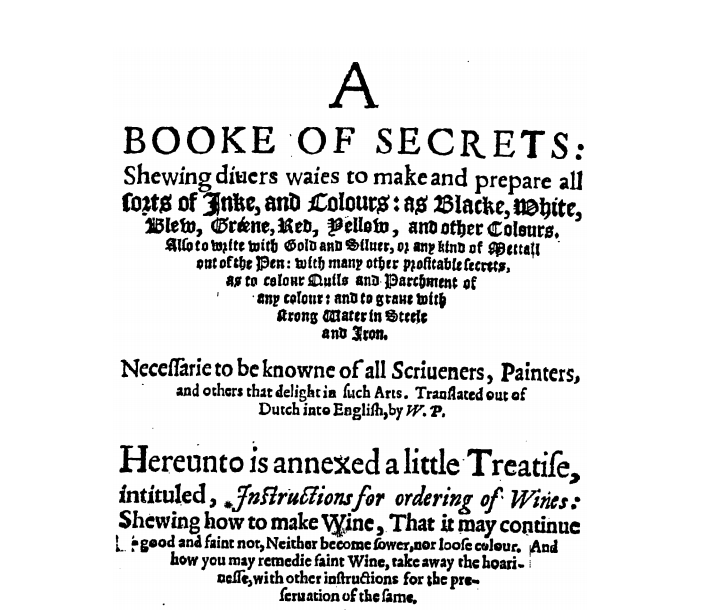
Books of Secrets (also called Secreta) are a whole genre of books I didn’t even know existed a little while ago. Genres (I mean like the novel, the epic poem, the Christian hagiography) are like media: they peak, and then they convalesce, and sometimes they die. The book of secrets is an example of a dead literary genre… sort of, though the conceptual basis and the ideology are alive in well, in transmuted form. In their original form, one might look at them basically as recipe/how-to books–and it was through the translation and distribution of books of secrets that alchemical knowledge proliferated in …

Continue Reading