A Recipe for Mum(me)

One of the things about writing about historical brewing practices is that, while the methodology is likely not to be too different from what a homebrewer does–mash grain, run off wort, sparge, run off sparge, boil, ferment, package, imbibe–the technology used to complete those steps is absolutely going to differ. Fiction-writing requires details, so I’ve been hunting through brewing manuals of the 1700s, which is a manifold pleasure. It’s fun for a few reasons, but I’ll focus on one for now: the recipes. Among the most amusing is the recipe for Mum that I discovered in The Whole Duty of a Woman, …

Continue Reading

The Mudang’s Dance (Reprint)

So, a few years ago, I was invited to write a piece for Arc Magazine. The result was “The Mudang’s Dance,” a piece on how accelerated modernization and social change seems to have given Korean society an interestingly different relationship with the future (and the past) from what dominates in the English-speaking world. The piece was only available in Arc 1.2… until now. It’s been reprinted in the premiere issue of Compass Cultura, a new travel webzine. See it here. (Note, it’s been a few years… which means my view has evolved somewhat since then; my view of Korea is always shifting and changing as new …

Continue Reading

Hop-Pickers and Pagan Ritual, from the 1750s to the 1930s

I’m still working on a series of posts on the South Sea Bubble. It’s kind of fractal: the more you look, the more you see, and it all links so complexly that it’s hard to fit into a single series of posts. So anyway, in the meantime, here’s another subject I’ve been reading up on: the tradition of hop-pickers. It seems like there’s been a surge of nostalgic memory for the tradition of Londoners from the East End making their yearly pilgrimage–a pilgrimage involving 250,000 people at its height, at the beginning of the 20th century–out to East Kent, where a large proportion …

Continue Reading

Distillers vs. Brewers: Tabulated Expenses from 1736

I know I promised a post on the South Sea Bubble next, but, well… it’s become a series, and the series isn’t done, so in the meantime, an interesting snippet from an anti-Gin tract.   Take note: Thomas Wilson’s Distilled Spirituous Liquors The Bane of the Nation (1736) has a clear agenda. (Also, an amazing title. 18th-century people just did titles like nobody else!) The agenda was to get the trade in gin banned in England; with that in mind, one should be careful how seriously one takes its content, especially concerning anything about distilling. It is, after all, a pamphlet written to rebut …

Continue Reading

Korean SF Festival 2014

This entry is part 64 of 72 in the series SF in South Korea

Those tracking Korean SF might be pleased to note that the Gwacheon International SF Film Festival I blogged about a while back–and which has continued over the years since–has expanded into a kind of Korean SF Festival, full stop. There’s a big film component, but there seems to be much more than screenings and an exhibit nowadays, which is great! It runs from the 26 September to 5 October this year, and is being held at the same spot as the year I attended: the Gwacheon Science Museum which is a very good venue, as long as you don’t mind the trek out to Gwacheon. Here’s a link to …

Continue Reading

The Georgian Postal System(s), and Cross-Writing

As I’ve been harping for a while now, modernity didn’t just spring out of nowhere… it got built out of chaos, and it got built, primarily, in the form of systems, since people realized that systematization was an effective way of converting chaos into order. Modernity thrives on order, for better or worse, but as is clear to anyone living in a big city where modernity is a recent import (and not yet completely metabolized), you cannot have a modern metropolis without highly functional, highly integrated systems. As I’ve mentioned lately, it seems to me that it was in the Georgian era that a lot of …

Continue Reading

Daniel Defoe’s Moll Flanders (1722)

I’ve read a lot the last few months, and not posted much about the novels I’ve finished, but I’ll make an exception for this… and for one nonfiction book on governesses, which I’ll get to later this month. (And a few thoughtful posts on novels I wasn’t crazy about, which… well, they’ll go up eventually, I suppose, if they seem worth it when I revisit them.) Moll Flanders was an enjoyable enough book, once I got past the way novels were written in that time, which is to say, once I got past the lack of any kind of expository description of anything. Sure, Swift does …

Continue Reading

Write-a-Thon Final Progress Report, Week 6

Week 6 of the Write-a-thon ended, for me, yesterday. (I did the writing on a week that runs Monday-Sunday.) Here’s my weekly update! If you don’t know what this Write-a-thon is, and want to know more, see here. (While I have a few generous sponsors already, I’d still love a few more, and if you’d like, it’s easy. More info on what’s in it for you at the link above.) Clarion West is still taking donations for the next couple of weeks, if you’re interested in supporting an amazing workshop program.

Continue Reading

Books For Malt-Worms

Today, a light post, but still relevant to beer and brewing in the early 1700s, following my recent post on “Books of Secrets.” Like all industries, beer and brewing are connected to both the industries that produce their raw materials, and spawn other industries as well. One of the more interesting industries that has been spawned by the beer business is the “beer book” business. Most homebrewers think of “beer books” as books on homebrewing–either style guides and recipes or technical manuals. Some beer history buffs will also think of books on beer history, of which a few great ones exist out there. The former has been …

Continue Reading

Bookes of Secrets (and How to Read Them)

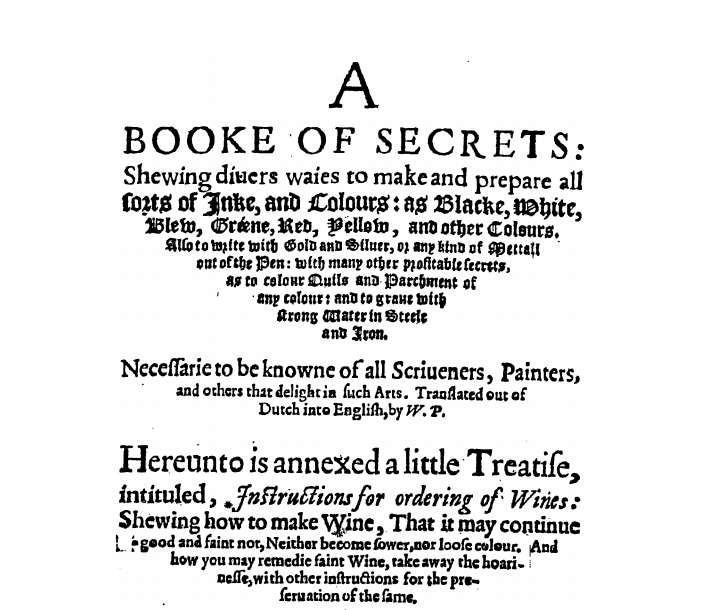
Books of Secrets (also called Secreta) are a whole genre of books I didn’t even know existed a little while ago. Genres (I mean like the novel, the epic poem, the Christian hagiography) are like media: they peak, and then they convalesce, and sometimes they die. The book of secrets is an example of a dead literary genre… sort of, though the conceptual basis and the ideology are alive in well, in transmuted form. In their original form, one might look at them basically as recipe/how-to books–and it was through the translation and distribution of books of secrets that alchemical knowledge proliferated in …

Continue Reading