What We Talk About When We Talk About Music: Part 3 — Hybridity

This entry is part 3 of 7 in the series What We Talk About When We Talk About Music

This post is part of a series. Since the posts build upon one another successively, I suggest you start with the first post in the series. Last time, in Part 2 of this series, I talked about “ear training” and the skills that are required by certain kinds of music if one is to listen to them competently–the requirement of a degree of work, a degree of slogging up a learning curve to grasp those kinds of music. The parallel for my overarching analogy of those mostly eat TV dinners and junk food on the one hand, and the self-described …

Continue Reading

What We Talk About When We Talk About Music: Part 2 — Ear Training

This entry is part 2 of 7 in the series What We Talk About When We Talk About Music

This post is part of a series. Since the posts build upon one another successively, I suggest you start with the first post in the series. Right, so last time, I drew a parallel between my view of music in the modern industrialized world, and the way “foodies” think of food in that same setting: namely, as something that has been essentially debased for expediency of production by large corporations, in the name of profit. But I’m sure those who aren’t feeling deeply insulted by this still have some sort of question in their minds about what it is I …

Continue Reading

What We Talk About When We Talk About Music: Part 1 — Background, Caveats, and an Analogy to Consider

This entry is part 1 of 7 in the series What We Talk About When We Talk About Music

I’ve been working for about a week now to put together a blog post that simply isn’t working. Like a story built to fail, the damned thing just is not cohering, no matter what i do: it veers off the road, it catches on fire, and when I put out the fire, the engine won’t turn over. So I’ve decided to break it down into pieces. Maybe. It depends whether that is still necessary at the end of this thing I’m writing now. It’s hard because, frankly, I think that what we conventionally include in the category of music includes …

Continue Reading

The Rite of Spring: Graphical Score

UPDATE (9 April 2012): Part 2 is up! See below. ORIGINAL POST: Well, I’m sure some of you out there are waiting for an update from Saigon, but I’m not up for writing one yet: I’ve developed some kind of a cold and been in bed all day, and want only to say that we’re settling in fine, and things are good. But I do feel like posting this: I recently received an email from Stephen Malinowski notifying me that the graphical score for the first part of Stravinsky’s The Rite of Spring was complete and online. (I assume he …

Continue Reading

On Le Sacre, Oedipus Rex, and Igor Stravinsky

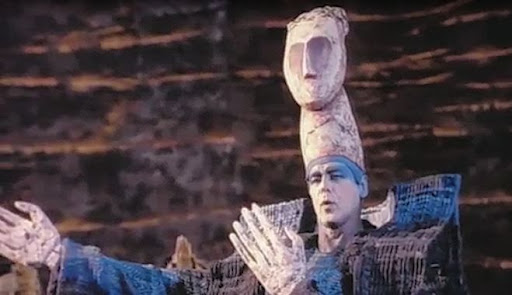
This week, I had the students who are studying Ancient Greek and Roman Mythology and Biblical Narrative check out a couple of works by Igor Stravinsky: The Rite of Spring (the ballet) Oedipus Rex (the opera-oratorio) For Oedipus, we watched the one-hour DVD of the Seiji Ozawa production (the one with Jessye Norman) in class; for the other, I had them check out The Rite on  Youtube — it’s one of the productions in which the performers did they best to reenact Nijinsky’s original choreography, and they also attempted to resurrect — as faithfully as possible — the original costumes …

Continue Reading

“The Rite of Spring” and Story Research

When I was still delivering newspapers (er, okay, fliers) for pocket money, I discovered Stravinsky’s masterpiece, Le Sacre de Printemps, known in English as The Rite of Spring. I immediately found the music somehow bizarrely familiar and comfortable, despite its dissonance, its extremity, the unnatural use of the instruments, and so on. This is hardly surprising, of course: anyone who watches a lot of film knows how influential this ballet by Stravinsky has proven to be on the work of film score composers, and some of what Stravinsky did even entered the common language of orchestral music afterwards. The premiere …

Continue Reading

Coming to Seoul: Dance Performance of Shaun Tan’s The Arrival

In the first week of May 2012, the New Zealand group Red Leap Theater (a dance company, by the looks of it) will be performing their rendition of Shaun Tan’s award-winning (and wonderful) wordless graphic novel The Arrival. I’m a huge fan of the book, and have tickets booked for Miss Jiwaku, myself, and our friend Sanko. The performance will be at the LG Arts Center, and you can book tickets here. It’s selling out quickly, so if you are in Seoul and like fantasy or SF, this is a special treat unlikely to be repeated. Tickets are 30,000, 50,000, …

Continue Reading

Coltrane: The Story of a Sound by Ben Ratliff

Ben Ratliff — a jazz critic for The New York Times, among other things — is like Trane in that he comes straight out with what he’s up to, though it might not be right away that you realize it. The title Coltrane: The Story of a Sound, if you look at it carefully, tells you what this book is really about, and it’s not just John Coltrane — it’s the story of the sound (or rather, the sounds) that burst into one’s mind when Trane’s name is mentioned: how Coltrane developed that sound from the beginning, how it evolved …

Continue Reading

A Particular American Fervency? (How It Might Connect to SF?)

I just ran across a really interesting quote on American culture, which was embedded in a discussion of jazz, but seems to apply quite well to American SF as well. Apparently, from 1961 to 1965, a British literary critic named A. Alvarez ran a show on BBC radio where writers talked about the intellectual scene in the United States. Alvarez collected the interviews  in a book, published by Penguin in 1965, under the same title as the radio program: Under Pressure. One of the Americans interviewed was Robert Lowell, and he’s what he had to say about it: We have some …

Continue Reading

David Amram on John Coltrane and Albert Einstein

Not long ago, I mentioned John Coltrane’s youthful interest in SF and pulp zines. But he was apparently also quite interested in science itself, something I’d suspected but don’t remember seeing confirmed as clearly as in this anecdote from David Amram, a French horn-playing jazz man who knew Trane in New York in the 1950s, and ran into him just outside a club, where Amram had just finished playing a set with Charlie Mingus. Coltrane was eating  a slice of pie, and: [Trane] said, “How are you?” I [Amram] said, “Everything’s fine.” And then he said to me, “What do …

Continue Reading