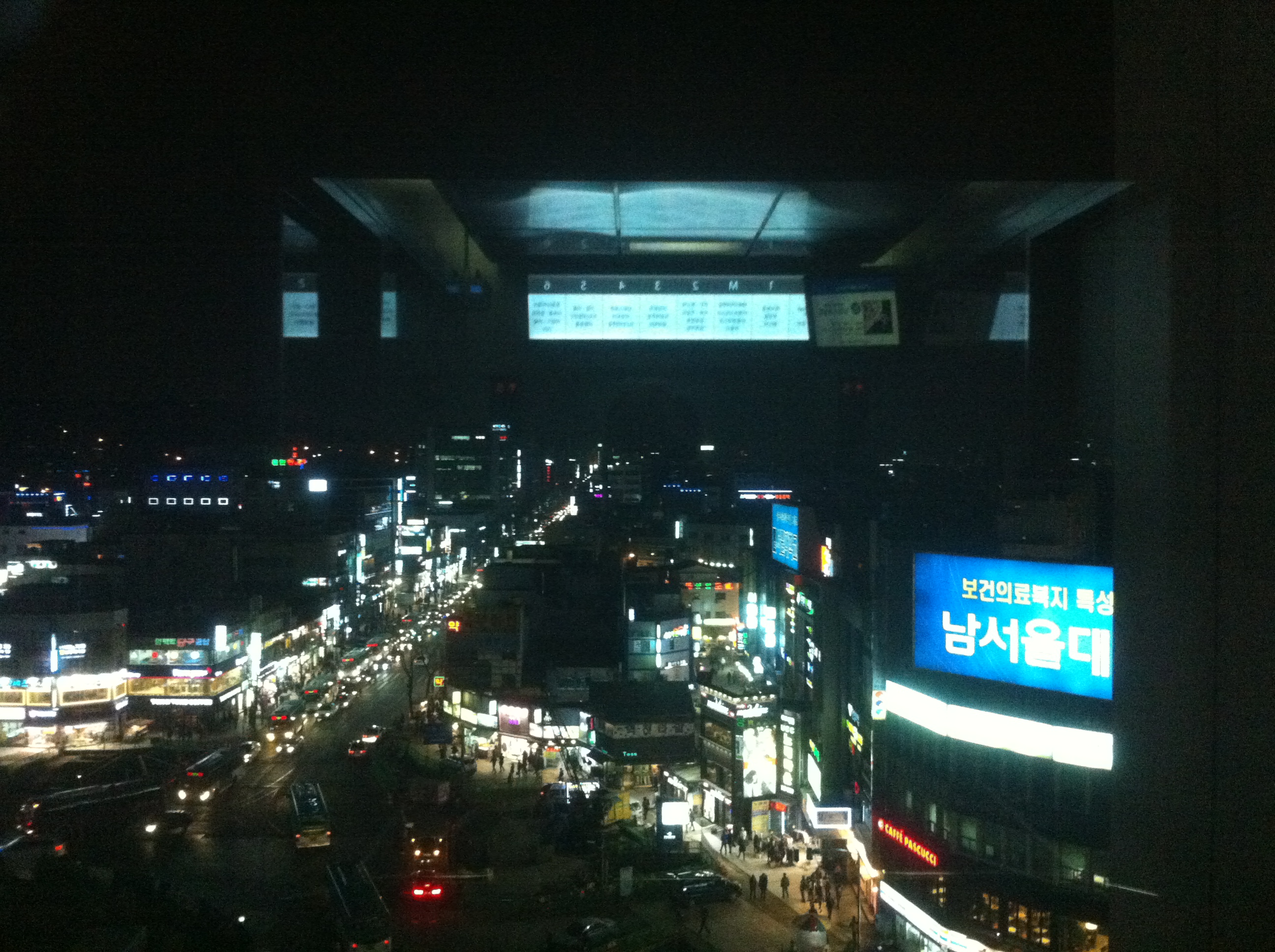
Observations on South Korea

Tyler Cowen (at Marginal Revolution) linked an interesting and pertinent article on the cultural dimension of development and “success” in South Korea:, which sounds a lot like what I’ve been saying over the years: South Korea’s success has been deep but not wide. Almost half of its population lives, works and competes in Seoul. Its occupational structure is also narrow. The number of professions in South Korea is only two-thirds of the number in Japan and only 38% of that in America. This striking statistic is not lost on the South Korean government (few are). It has appointed a task force …

Continue Reading

Thoughts On Ellen Oh’s Advice re: #DiversityinSFF

While looking up a little more information for a post to add to my series on SF in South Korea (though the post is about Koreans outside Korea writing speculative fiction) I ran across this post at the website of Ellen Oh, one of the authors I’ll be discussing in that forthcoming post. Oh is the Korean-American author of a series of books titled The Prophecy series, which are a high fantasy trilogy set in what is (according to this interview) a fantastical version of Korea modeled on the Three Kingdoms period. (I’ll have more to say in a forthcoming …

Continue Reading

On Rich Young People Today…

…for a value of today dating back to Mary Wollstonecraft’s tenure as a governess, and courtesy of Ruth Brandon’s book Governess: The Lives and Times of the Real Jane Eyres: Mary found them quite uncultivated, with no topics of conversation other than dress, dogs and marriage. To which Mrs. Jiwaku immediately exclaimed: “It’s Korea!” Meaning South Korea, today. Except that in contemporary South Korea, it’s not just rich young people… not everyone is like this, but the middle class, and even the aspirational types in the lower class, are mostly precisely this way. Well, okay, dress, dogs, Kpop, and marriage. Which reminds …

Continue Reading

Out from the Sinews

In a book I read long ago, in a galaxy far, far away, the Christopher Dewdney wrote in his book of poetry The Radiant Inventory about neurology, using the most brilliantly poetical and beautiful language. He wrote about all kinds of things, of course: books of poetry are like that. But among the things he discussed in the book was the neurobiology of break-ups, and why they are so difficult. I can’t quote the book, or even paraphrase it in any way I’d regard as trustworthy–my copy is somewhere in that other galaxy where I read it, in a box, floating …

Continue Reading

The Suwon Revelation

After spending seven of the past eleven years in the Yeokgok district of Bucheon City, not living there has been full of surprises. Even though I tried to resist it, I developed a habit of mind wherein I conflated Yeokgok with Korea generally, just as I conflate Seoul Subway Line 1 with the whole system. Well, like riding Line 6 for a while, staying in Suwon for a week has been a revelation. For one thing, people don’t look us up and down, or scowl nastily at us the way the used to in Yeokgok, or on Line 1. They …

Continue Reading

Meditations on Junk, #1: Ugly Koreans/Ugly Americans

I’m flipping through Min Byoung-Chul’s Ugly Koreans/Ugly Americans. (Which is, by the way, insanely overpriced on Amazon.com.) It’s a sort of typical book in Korea, basically intellectual junk crammed full of East vs. West generalizations and “explanations” by a Korean who doesn’t himself quite grasp what he’s taken upon himself to explain. (Also, to be frank, the first half of the book seems to be made up mainly of genuinely rude, disgusting, or dangerous behaviours common among Koreans, while the second half, supposedly balancing this, is full of very tame gestures and comments about how Americans are “impatient” with people …

Continue Reading

If You Wanna Be My 형…

Yeah, sung to the tune of that horrible Spice Girls song. Ugh. Miss Jiwaku and I talked after she got back from her film program meeting today, about her frustrations. To what do her frustrations mostly connect? Older people who insist on “respect” and special treatment on account of their age, regardless of incompetence, rudeness, or plain stupidity. There’s an older person in her film program who is particularly useless, who apparently was constantly rude to her, who finally warmed up to her… why? Because she poured him soju with two hands and used the magic “term of respect” address …

Continue Reading

… In Which America Learns Something Interesting about Psy (and South Korea)

After years of South Koreans asking me, “Are you American?” and then acting all relieved or happy when I tell them, no, I’m Canadian, I can’t help but be amused at the newest news report on Psy. Apparently some journalists in America have realized that he’s expressed raging bigotry in his songs performances in the past, to the tune of: 이라크 포로를 고문해 댄 씨발양년놈들과 고문 하라고 시킨 개 씨발 양년놈들에 딸래미 애미 며느리 애비 코쟁이 모두 죽여 아주 천천히 죽여 고통스럽게 죽여 Here’s a more representative translation of those lyrics, by the way: Kill those fucking Yankees who have been …

Continue Reading

The 정 Challenge

This evening, Miss Jiwaku and I had a conversation with some of her relatives. These particular relatives are very nice and very decent people, good folks. But there was a line in the conversation that got me, where someone said, “But you know, as nice or polite as people in other countries might be to one another, Koreans have something unique… they have jeong.” If you haven’t run into this idea, jeong, well, then you apparently haven’t talked to many South Koreans. It gets translated variously as “harmony” or “coexistence” or all kinds of other things that sound, well, nice, but …

Continue Reading

New Term: “White Endorsement Monkey” and “White Defamation Monkey”

Well, I’ve googled it and don’t see it out there, so I’m going to call dibs and coin this term: White Endorsement Monkey. What is a White Endorsement Monkey? Well, if you’re a white person living abroad, you might experience this. I certainly have experienced it in Korea. Don’t get me wrong: as stomach turning and ass-kissing as this book cover looks to me: … I’m not calling this author a White Endorsement Monkey, because I’m not actually talking about what foreigners themselves do — but rather to a pressure that is sometimes imposed on non-Koreans by some Koreans. That …

Continue Reading